
All books

Professional

Apps About Coach Log in Start reading

Chemistry · Glossary

What is Mixed potential?

Definition 11.1 University Chemistry — Year 2 · Chapter 11 — Batteries, Fuel Cells and Electrolysis

The mixed potential of an electrode on which two different couples react, one oxidised and one reduced, is the potential it takes when no net current flows: the anodic current of one couple is then equal and opposite to the cathodic current of the other.
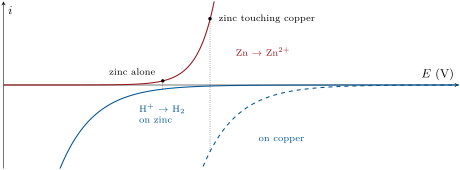
Zinc in acid (model curves, zinc ions dilute; potentials from -1.1 to -0.3\, V). Alone, zinc settles at the mixed potential where its oxidation balances the slow reduction of H+ on zinc: a small current, a slow dissolution. Touching copper, on which the reduction of H+ is less slow, the balance moves to a higher potential and a current more than ten times larger: the zinc dissolves fast, hydrogen bubbles on the copper.
Zinc in acid (model curves, zinc ions dilute; potentials from −1.1-1.1 to −0.3 V-0.3\,\mathrm{V}). Alone, zinc settles at the mixed potential where its oxidation balances the slow reduction of HX+\ce{H+} on zinc: a small current, a slow dissolution. Touching copper, on which the reduction of HX+\ce{H+} is less slow, the balance moves to a higher potential and a current more than ten times larger: the zinc dissolves fast, hydrogen bubbles on the copper.
Read in context →