University Chemistry — Year 2 · Bachelor Year 2
11Batteries, Fuel Cells and Electrolysis
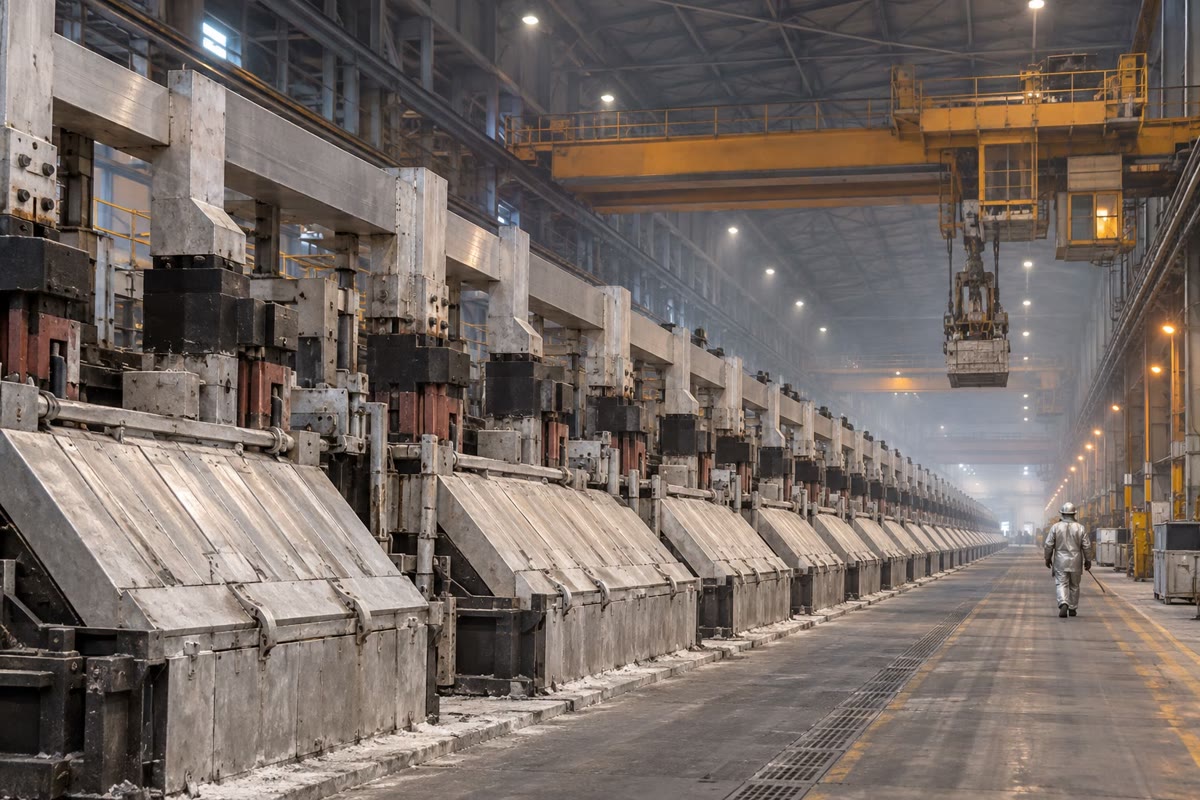
Every kilogram of aluminium won from its ore takes about of electricity; melting down a kilogram of scrap takes, in principle, the that heats it to its melting point and melts it. The difference is the work of a long row of electrolysis cells, each passing hundreds of thousands of amperes through molten salt at a few volts. A battery runs the other way: a spontaneous reaction drives the current. With the current–potential curves of Chapter 10, both are read on the same diagram, and so is a piece of zinc dissolving in acid.
You already know
Chapter 9: , maximum work, the Faraday constant. Chapter 10: current–potential curves, fast and slow systems, overpotentials, limiting currents, the walls of water. Chapter 6: why aluminium is not won by carbon. The school volume: electrolysis, accumulators.
11.1 Spontaneous reactions read on curves
Definition 11.1 (Mixed potential)
The mixed potential of an electrode on which two different couples react, one oxidised and one reduced, is the potential it takes when no net current flows: the anodic current of one couple is then equal and opposite to the cathodic current of the other.
Proposition 11.2 (A metal in a solution)
A metal dipping into a solution that can oxidise it settles at the potential where , the anodic current of the metal’s oxidation balancing the cathodic current of the oxidant’s reduction; the metal dissolves at the rate .
Proof. An isolated piece of metal carries no net current. Both half-reactions happen on its surface at the same potential, so their currents, read on their curves at that potential, add up to zero. By Proposition 10.3, the anodic current gives the rate of oxidation. ∎
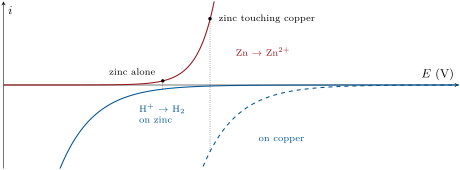
The same reading explains corrosion (Chapter 12): the corrosion rate of a metal is the current at its mixed potential.
11.2 Cells delivering a current
Definition 11.3 (Batteries)
A primary cell is an electrochemical cell used once, until its reagents are spent. An accumulator is a cell that can be recharged by forcing a current through it in the reverse direction, which reverses its reaction. The specific energy of a cell is the electrical energy it delivers per unit mass, usually in .
Proposition 11.4 (Voltage of a cell delivering a current)
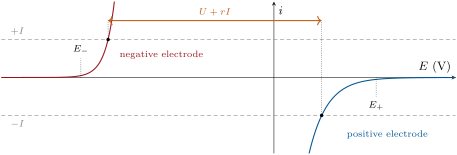
A cell delivering a current has a voltage
where and are the equilibrium potentials of its two electrodes, the overpotential of the oxidation at the negative electrode, that of the reduction at the positive electrode, and the internal resistance (electrolyte, separator, connections).
Proof. The same current is anodic at the negative electrode, whose potential is read on its anodic curve, , and cathodic at the positive one, whose potential is . Between them the current crosses the electrolyte, where the potential drops by . Hence . ∎
Method 11.5 (The operating point of a cell or an electrolyser)
- Draw the anodic curve of the electrode that is oxidised and the cathodic curve of the one that is reduced.
- For a current , read the potential of each electrode at on the anodic curve and at on the cathodic one.
- The difference of the two potentials, corrected by (subtracted for a cell, added for an electrolyser), is the voltage.
Example 11.6 (The lead–acid accumulator)
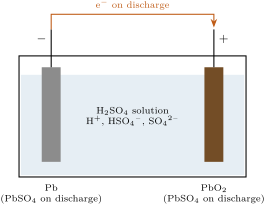
At the negative electrode ; at the positive one . Overall
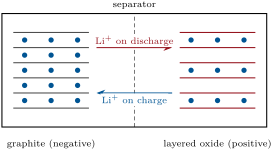
, . Both electrodes are covered by lead sulfate as the cell discharges; charging reverses the reaction. The reduction of on lead and the oxidation of water on lead dioxide are slow: that is why a cell of can be charged in water, whose thermodynamic window is only wide.
History — The voltaic pile
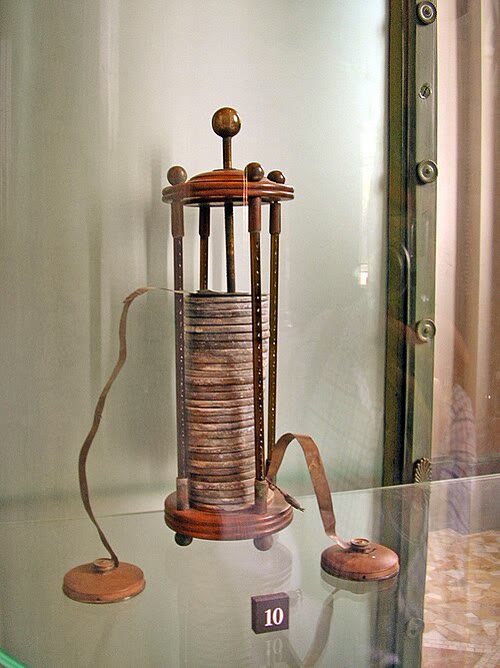
In 1800 Alessandro Volta described a column of discs of two different metals, zinc and copper or silver, separated by cloth soaked in brine: the first source of a steady electric current. Within weeks others used it to decompose water, and within a decade Humphry Davy had isolated sodium and potassium by electrolysis of their molten hydroxides with a large pile. The photograph shows one of Volta’s own piles. (Photograph: GuidoB, CC BY-SA 3.0, Wikimedia Commons.)
11.3 Fuel cells
Definition 11.7 (Fuel cell)
A fuel cell is a cell whose reagents, a fuel and an oxidant (usually the oxygen of the air), are fed continuously to its electrodes and whose products are removed, so that it delivers current as long as it is supplied.
In the proton-exchange membrane cell of the bus of Chapter 9, hydrogen is oxidised on a platinum catalyst, , protons cross a thin acidic polymer membrane, and oxygen is reduced on the other side, . The oxidation of hydrogen on platinum is a fast system; the reduction of oxygen is slow on every electrode. Most of the voltage lost between the of the reversible cell and the working voltage is the overpotential of the oxygen electrode, the rest the resistance of the membrane and, at high current, the supply of oxygen to the catalyst (a limiting current).
11.4 Electrolysis
Definition 11.8 (Electrolysis)
An electrolysis is a non-spontaneous redox reaction forced by a current supplied by an external generator; the cell in which it takes place is an electrolyser. The anode, where the oxidation occurs, is connected to the positive pole of the generator.
Proposition 11.9 (Thermodynamic minimum voltage)
An electrolysis whose reaction has requires a voltage of at least .
Proof. The generator supplies the work per mole of reaction; by Theorem 9.3 applied to the reverse reaction, the electrical work received must be at least . ∎
Proposition 11.10 (Voltage of an electrolyser)
An electrolyser passing a current needs
with , the equilibrium potentials of the anode and cathode couples (), , their overpotentials at that current and the resistance between the electrodes.
Proof. As for a cell, the same current is anodic at the anode, at potential , and cathodic at the cathode, at ; the generator must also drive it through the electrolyte, adding . ∎
Method 11.11 (Predicting an electrolysis)
- List every species that can be oxidised at the anode (including the anode metal and the solvent) and every species that can be reduced at the cathode (including the solvent).
- Draw their current–potential curves on the electrode materials used.
- As the voltage is raised, the first anodic curve and the first cathodic curve reached give the reactions; at larger currents, the next ones add theirs.
Definition 11.12 (Faradaic efficiency)
The faradaic efficiency of an electrolysis is the fraction of the charge passed that produces the wanted product. Its specific energy consumption is the electrical energy used per unit mass of product.
Proposition 11.13 (Faraday’s law)
A current passed for a time with faradaic efficiency produces a mass of a product of molar mass formed with electrons per mole.
Proof. The charge , of which forms the product, corresponds by Proposition 9.2 to moles. ∎
Proposition 11.14 (Energy per kilogram)
At a voltage and faradaic efficiency , the specific energy consumption is .
Proof. The energy is and the mass ; divide. ∎
11.5 Industrial electrolyses
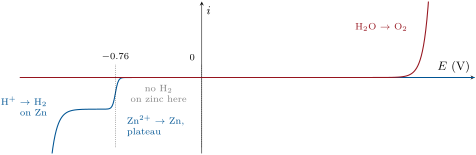
Zinc. Most zinc is won by electrolysis of the acidic zinc sulfate solution of Chapter 6. Zinc is deposited on the cathode although is the stronger oxidant: on zinc the reduction of is very slow, and the zinc wave is reached first; the anode gives off oxygen.
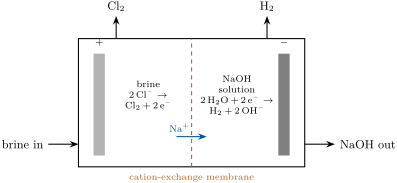
Chlorine and sodium hydroxide. Brine is electrolysed in a cell divided by a membrane that lets only cations through. At the anode chloride is oxidised, ; at the cathode water is reduced, ; sodium ions cross the membrane to balance the charge, and a sodium hydroxide solution leaves the cathode side, free of chloride. The thermodynamic minimum is for in standard conditions. Chlorine forms at the anode rather than oxygen, though the / couple lies lower: the oxidation of water is the slower of the two on the anode materials used.
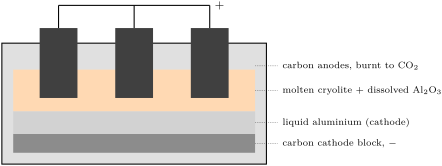
Aluminium. Aluminium oxide is dissolved in molten cryolite, , which melts far lower than alumina, and electrolysed between a carbon cathode, on which liquid aluminium collects, and carbon anodes that burn away as carbon dioxide (Hall–Héroult process):
The thermodynamic minimum near is about (Problem 11.1); the cell of that problem works at three and a half times as much, the excess turned into the heat that keeps the bath molten.
History — Hall and Héroult, 1886
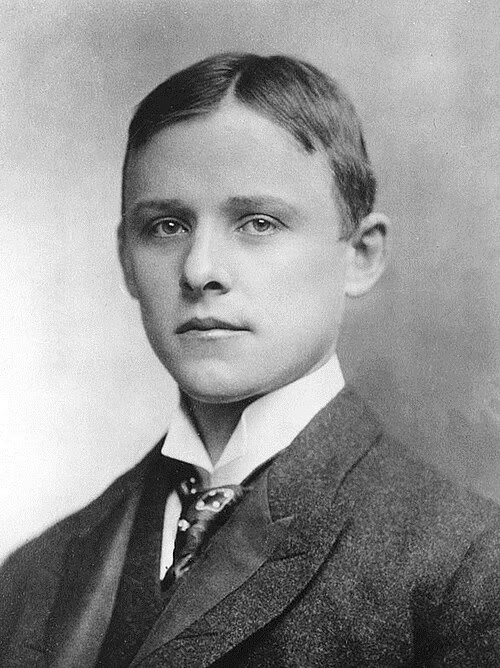
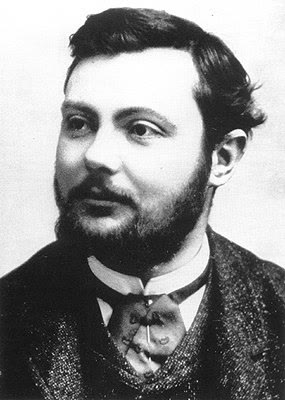
In 1886, at the age of twenty-two or twenty-three, Charles Martin Hall and Paul Héroult, on the two sides of the Atlantic, found independently that alumina dissolves in molten cryolite and can be electrolysed there. Aluminium, until then a precious metal made by reducing its chloride with sodium, became the cheapest of the light metals once electricity could be generated in bulk. (Portraits: Hall, about 1880s, unknown author, public domain; Héroult, public domain; Wikimedia Commons.)
Sodium. Sodium cannot be deposited from water, which it reduces. It is made by electrolysis of molten sodium chloride, its melting point lowered by an added salt (a eutectic mixture, Chapter 8), with chlorine as by-product. At , : the minimum voltage is .
11.6 Exercises
Exercise 11.1 ★
On the zinc-in-acid figure, read the mixed potential and the current of zinc alone and of zinc touching copper (model units), and say which dissolves faster.
Solution
Solution of Exercise 11.1.
Zinc alone: about and a current of 0.15 (model units). Touching copper: about and 2.4. The current, hence the dissolution rate, is some sixteen times larger in contact with copper.
Exercise 11.2 ★
What mass of zinc is deposited in one hour by a current of with a faradaic efficiency of 100 %?
Solution
Solution of Exercise 11.2.
.
Exercise 11.3 ★
Compute the standard voltage of the lead–acid accumulator from the Gibbs energies of formation given in the chapter, and the number of cells in a car battery.
Solution
Solution of Exercise 11.3.
(as in the chapter); six cells in series give .
Exercise 11.4 ★
What charge, in ampere-hours, can one gram of lithium deliver if it is all oxidised to ?
Solution
Solution of Exercise 11.4.
; , that is .
Exercise 11.5 ★★
A copper refining cell passes for and deposits of copper. Compute the faradaic efficiency.
Solution
Solution of Exercise 11.5.
At 100 %: ; .
Exercise 11.6 ★★
A zinc electrowinning cell works at with a faradaic efficiency of 90 % (exercise data). Compute the electrical energy per kilogram of zinc.
Solution
Solution of Exercise 11.6.
, that is .
Exercise 11.7 ★★
A battery gives at and at . Assuming the overpotentials negligible, find its internal resistance and its voltage with no current.
Solution
Solution of Exercise 11.7.
: ; .
Exercise 11.8 ★★
Brine is electrolysed in the membrane cell. Write the electrode reactions, compute the minimum voltage, and explain why the products must be kept apart.
Solution
Solution of Exercise 11.8.
Anode ; cathode . , . Chlorine would react with the hydroxide (), spoiling both products, and a mixture of chlorine and hydrogen can explode.
Exercise 11.9 ★★
Compute the minimum voltage for the electrolysis of molten sodium chloride at and the minimum energy per kilogram of sodium.
Solution
Solution of Exercise 11.9.
, : . Per kilogram of sodium: , that is .
Exercise 11.10 ★★★
Using current–potential curves, explain why zinc can be plated from an acidic bath on a zinc cathode, and predict what would happen on a platinum cathode at the start of the plating.
Solution
Solution of Exercise 11.10.
On a zinc cathode the reduction of is slow and its wall lies below the zinc wave: as the potential is lowered, zinc is deposited first, with little hydrogen. On platinum the reduction of is fast and starts near : at first only hydrogen is evolved. Once the platinum is covered with zinc, the cathode behaves as a zinc cathode and zinc deposits.
Exercise 11.11 ★★★
From at and (: and ; : and ), compute the minimum voltage of the Hall–Héroult cell at , and compare it with an inert anode on which oxygen would be released.
Solution
Solution of Exercise 11.11.
At : , . , : . Inert anode: , ; the burning carbon supplies about of the work.
Exercise 11.12 ★★★
Electricity is stored by electrolysing water at and recovered in a fuel cell at , both with a faradaic efficiency of 100 %. Compute the round-trip efficiency and explain where the energy goes.
Solution
Solution of Exercise 11.12.
Per mole of water the charge is the same both ways: efficiency . The rest is heat: the overpotentials of both oxygen electrodes (slow in both directions), those of the hydrogen electrodes, and the ohmic losses.
11.7 Problem: One Tonne of Aluminium
Problem 11.1
Weekend problem — the reaction of the Hall–Héroult cell and its minimum voltage, the charge and time to make a tonne of aluminium, the energy used, and the carbon burnt
Data: JANAF Gibbs energies of formation at and (): , ; , . Cell (exercise data): current , voltage , faradaic efficiency 94 %, bath near . Molar masses (): Al 26.982, C 12.011, O 15.999. Heat to bring aluminium from to liquid at its melting point: .
Part I — The minimum voltage.
- Give the oxidation numbers of aluminium, oxygen and carbon in the reactants and products.
- Write the cathode and anode half-reactions, with the oxide ion carried by the molten bath.
- Write the overall reaction and the number of electrons exchanged.
- Interpolate of and at .
- Compute at .
- Deduce the minimum voltage.
- Compute the minimum voltage with an inert anode, , and explain the role of the carbon.
Part II — Charge and time.
- What amount of aluminium is in one tonne?
- What charge would it need with a faradaic efficiency of 100 %?
- What charge is actually passed?
- How long does one cell take to make a tonne?
- What mass of aluminium does one cell make per day?
- Suggest where the lost 6 % of the charge goes.
Part III — Energy.
- Compute the electrical energy per tonne.
- Express it in per kilogram.
- Compute the minimum energy per kilogram, at the minimum voltage and 100 % efficiency.
- Where does the rest of the energy go, and why is it not wasted entirely?
- Compute the electrical power of one cell.
- Compute the heat needed to remelt one kilogram of scrap, in , and compare.
- What fraction of the working voltage is the thermodynamic minimum?
Part IV — Carbon.
- Compute the mass of carbon burnt per tonne of aluminium according to the equation.
- Compute the mass of carbon dioxide released by the anodes per tonne.
- Real cells burn more carbon than that. Suggest two reasons.
- Express the anode per kilogram of aluminium.
- What would an inert anode change for the voltage and for the gas released?
- State the electrical energy per kilogram of aluminium.
Solution
Solution of Problem 11.1.
1. Aluminium ; oxygen stays ; carbon . 2. Cathode ; anode . 3. , . 4. : ; : . 5. . 6. . 7. : the oxidation of carbon, itself exergonic, pays nearly half of the work of decomposing the oxide. 8. . 9. . 10. . 11. , . 12. : per day. 13. Part of the aluminium dissolved in the bath reaches the anode gas and is reoxidised by carbon dioxide, so its charge is spent twice; some current also leaks through the bath without electrolysing it. 14. , . 15. . 16. , . 17. Into heat: the overpotentials of the electrodes and, mostly, the ohmic drop in the bath. That heat keeps the bath molten at about , which would otherwise need fuel. 18. . 19. , : about 2 % of the energy of the electrolysis. 20. . 21. . 22. . 23. The hot tops of the anodes burn in the air; part of the carbon leaves as carbon monoxide ( at that temperature), which takes twice as much carbon per oxygen atom. 24. of per kilogram of aluminium. 25. The minimum voltage would rise by about , but the anode would give off oxygen instead of carbon dioxide and would not be consumed. 26. The cell uses of electrical energy per kilogram of aluminium.