All books

Professional

Apps About Coach Log in Start reading

Chemistry · Glossary

What is Outer- and inner-sphere electron transfer?

Also known as: outer-sphere electron transfer · inner-sphere electron transfer · self-exchange reaction

Definition 19.15 University Chemistry — Year 3 · Chapter 19 — Reaction Mechanisms of Complexes

In outer-sphere electron transfer the electron passes between two complexes whose coordination spheres stay intact; in inner-sphere electron transfer it passes through a ligand bridging the two metals in a transient binuclear complex. A self-exchange reaction is an electron transfer between the two oxidation states of the same couple, with no net chemical change, such as [Fe(HX2O)X6]X3++[Fe(HX2O)X6]X2+\ce{[Fe(H2O)6]^{3+} + [Fe(H2O)6]^{2+}}.

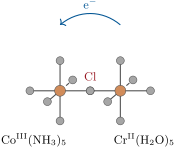
Taube’s bridged intermediate (schematic): the chloride, still bound to cobalt(III), enters the coordination sphere of chromium(II) by replacing a water molecule; the electron crosses through the bridge, and the chloride stays on the now inert chromium(III).
Read in context →