
All books

Professional

Apps About Coach Log in Start reading

Chemistry · Glossary

What is Oxide glasses?

Also known as: oxide glass · network former · network modifier

Definition 23.11 University Chemistry — Year 3 · Chapter 23 — Inorganic Materials and Nanomaterials

An oxide glass is an amorphous oxide solid, made by cooling a melt without crystallisation. Its network formers (SiOX2\ce{SiO2}, BX2OX3\ce{B2O3}, PX2OX5\ce{P2O5}) build a continuous network of corner-sharing polyhedra; its network modifiers (NaX2O\ce{Na2O}, CaO\ce{CaO}) break bridges in that network, each oxide ion added turning one bridging oxygen into two non-bridging ones, with the cations sitting in the holes.
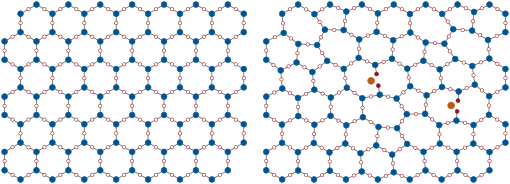
A two-dimensional picture of a crystal and a glass of the same composition (blue: three-coordinate formers; open red circles: bridging oxygens). Left, the crystal repeats one ring. Right, the glass: every former still has three oxygens at nearly the same distances, but the rings have five, six or seven members and nothing repeats; at two places a modifier has broken a bridge, leaving two non-bridging oxygens (filled red) and a cation (orange) in the hole. Model network, relaxed with springs.
Read in context →