
All books

Professional

Apps About Coach Log in Start reading

Chemistry · Glossary

What is Oxygen demand?

Also known as: biochemical oxygen demand · chemical oxygen demand

Definition 32.9 University Chemistry — Year 3 · Chapter 32 — Environmental Chemistry and Toxicology

The biochemical oxygen demand (BOD) of a water is the mass of dioxygen consumed per litre by microorganisms oxidising its organic matter in the dark, over a stated time (five days at 20 ∘C20\,{}^{\circ}\mathrm{C} for BOD5\mathrm{BOD_5}). Its chemical oxygen demand (COD) is the mass of dioxygen equivalent to the dichromate consumed in oxidising its organic matter chemically.
Left: the BOD of a model sewage, L_0 = 250\, mg/ L and k = 0.23\, d-1: about two thirds of the demand is used in five days. Right: the oxygen sag in a river below an outfall (Streeter–Phelps model): decay of the organic load consumes oxygen faster than the air restores it at first, until the deficit peaks after about 2.4 days.
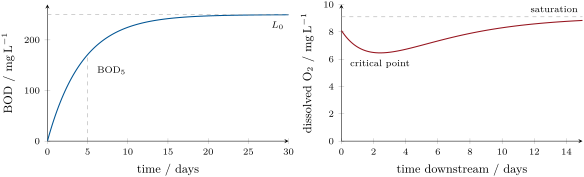
Left: the BOD of a model sewage, L0=250 mg/LL_0 = 250\,\mathrm{mg}/\mathrm{L} and k=0.23 d−1k = 0.23\,\mathrm{d}^{-1}: about two thirds of the demand is used in five days. Right: the oxygen sag in a river below an outfall (Streeter–Phelps model): decay of the organic load consumes oxygen faster than the air restores it at first, until the deficit peaks after about 2.4 days.
Read in context →