
All books

Professional

Apps About Coach Log in Start reading

Chemistry · Glossary

What is Physisorption, chemisorption?

Also known as: physisorption · chemisorption

Definition 16.2 University Chemistry — Year 3 · Chapter 16 — Surfaces, Adsorption and Heterogeneous Catalysis

Physisorption is adsorption by van der Waals forces, with enthalpies of adsorption of a few tens of kilojoules per mole at most, comparable to enthalpies of condensation, and no change of the molecule. Chemisorption forms chemical bonds with the surface, with enthalpies of about 40 to several hundred kilojoules per mole; it can break the molecule (dissociative chemisorption) and stops at one layer.
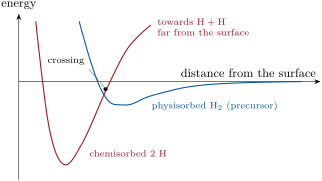
Potential energy of a hydrogen molecule approaching a metal surface (schematic). The molecule first falls into the shallow physisorption well; where this curve crosses the curve of two separately bonded H atoms, it can dissociate into the deep chemisorption well. If the crossing lies above zero, dissociative chemisorption is activated.
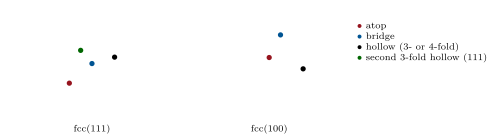
Top views of the two densest faces of a face-centred cubic metal, with the adsorption sites: atop one atom, bridging two, and in the hollows between three atoms on (111) (two kinds, above an atom of the second layer or not) or four atoms on (100).
Read in context →