All books

Professional

Apps About Coach Log in Start reading

Chemistry · Glossary

What is Potentiometric titration?

Definition 15.12 University Chemistry — Year 1 · Chapter 15 — Titration Methods and Curves

A potentiometric titration follows the potential of an electrode in the solution against a reference electrode, for a redox (platinum wire), precipitation (silver wire) or complexation titration.
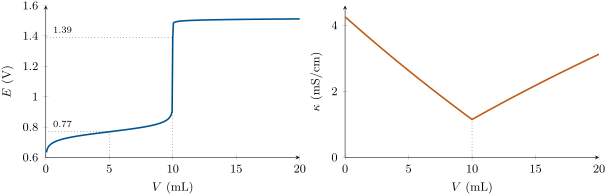

Left: potentiometric titration of 10.0\, mL of iron(II) at 0.100\, mol/ L by permanganate at 0.0200\, mol/ L in 1\, mol/ L acid (platinum electrode, potential against the hydrogen electrode). Right: conductimetric titration of 100\, mL of hydrochloric acid at 0.0100\, mol/ L by sodium hydroxide at 0.100\, mol/ L; the equivalence is at the intersection of two straight lines.
Left: potentiometric titration of 10.0 mL10.0\,\mathrm{mL} of iron(II) at 0.100 mol/L0.100\,\mathrm{mol}/\mathrm{L} by permanganate at 0.0200 mol/L0.0200\,\mathrm{mol}/\mathrm{L} in 1 mol/L1\,\mathrm{mol}/\mathrm{L} acid (platinum electrode, potential against the hydrogen electrode). Right: conductimetric titration of 100 mL100\,\mathrm{mL} of hydrochloric acid at 0.0100 mol/L0.0100\,\mathrm{mol}/\mathrm{L} by sodium hydroxide at 0.100 mol/L0.100\,\mathrm{mol}/\mathrm{L}; the equivalence is at the intersection of two straight lines.
Read in context →