University Chemistry — Year 1 · Bachelor Year 1
15Titration Methods and Curves
A pharmacist receives a batch of vitamin C tablets labelled and must certify, before they are sold, that each holds what the label says. She will not weigh the vitamin directly: it is mixed with binders and fillers. She will titrate it — let it react with a reagent of known concentration, measure the volume needed, and compute the amount. Which reaction, how to see its end, and how sure the result is: these are the questions of this chapter, which brings the equilibria of the last five chapters to the laboratory bench.
You already know
The school volume (grades 11 and 12) titrated acids by bases with a colour change, followed titrations with a pH meter and a conductivity meter, and used the equivalence relation . The predominant-reaction method is in Chapter 10; precipitation, complexation and redox equilibria in Chapters 11, 12 and 13.

15.1 Titration and equivalence
Definition 15.1 (Titration, equivalence)
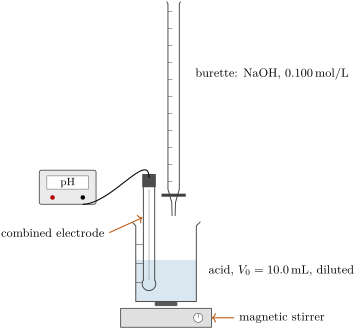
A titration determines the amount of a species, the analyte, by a reaction with a reagent of known concentration, the titrant, added progressively. The reaction must be single, quantitative ( large) and fast. The equivalence is reached when titrant and analyte have been brought together in the stoichiometric proportions of the reaction; the volume added then is the equivalence volume, and the point of the titration curve at that volume is the equivalence point. The volume at which the experimenter stops, seeing a colour change or a break in a curve, is the end point; a good method makes it coincide with the equivalence.
Proposition 15.2 (Equivalence relation)
For a titration reaction , with analyte A ( mol) and titrant B at concentration , the equivalence volume satisfies
Proof. Let be the extent after adding of titrant. Before equivalence B is limiting and, the reaction being quantitative, ; after it, A is limiting and . The equivalence is the volume where both are used up together, and : eliminating gives the relation. ∎
15.2 Direct and indirect titrations
Definition 15.3 (Kinds of titration)
In a direct titration the titrant reacts with the analyte itself. In a back titration a known excess of a reagent is added to the analyte, and the excess left is titrated. When a solution contains several analytes that react in turn with the titrant, they are measured by successive titrations, one equivalence after another; when they react together and give a single equivalence, by a simultaneous titration, which gives only their sum.
Method 15.4 (Back titration)
Use it when the direct reaction is slow, when the analyte is unstable or volatile, or when no indicator fits the direct reaction.
- Add a known amount of reagent R, in excess, and let it react completely with the analyte A ().
- Titrate the excess R with a titrant T () to the equivalence volume .
- Compute , then .
The weekend problem titrates vitamin C this way: ascorbic acid reduces an excess of iodine, and the iodine left is titrated by thiosulfate.
15.3 pH-metric titrations and indicators
Proposition 15.5 (Half-equivalence of a weak acid)
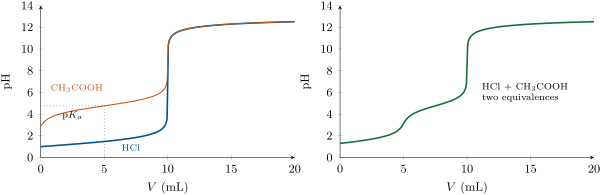
When a weak acid HA is titrated by a strong base, at half-equivalence , provided that the acid is not too strong nor too dilute ( roughly between 4 and 10 at ).
Proof. At half-equivalence the quantitative reaction has converted half of HA: , and the Henderson relation gives . The condition ensures that the reaction of HA with water and that of with water do not change those amounts appreciably. ∎
Proposition 15.6 (pH at the equivalence of a weak acid)
At the equivalence of a weak acid () by a strong base, the solution is the conjugate base at concentration (after dilution), and
Proof. The predominant reaction of the base with water, , has ; with little base converted, (Proposition 10.12), whence the result. For ethanoic acid, : . ∎
Proposition 15.7 (Successive titrations)
Two acids titrated by the same base give separate equivalences, each to better than , if their differ by at least 4.
Proof. At the first equivalence, the reaction of the base with the second acid , , has . Starting from equal amounts, the fraction of the second acid already titrated satisfies ; for , , that is . ∎
Phosphoric acid (2.15, 7.21, 12.34) gives two clear equivalences; the third is lost in the water of the base. Ethanoic acid mixed with hydrochloric acid (right of the figure) is titrated after it, the strong acid being in effect a below 0.
Method 15.8 (Locating an equivalence on a curve)
- Derivative: compute between successive points; the equivalence is at its maximum.
- Tangents: draw two parallel tangents to the curve on each side of the jump, and the parallel equidistant from them; it cuts the curve at the equivalence point.
Method 15.9 (Tangents, by computation)
For a curve recorded by computer, fit the points of each side of the jump with a smooth function and take the inflection point; for a symmetric jump (strong acid, strong base) the midpoint of the jump at pH 7 is the equivalence point.
Definition 15.10 (Colour indicator, turning zone)
A colour indicator is a weak acid–base pair HIn/In whose two forms have different colours. Its colour changes over the turning zone, the pH range where neither form clearly dominates, about .
| indicator | turning zone | colours (acid / base) | |
|---|---|---|---|
| methyl orange | 3.5 | 2.5–4.5 | red / yellow |
| methyl red | 4.8 | 3.8–5.8 | red / yellow |
| phenol red | 7.9 | 6.9–8.9 | yellow / red |
| thymol blue (second change) | 9.2 | 8.2–10.2 | yellow / blue |
Method 15.11 (Choosing an indicator)
Choose an indicator whose turning zone lies inside the vertical jump of the curve, as close as possible to the pH at equivalence. Strong acid by strong base (jump 3.3 to 10.7 for here): any of the four. Ethanoic acid (equivalence 8.73): phenol red or thymol blue; methyl orange would change colour long before the equivalence.
15.4 Potentiometric titrations
Definition 15.12 (Potentiometric titration)
A potentiometric titration follows the potential of an electrode in the solution against a reference electrode, for a redox (platinum wire), precipitation (silver wire) or complexation titration.
Proposition 15.13 (Remarkable points of a redox titration)
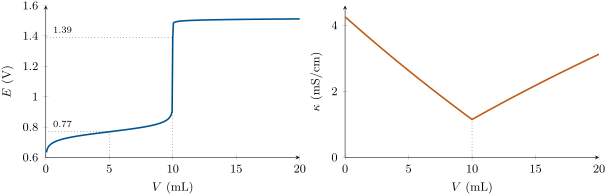
For the titration of by with (couples of and electrons), , , and at equivalence
for couples whose half-equations involve no other species (or at a pH that keeps the extra terms fixed).
Proof. At half-equivalence half of is oxidised: and the Nernst equation of couple 1 gives . At as much is in excess as was reduced: , . At equivalence, multiply the Nernst equation of couple 1 by and that of couple 2 by and add; the stoichiometry makes (the amounts of and left are in the same ratio as the products), so the logarithms cancel. ∎
For iron(II) by permanganate in acid, and : V. The jump, from about 0.8 to 1.5 V, is so large that the end point is sharp; in practice permanganate is its own indicator, its violet colour persisting at the first drop in excess.
15.5 Conductimetric, complexometric and precipitation titrations
Definition 15.14 (Molar ionic conductivity)
The conductivity of a solution (in ) measures how well it carries current through the motion of its ions. The molar ionic conductivity of an ion is its contribution per mole per unit volume; its value at infinite dilution, , is a constant of the ion and the solvent at a given temperature.
Proposition 15.15 (Kohlrausch’s law)
In dilute solution, the conductivity is the sum of the contributions of the ions,
Kohlrausch’s law; the molar conductivity of a salt is the sum of those of its ions.
Proof. Admitted at this level. ∎
Kohlrausch’s law expresses that dilute ions move independently; its limits at higher concentration are studied in the Year 2 volume. We use it here as an experimental law.
Proposition 15.16 (Slopes of a conductimetric titration)
When a strong acid HX is titrated by a strong base NaOH in a large volume (dilution neglected), the conductivity varies linearly with the volume added, with slope proportional to before equivalence and to after.
Proof. Before equivalence each mole of hydroxide added removes one mole of () and brings one mole of ; after equivalence it adds one and one . is unchanged. By Kohlrausch’s law the conductivity changes by those combinations of times the amount added divided by the (fixed) volume. ∎
From the limiting conductivities, and , and those of the salts (426) and (126.5), Kohlrausch’s law gives and . The hydrogen and hydroxide ions conduct far better than the others: the curve is a sharp V.
Complexometric titrations use edta: at pH 10 (ammonia buffer) calcium and magnesium react with it quantitatively (conditional constants of Chapter 12), and an indicator that is itself a weak complexing agent of the metal changes colour when edta takes the last metal ions from it — the titration of water hardness. Precipitation titrations use silver ions: chloride is titrated by silver nitrate with chromate as the indicator (Exercise 11.8), or followed with a silver electrode (Chapter 13). The precision of all these results, set by the glassware and the end point, is treated in Chapter 29.
15.6 Exercises
Exercise 15.1 ★
of a sodium hydroxide solution need of hydrochloric acid at . Write the reaction, its constant, and compute the concentration of the base.
Solution
Solution of Exercise 15.1.
, . .
Exercise 15.2 ★
Which indicator of the table suits the titration of ammonia (, ) by hydrochloric acid at ? Compute the pH at equivalence first.
Solution
Solution of Exercise 15.2.
At equivalence the solution is ammonium chloride at : . Methyl red (3.8–5.8) contains it; methyl orange, whose zone (2.5–4.5) is reached only after equivalence as the pH falls, would change too late.
Exercise 15.3 ★
of iron(II) are titrated by permanganate at ; the violet colour persists from . Write the reaction and compute the concentration of iron(II).
Solution
Solution of Exercise 15.3.
; .
Exercise 15.4 ★
A water sample of is titrated by edta at at pH 10; the equivalence is at . Edta reacts one to one with calcium and magnesium. Compute the total concentration of these two ions. Is this a simultaneous or a successive titration?
Solution
Solution of Exercise 15.4.
of calcium plus magnesium. Both react before the end point, which gives only their sum: a simultaneous titration.
Exercise 15.5 ★★
For the titration of of ethanoic acid at by sodium hydroxide at , compute the pH at 0, 5.0, 10.0 and with the methods of Chapter 10, and compare with the curve of this chapter.
Solution
Solution of Exercise 15.5.
0 mL: weak acid, . 5.0 mL: half-equivalence, 4.76. 10.0 mL: 8.73 (Proposition 15.6). 15.0 mL: excess hydroxide in , , . All agree with the computed curve to 0.01.
Exercise 15.6 ★★
Show that a pH-metric titration of phosphoric acid by sodium hydroxide gives two jumps, and compute the pH at each equivalence for an acid at (, base ). Why is there no third jump?
Solution
Solution of Exercise 15.6.
The 2.15 and 7.21 differ by more than 4, as do 7.21 and 12.34: two equivalences, at 10.0 and . First: solution of , ; second: , (the exact curve gives 4.71 and 9.66, the formulas neglecting dilution and water). The third acidity ( 12.34) is too close to that of water: the hydroxide added reacts only partly and the pH rises without a jump.
Exercise 15.7 ★★
A mixture of hydrochloric acid and ethanoic acid () is titrated by sodium hydroxide at : two equivalences, at and . Compute the two concentrations. What is the pH halfway between the two equivalences?
Solution
Solution of Exercise 15.7.
Hydrochloric acid: ; ethanoic acid: . Halfway, half of the ethanoic acid is titrated: .
Exercise 15.8 ★★
Compute the potential of the platinum electrode in the titration of iron(II) by permanganate (data of the chapter) at 2.0, 9.0, 11.0 and .
Solution
Solution of Exercise 15.8.
. 2.0 mL: V; 9.0 mL: V; 11.0 mL: excess permanganate , , V; 20.0 mL: 1.51 V.
Exercise 15.9 ★★
Using Kohlrausch’s law and the values of the chapter, compute the conductivity of the titrated hydrochloric acid at 0, 10.0 and of base ( of acid at , base , dilution taken into account), and the two slopes.
Solution
Solution of Exercise 15.9.
0 mL: . 10.0 mL: and at , . 20.0 mL: , and mol/L, mS/cm. Slopes (dilution neglected, adds ): and mS/cm per mL.
Exercise 15.10 ★★★
Prove that the pH-metric curve of a strong acid titrated by a strong base is symmetric about the equivalence point when dilution is neglected, and compute the size of the jump between mL for the titration of the chapter. How does it change if all concentrations are divided by 100?
Solution
Solution of Exercise 15.10.
At the excess acid is , at the excess base is ; in the same volume, before equals after, so : symmetry about (V, 7). Jump: excess in , pH 3.30 to 10.70, 7.4 units. Divided by 100: mol in , pH 5.3 to 8.7, 3.4 units: a much less sharp end point.
Exercise 15.11 ★★★
Derive the equation of the potentiometric curve of iron(II) by permanganate before and after the equivalence, and check the three remarkable points of Proposition 15.13. How would the equivalence potential change at pH 1?
Solution
Solution of Exercise 15.11.
Before: formed , left , so : at , . After: excess , : (pH 0); at , 1.51 V. At equivalence V. At pH 1 the permanganate couple is lower by V: V.
Exercise 15.12 ★★★
Ammonium chloride (, ) cannot be titrated accurately by sodium hydroxide with an indicator. Explain from the curve, then propose a back titration: excess sodium hydroxide, boil off the ammonia, titrate the remaining hydroxide with hydrochloric acid. Write the computation.
Solution
Solution of Exercise 15.12.
has : the reaction is not complete near the equivalence and the jump is small, around pH 11 (equivalence pH ). Back titration: add of sodium hydroxide (excess), boil to drive off the ammonia formed, then titrate the hydroxide left with hydrochloric acid (, sharp strong–strong jump): .
15.7 Problem: How Much Vitamin C in the Tablet?
Problem 15.1
Weekend problem — the reaction of iodine with ascorbic acid, a back titration by thiosulfate, the computation of the result, and its uncertainty, ending on the mass of ascorbic acid per tablet
A tablet is crushed and dissolved in water in a volumetric flask. A aliquot is taken with a pipette, and of iodine solution at are added (excess). The iodine left is titrated by sodium thiosulfate at with starch as the indicator: the blue colour vanishes at . Ascorbic acid is (); iodine oxidises it to . V, V.
Part I — The reactions.
- Write the half-equation of the couple /.
- Write the reaction of iodine with ascorbic acid.
- Give the oxidation number of iodine in and .
- Write the reaction of iodine with thiosulfate and compute its constant.
- Starch gives a deep blue colour with iodine. Why does the colour vanish exactly at the equivalence of the thiosulfate titration?
- Ascorbic acid is slowly oxidised by the oxygen of air. Why does that argue for adding the iodine at once, in excess?
Part II — Why a back titration?
- What would a direct titration of ascorbic acid by iodine require?
- Describe the back titration as the three steps of Method 15.4.
- Why must the iodine be in excess? Check it with the result.
- Why is the thiosulfate solution standardised shortly before use?
- The aliquot is of : what is the dilution factor?
- Which glassware delivers the of iodine solution?
Part III — The computation.
- Compute the amount of iodine introduced.
- Compute the amount of thiosulfate used.
- Deduce the amount of iodine in excess.
- Deduce the amount of iodine that reacted with ascorbic acid.
- Compute the amount of ascorbic acid in the aliquot.
- Compute the amount, then the mass, of ascorbic acid in the tablet.
- Compare with the label ().
Part IV — How sure? The tolerances are: flask , pipettes and , burette reading ; the two concentrations are known to .
- Express in the tablet as a function of the measured quantities.
- Which relative uncertainties enter the amount of iodine introduced and the amount in excess?
- Why does a difference of two amounts amplify the relative uncertainty?
- Combining the contributions as in Chapter 29 (quadratic sum), estimate the relative uncertainty of the result.
- Give the mass of ascorbic acid per tablet with its uncertainty, to two significant figures.
Solution
Solution of Problem 15.1.
1. . 2. . 3. 0 and I. 4. , . 5. The blue colour needs iodine; it disappears with the last iodine, at the equivalence. 6. Losses to air would lower the result; added at once and in excess, the iodine oxidises the ascorbic acid quickly and completely. 7. A fast, quantitative reaction during the whole titration, without air oxidation while the titrant is slowly added, and an end point at the first excess of iodine. 8. Excess iodine ; reaction with ascorbic acid; titration of the iodine left by thiosulfate. 9. Otherwise some ascorbic acid would remain and the iodine excess, zero, would not tell how much. Here reacted out of : excess indeed. 10. Thiosulfate solutions change slowly with time; its concentration enters the result directly. 11. 10. 12. A volumetric pipette. 13. . 14. . 15. Half: . 16. . 17. One to one: . 18. : , : . 19. About below the label. 20. . 21. Iodine introduced: pipette and concentration , about , that is . Excess: burette and concentration , about , that is . 22. The absolute uncertainties combine, while the difference is smaller than either amount: , of , more than either term. 23. With the flask () and the aliquot pipette (): . 24. g: of ascorbic acid per tablet.