
All books

Professional

Apps About Coach Log in Start reading

Chemistry · Glossary

What is Pyrometallurgy and hydrometallurgy?

Also known as: pyrometallurgy · hydrometallurgy · roasting · leaching · cementation

Definition 6.13 University Chemistry — Year 2 · Chapter 6 — Ellingham Diagrams and Metallurgy

Pyrometallurgy extracts a metal at high temperature, by reduction of its oxide in a furnace. Hydrometallurgy extracts it from an aqueous solution. Their usual steps are roasting (heating a sulfide ore in air to turn it into an oxide, 2 ZnS+3 OX2→2 ZnO+2 SOX2\ce{2ZnS + 3O2 -> 2ZnO + 2SO2}), leaching (dissolving the metal’s compound, often in sulfuric acid, ZnO+2 HX+→ZnX2++HX2O\ce{ZnO + 2H+ -> Zn^2+ + H2O}), purification of the solution, for instance by cementation (reduction of the ions of a nobler metal by a powder of a less noble one, CuX2++Zn→Cu+ZnX2+\ce{Cu^2+ + Zn -> Cu + Zn^2+}), and the recovery of the metal, often by electrolysis.
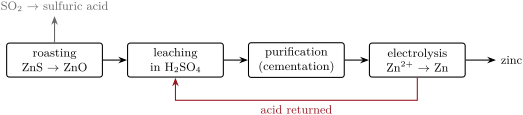
The hydrometallurgical route to zinc. The sulfur dioxide of the roaster is made into the sulfuric acid of the leach; the acid regenerated at the electrolysis anode is returned to it.
Read in context →