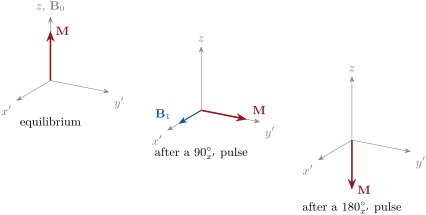
A radiofrequency pulse is a short burst of radio waves at , whose magnetic field , fixed in the rotating frame along , turns about . The angle turned is the flip angle for a pulse of duration : a pulse brings into the plane, a pulse inverts it.
 Coach
Log in
Start reading
Coach
Log in
Start reading
Chemistry · Glossary
Also known as: radiofrequency pulse · flip angle
A radiofrequency pulse is a short burst of radio waves at , whose magnetic field , fixed in the rotating frame along , turns about . The angle turned is the flip angle for a pulse of duration : a pulse brings into the plane, a pulse inverts it.