
All books

Professional

Apps About Coach Log in Start reading

Chemistry · Glossary

What is Standard solution, calibration scale?

Also known as: standard solution · calibration scale

Definition 26.15 School Chemistry — Grades 1 to 12 · Chapter 26 — Concentration and Dilution

A standard solution is a solution whose concentration is accurately known. A calibration scale is a series of standard solutions of the same solute, at increasing concentrations, usually made by diluting one stock solution; comparing an unknown solution with it gives an estimate of the unknown’s concentration.
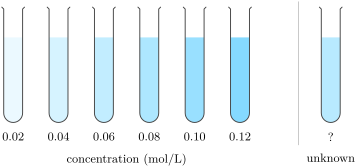
A calibration scale of copper sulfate solutions and an unknown solution. The unknown lies between the third and fourth tubes.

Examples

Example 26.16 (A blue scale)

From a stock solution of copper sulfate at 0.20 mol/L0.20\,\mathrm{mol}/\mathrm{L}, six standards are prepared at 0.02, 0.04, 0.06, 0.08, 0.10 and 0.12 mol/L0.12\,\mathrm{mol}/\mathrm{L}, each in identical tubes filled to the same height. A solution of unknown concentration, in the same kind of tube, looks darker than the 0.06 mol/L0.06\,\mathrm{mol}/\mathrm{L} tube and paler than the 0.08 mol/L0.08\,\mathrm{mol}/\mathrm{L} one: its concentration lies between the two, about 0.07 mol/L0.07\,\mathrm{mol}/\mathrm{L}.

Read in context →