School Chemistry — Grades 1 to 12 · Grades 1–12
26Concentration and Dilution
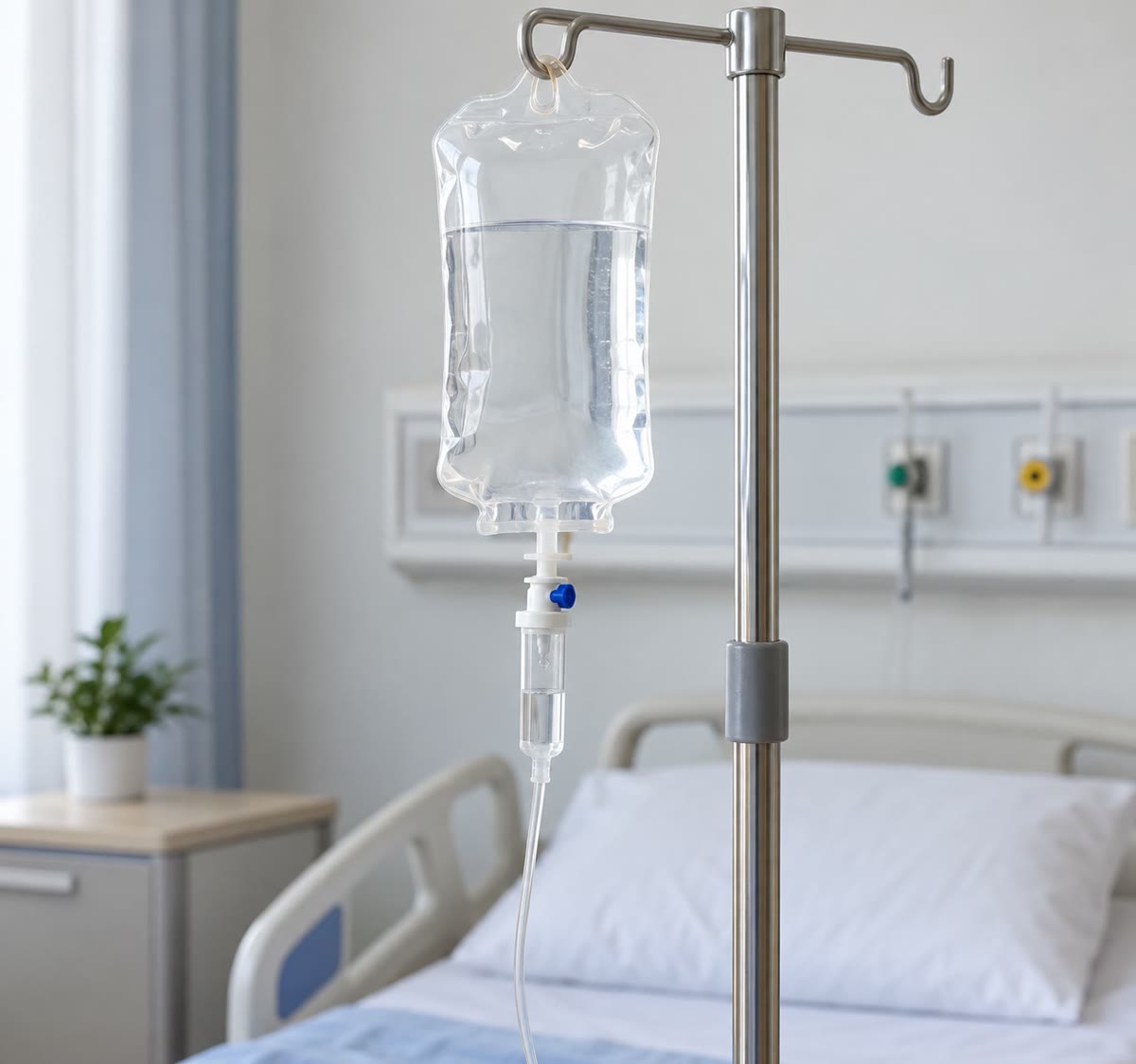
A hospital drip bag hangs above a patient’s bed. Its label reads “0.9 % sodium chloride”: salt in water, nothing more. Yet the figure 0.9 is not a detail. Too little salt, and the patient’s blood cells would swell with water; too much, and they would shrivel. A solution is not described by its ingredients alone, but by how much solute each volume of it holds, its concentration. This chapter measures concentrations, prepares solutions of an exact concentration, and dilutes them.
You already know
A solution is made of a solvent and one or more dissolved solutes; the solubility is the largest mass of solute that a given quantity of solvent can dissolve (Chapter 9). The amount of a species is , in moles (Chapter 25).
26.1 Mass concentration
Definition 26.1 (Mass concentration)
The mass concentration of a solute in a solution is the mass of dissolved solute per volume of solution:
in grams per litre ().
Example 26.2 (Sugared water)
of sugar are dissolved in water, and the solution is made up to . Its mass concentration in sugar is . Any part of it has the same concentration: a glass of of it holds of sugar.
Remark 26.3 (The volume is that of the solution)
The volume in is the volume of the whole solution, not that of the water poured in: dissolving a solute changes the volume a little. That is why a solution is always made up to a known final volume, in a flask marked for it.
Remark 26.4 (Concentration is not solubility)
The solubility of a solute is the largest concentration it can reach; a solution may have any concentration from zero up to it. Sodium chloride dissolves up to about per kilogram of water at ; the drip bag holds only per litre, very far from saturation.
Remark 26.5 (Percentages on labels)
On medical and food labels, “0.9 %” for a solid dissolved in water usually means of solute per of solution. In grams per litre it is ten times more: the drip bag holds of sodium chloride.
26.2 Molar concentration
Definition 26.6 (Molar concentration)
The molar concentration of a solute in a solution is the amount of dissolved solute per volume of solution:
in moles per litre ().
Proposition 26.7 (From one concentration to the other)
For a solute of molar mass ,
Proof. . ∎
Example 26.8 (The drip bag in moles)
The drip bag holds of sodium chloride, of molar mass . Its molar concentration is
The manufacturer’s label gives the same figure the other way round: 154 thousandths of a mole of sodium ions per litre.
Remark 26.9 (Ions in solution)
Sodium chloride dissolves as separate ions and (Chapter 17): a solution of sodium chloride at holds of sodium ions and of chloride ions. How an ionic solid comes apart in water is the subject of a later chapter.
26.3 Preparing a solution by dissolving
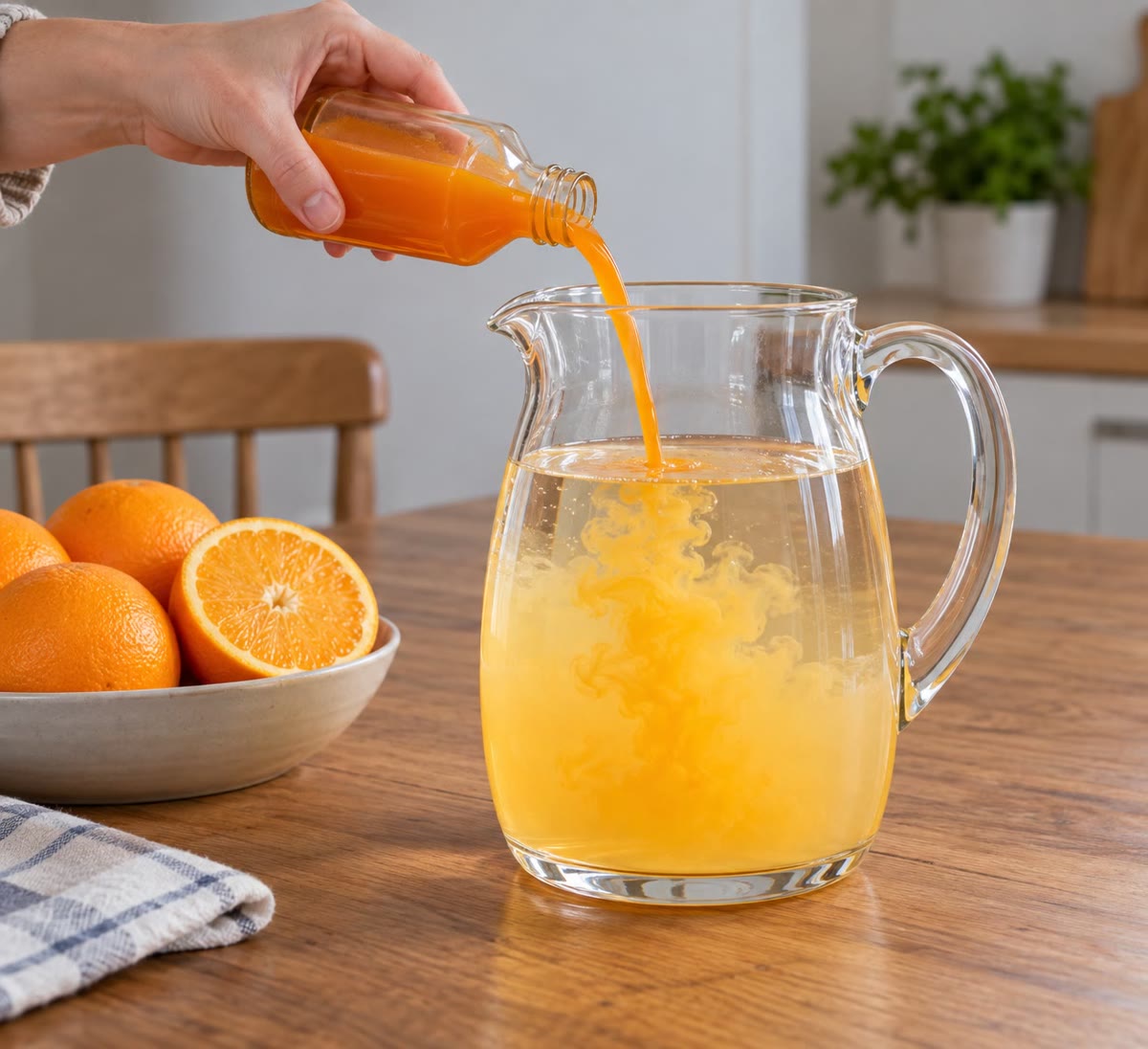
Method 26.10 (Preparing a solution by dissolving a solid)
To prepare a volume of solution of molar concentration :
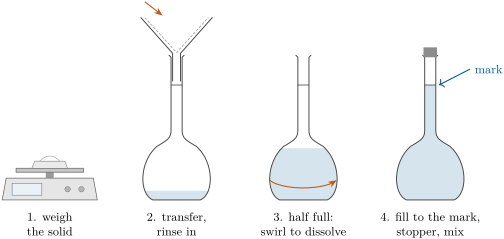
- Compute the amount needed, , and the mass to weigh, .
- Weigh this mass of solid in a small dish on a balance.
- Pour the solid through a funnel into a volumetric flask of volume ; rinse the dish and the funnel with distilled water into the flask, so that no solid is lost.
- Add distilled water up to about half of the flask and swirl until all the solid has dissolved.
- Add distilled water up to the mark, the last drops with a dropper; stopper the flask and turn it over several times to mix.
In the lab — Filling to the mark
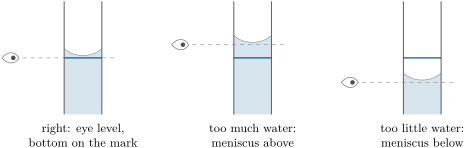
The mark of a volumetric flask is a ring around its neck. Water in a narrow glass tube does not end flat: its surface curves down in the middle, forming a meniscus. The flask is full when the bottom of the meniscus touches the mark, seen with the eye at the level of the mark, so that the front and the back of the ring look like a single line. Seen from above or from below, the level can look right when it is not.
26.4 Diluting
Definition 26.11 (Dilution, stock solution, dilution factor)
A dilution lowers the concentration of a solution by adding solvent. The concentrated solution taken at the start is the stock solution. The dilution factor is the ratio of the concentration of the stock solution to that of the diluted solution:
Proposition 26.12 (The amount of solute is kept)
During a dilution, the amount of solute does not change: if a volume of stock solution of concentration is made up to a volume , the diluted solution has the concentration given by
The same holds for mass concentrations.
Proof. Only solvent is added: the solute taken with the volume , an amount , is all in the final volume , where it makes up the amount . ∎
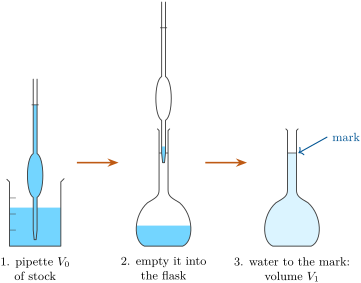
Method 26.13 (Preparing a solution by dilution)
To prepare a volume of solution of concentration from a stock solution of concentration :
- Compute the volume of stock solution to take, (that is, ).
- Pour a little stock solution into a clean beaker (never pipette straight from the bottle) and take exactly with a volumetric pipette, filled to its mark.
- Let the pipette empty into a volumetric flask of volume .
- Add distilled water up to the mark, stopper and mix.
Example 26.14 (A tenfold dilution)
A stock solution of copper sulfate has ; at are needed. The dilution factor is , so : a pipette and a flask.
26.5 A calibration scale
Definition 26.15 (Standard solution, calibration scale)
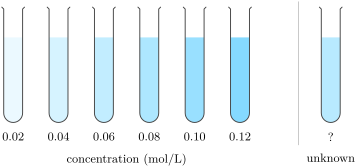
A standard solution is a solution whose concentration is accurately known. A calibration scale is a series of standard solutions of the same solute, at increasing concentrations, usually made by diluting one stock solution; comparing an unknown solution with it gives an estimate of the unknown’s concentration.
Example 26.16 (A blue scale)
From a stock solution of copper sulfate at , six standards are prepared at 0.02, 0.04, 0.06, 0.08, 0.10 and , each in identical tubes filled to the same height. A solution of unknown concentration, in the same kind of tube, looks darker than the tube and paler than the one: its concentration lies between the two, about .
Safety


Copper sulfate solutions: harmful if swallowed, irritating to the skin, damaging to the eyes, very toxic to aquatic life. Goggles and gloves; the used solutions are collected for treatment, never poured down the sink.
Remark 26.17 (The limits of the eye)
The eye can only say “between these two tubes”. To measure a concentration more finely from the colour of a solution, chemists measure how much light it absorbs; a later chapter does exactly that.
26.6 Exercises
Exercise 26.1 ★
of sugar are dissolved to make of solution. Compute the mass concentration of sugar in grams per litre.
Solution
Solution of Exercise 26.1.
.
Exercise 26.2 ★
A solution of contains of glucose. Compute its molar concentration.
Solution
Solution of Exercise 26.2.
.
Exercise 26.3 ★
What mass of anhydrous copper sulfate must be weighed to prepare of solution at ?
Solution
Solution of Exercise 26.3.
; ; .
Exercise 26.4 ★
A stock solution at is diluted to . What is the dilution factor? What volume of stock is needed to make of diluted solution?
Solution
Solution of Exercise 26.4.
; .
Exercise 26.5 ★
A solution of sodium chloride has a molar concentration of . What is its mass concentration?
Solution
Solution of Exercise 26.5.
, about .
Exercise 26.6 ★★
What volume of a stock solution at must be taken to prepare of solution at ? Name the two pieces of glassware used.
Solution
Solution of Exercise 26.6.
(dilution factor 25). A volumetric pipette and a volumetric flask.
Exercise 26.7 ★★
Why is a solution of exact concentration made up in a volumetric flask rather than in a beaker with graduations? Why is a volume of stock measured with a volumetric pipette rather than with a graduated cylinder?
Solution
Solution of Exercise 26.7.
The volumetric flask has a single mark, made for one volume and accurate to a small fraction of a percent; the graduations of a beaker are only a rough guide. Likewise a volumetric pipette delivers one volume very accurately, while a graduated cylinder is wider and read less precisely.
Exercise 26.8 ★★
Look at the calibration scale of copper sulfate. A second unknown is paler than the tube but darker than the one. Estimate its concentration. How could the scale be changed to estimate it more precisely?
Solution
Solution of Exercise 26.8.
Between and : about . For more precision, add standards between these two, for example at 0.025, 0.030 and : a finer scale where it is needed.
Exercise 26.9 ★★
A glucose solution for infusion contains of glucose . Compute its molar concentration.
Solution
Solution of Exercise 26.9.
; .
Exercise 26.10 ★★
A syrup is made by dissolving of sucrose to make of solution. Compute its molar concentration. It is then diluted ten times. What mass of sucrose does a spoonful of the diluted syrup contain?
Solution
Solution of Exercise 26.10.
, so and . Diluted ten times: , that is . A spoonful of holds of sucrose.
Exercise 26.11 ★★
A solution has a mass concentration of . What is its concentration (a) after water is added to double its volume; (b) after half of its water has been evaporated, all the solute remaining dissolved?
Exercise 26.12 ★★★
A solution at is diluted ten times, the result diluted ten times again, and once more.
- What is the final concentration?
- Why is this done in three steps rather than in a single dilution by 1000 (think of the volumes of glassware needed)?
Exercise 26.13 ★★★
of calcium chloride are dissolved to make of solution. In water the solid separates into calcium ions and chloride ions .
- Compute the molar concentration of calcium chloride dissolved.
- Deduce the molar concentrations of the calcium ions and of the chloride ions in the solution.
Solution
Solution of Exercise 26.13.
- ; ; .
- Each gives one and two : and .
Exercise 26.14 ★★★
A volumetric flask has a neck of inner diameter . A student fills it with the bottom of the meniscus above the mark.
- What extra volume of water has been added (volume of a cylinder: )?
- By what percentage is the concentration of the solution too low?
Solution
Solution of Exercise 26.14.
- , : , that is too much water.
- The same solute is in instead of : the concentration is too low by .
Exercise 26.15 ★★★
of sodium chloride solution at are mixed with of sodium chloride solution at . Assuming the volumes add, compute the concentration of the mixture. Is it the average of the two concentrations? Explain.
Solution
Solution of Exercise 26.15.
in : . It is not the plain average, : there is three times more of the dilute solution, so the mixture is closer to . It is the average weighted by the volumes.
26.7 Problem: The Drip Bag
Problem 26.1
Weekend problem — how much of a concentrated salt solution goes into one bag of “0.9 %” saline?
A hospital pharmacy laboratory keeps a concentrated sterile solution of sodium chloride containing (on its label: “20 %”). It must prepare bags of of the “0.9 %” solution used in drips, by diluting the concentrated solution with sterile water.
Part I — What 0.9 % means.
- The label “0.9 %” means of salt per of solution. Give the mass concentration in .
- Express it also in milligrams per millilitre.
- What mass of sodium chloride does a bag contain?
- Sodium chloride dissolves up to about per kilogram of water. Is the solution of the bag far from saturation?
- A patient receives of this solution in a day. What mass of salt is that?
Part II — In moles.
- Compute the molar mass of sodium chloride.
- Compute the molar concentration of the solution of the bag.
- What amount of sodium chloride does one bag contain?
- What are the molar concentrations of sodium ions and of chloride ions in the bag?
- How many sodium ions does one bag contain?
Part III — From the concentrated solution.
- Compute the dilution factor between the concentrated solution and the solution of the bag.
- Which mass of sodium chloride must come from the concentrated solution for one bag? Deduce the volume of concentrated solution to take.
- Check this volume with the dilution factor.
- Compute the molar concentration of the concentrated solution, and check that .
- About what volume of sterile water is then added (assume the volumes add)?
Part IV — Glassware and accuracy.
- No volumetric pipette of this volume exists. Which piece of glassware, graduated in tenths of a millilitre, could deliver it?
- In which vessel should the final volume be made up, to be accurate?
- If were taken instead of the right volume, what mass concentration would the bag have? By what percentage would it be wrong?
- State the final answer: what volume of the concentrated solution goes into one bag?
Solution
Solution of Problem 26.1.
1. per : .
2. per , that is per millilitre.
3. .
4. Yes: about per litre against some per kilogram of water at saturation, about forty times less.
5. of salt.
6. .
7. .
8. (or ).
9. Each gives one and one : both at .
10. sodium ions.
11. .
12. The of the bag all come from the concentrated solution: .
13. .
14. ; and : equal.
15. About of sterile water.
16. A graduated pipette of (or a burette), read to .
17. In a volumetric flask, made up to the mark.
18. , too concentrated by .
19. of the concentrated (“20 %”) solution for one bag.