All books

Professional

Apps About Coach Log in Start reading

Chemistry · Glossary

What is Systematic absence?

Definition 9.11 University Chemistry — Year 3 · Chapter 9 — Crystallography and X-ray Diffraction

A systematic absence is a reflection whose structure factor vanishes for every crystal of a given lattice centring or symmetry, whatever its atoms.
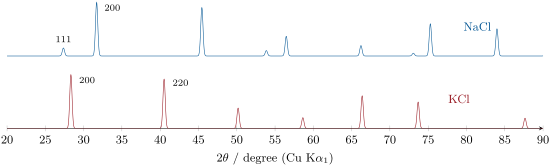
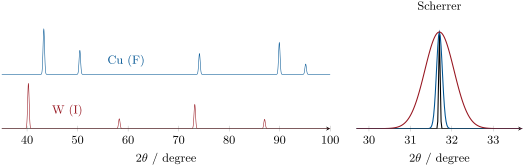
Computed powder patterns (Cu K_1; scattering factors taken equal to the numbers of electrons, so that only the absences and the broad trends of intensity are meaningful). Top: NaCl and KCl; the all-odd lines of KCl vanish. Bottom left: copper (F) shows (111), (200), (220), (311)…; tungsten (I) shows (110), (200), (211)…. Bottom right: the (200) line of NaCl for crystallites of 200 (black), 50 (blue) and 10 nm (red): smaller crystals give broader lines. Computed powder patterns (Cu K_1; scattering factors taken equal to the numbers of electrons, so that only the absences and the broad trends of intensity are meaningful). Top: NaCl and KCl; the all-odd lines of KCl vanish. Bottom left: copper (F) shows (111), (200), (220), (311)…; tungsten (I) shows (110), (200), (211)…. Bottom right: the (200) line of NaCl for crystallites of 200 (black), 50 (blue) and 10 nm (red): smaller crystals give broader lines.
Computed powder patterns (Cu Kα1\alpha_1; scattering factors taken equal to the numbers of electrons, so that only the absences and the broad trends of intensity are meaningful). Top: NaCl\ce{NaCl} and KCl\ce{KCl}; the all-odd lines of KCl\ce{KCl} vanish. Bottom left: copper (F) shows (111), (200), (220), (311)…; tungsten (I) shows (110), (200), (211)…. Bottom right: the (200) line of NaCl\ce{NaCl} for crystallites of 200 (black), 50 (blue) and 10 nm (red): smaller crystals give broader lines.
Read in context →
