University Chemistry — Year 3 · Bachelor Year 3
9Crystallography and X-ray Diffraction
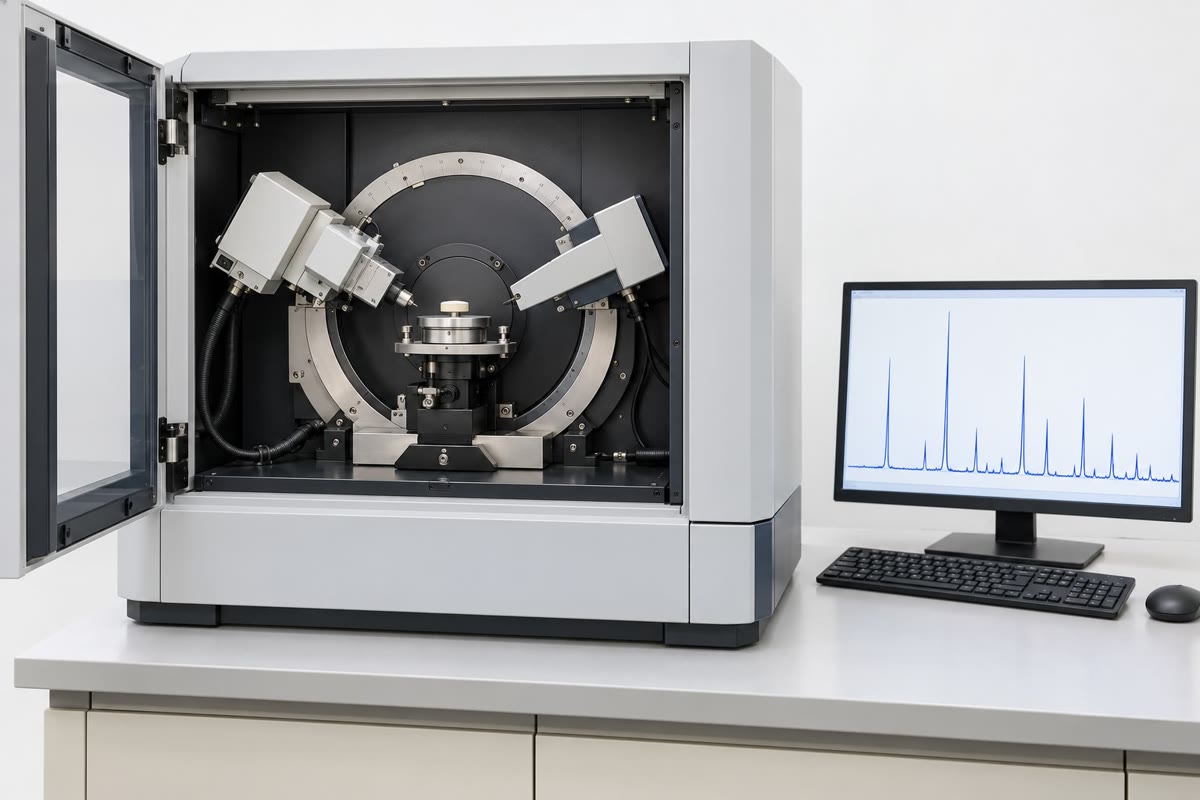
In 1912 a beam of X-rays sent through a crystal of copper sulfate left on a photographic plate a pattern of sharp spots: crystals diffract X-rays as a grating diffracts light, because the distances between their atoms are comparable to the X-ray wavelength. A year later William Lawrence Bragg, then a student, read from such patterns the structure of rock salt — and showed that the solid contains no molecules at all, only a lattice in which each ion has six neighbours of the other kind. Every crystal structure quoted in the Year 1 volume and in this book was found in this way. This chapter gives the geometry of lattices and of their symmetry, the condition for diffraction, the intensities that reveal the contents of the cell, and the powder and single-crystal methods used in every laboratory.
You already know
The Year 1 volume described crystals by a lattice of nodes, a motif and a unit cell with its lattice parameters; counted the multiplicity of a cell; built the face-centred and body-centred cubic and the hexagonal close-packed structures and the rock-salt, caesium chloride, zinc-blende and fluorite types; and computed a density from a cell. Chapter 4 defined symmetry operations and point groups.
9.1 Crystal systems and Bravais lattices
A lattice can only have symmetry operations that map the lattice onto itself. That restricts them severely.
Theorem 9.1 (The crystallographic restriction)
The only rotation axes compatible with a lattice are of order 1, 2, 3, 4 and 6.
Proof. In a basis of lattice vectors, a symmetry rotation maps lattice vectors onto lattice vectors, so its matrix has integer entries and an integer trace. The trace does not depend on the basis; in an orthonormal basis with along the axis it is . Hence is an integer between and 2: , : orders 2, 3, 4, 6, 1. A fivefold axis is impossible. ∎
Definition 9.2 (Crystal system, Bravais lattice, lattice centring)
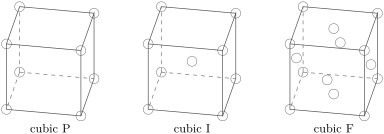
Lattices are grouped by their symmetry into seven crystal systems (triclinic, monoclinic, orthorhombic, tetragonal, trigonal, hexagonal, cubic). A cell may hold lattice nodes only at its corners (primitive, P) or also at its centre (body-centred, I), at the centres of all faces (face-centred, F) or of one pair of faces (base-centred, C), or along a body diagonal (rhombohedral, R): this is its lattice centring. The 14 distinct combinations of a system and a centring are the Bravais lattices.
| system | cell constraints | centrings |
|---|---|---|
| triclinic | none | P |
| monoclinic | P, C | |
| orthorhombic | P, C, I, F | |
| tetragonal | , all angles | P, I |
| trigonal | , (rhombohedral axes) | R |
| hexagonal | , , | P |
| cubic | , all angles | P, I, F |
9.2 Lattice planes and the reciprocal lattice
Definition 9.3 (Lattice plane, Miller indices, interplanar spacing)
A lattice plane is a plane through at least three non-aligned nodes; it belongs to a family of parallel, equally spaced planes that contain every node. If the plane of the family nearest the origin cuts the axes at , , , the integers , without common factor, are its Miller indices (an index 0 for a plane parallel to an axis). The distance between adjacent planes is the interplanar spacing .
Proposition 9.4 (Spacings in orthogonal cells)
For an orthorhombic cell, ; for a cubic cell, .
Proof. The plane has normal vector and lies at distance from the origin; the parallel plane through the origin belongs to the family, so . ∎
Definition 9.5 (Reciprocal lattice)
For a lattice of basis vectors , , and cell volume , the reciprocal lattice has basis vectors , , , so that and . Its node is perpendicular to the planes , and .
9.3 Diffraction
Theorem 9.6 (Bragg’s law)
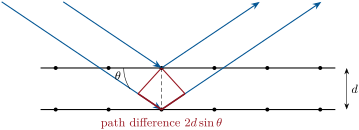
X-rays of wavelength are reflected by a family of planes of spacing only at the glancing angles satisfying
Bragg’s law. The order is absorbed by writing the reflection with spacing .
Proof. Rays scattered by two adjacent planes, at equal angles of incidence and reflection , differ in path by (the two segments on either side of the normal through the lower plane). They reinforce when this difference is a whole number of wavelengths; with millions of planes, any other angle gives rays that cancel in pairs. ∎
Proposition 9.7 (Laue condition)
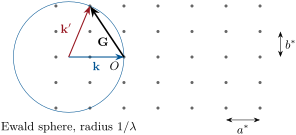
With incident and scattered wave vectors and of length , diffraction occurs when , a vector of the reciprocal lattice; this is equivalent to Bragg’s law.
Proof. Waves scattered by two nodes separated by a lattice vector differ in phase by ; they all reinforce if this is a multiple of for every , i.e. if is in the reciprocal lattice (by the definition , …). For elastic scattering, and , where is the angle between them; with this is , and is normal to the reflecting planes. ∎
Definition 9.8 (Ewald sphere)
The Ewald sphere has radius and passes through the origin of the reciprocal lattice, its centre at from the origin; a reflection occurs whenever a reciprocal-lattice node lies on it.
9.4 Intensities and symmetry
Bragg’s law gives the directions of the diffracted beams, which depend only on the lattice; their intensities depend on what is in the cell.
Definition 9.9 (Atomic scattering factor, structure factor)
The atomic scattering factor of an atom is the amplitude it scatters, in units of that of one electron; it equals its number of electrons in the forward direction and falls off at higher angles. The structure factor of reflection is
summed over the atoms of the cell at fractional coordinates .
Proposition 9.10 (Intensity)
The intensity of a reflection is proportional to .
Partial proof. Atom sits at ; for a reflection, , so its wave has the phase relative to an atom at the origin, and amplitude : the cell scatters the sum , and every cell the same. An intensity is the square modulus of an amplitude. That multiple scattering can be neglected (the kinematic approximation) is admitted. ∎
Definition 9.11 (Systematic absence)
A systematic absence is a reflection whose structure factor vanishes for every crystal of a given lattice centring or symmetry, whatever its atoms.
Proposition 9.12 (Absences of centred lattices)
In a body-centred lattice, reflections with odd are absent; in a face-centred lattice, reflections with , , of mixed parity are absent.
Proof. I centring: every atom at has a copy at , whose phase factor differs by : . F centring: copies at three face centres give the factor , equal to 4 if , , are all even or all odd and to 0 otherwise. ∎
Example 9.13 (Rock salt and sylvite)
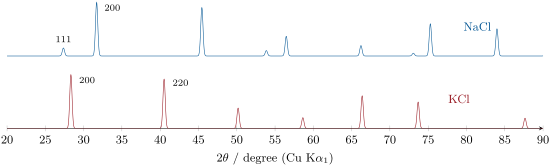
In the rock-salt structure, cations at and anions at , each with the F translations: for unmixed indices. For , and : the all-odd reflections (111), (311) are weak but present. For , and both have 18 electrons: the all-odd reflections almost vanish, and the pattern looks like that of a primitive cubic lattice of half the cell edge (figure below).
Proposition 9.14 (Friedel’s law)
In the absence of anomalous scattering, : a diffraction pattern looks centrosymmetric even when the crystal is not.
Proof. With real , , of the same modulus. ∎
Symmetry elements that combine a rotation or a reflection with a fraction of a lattice translation exist only in crystals.
Definition 9.15 (Screw axis, glide plane, space group)
A screw axis combines a rotation by with a translation of of the lattice repeat along the axis (: half a turn and half a cell). A glide plane combines a reflection with a translation of half a lattice vector parallel to the plane (, , glides). The group of all the symmetry operations of a crystal, translations included, is its space group: there are 230. Its smallest part from which the whole crystal is generated by the operations is the asymmetric unit. A set of points left on themselves by a subgroup of the operations is a Wyckoff position: general positions have no symmetry, special positions lie on symmetry elements.
Proposition 9.16 (Absences from a screw axis)
A axis along makes the reflections with odd absent.
Proof. The axis maps to . For both atoms have phase factors and : their sum vanishes for odd . ∎
Method 9.17 (Reading a space-group symbol)
- The first letter is the lattice centring (P, I, F, C, R).
- The next symbols give the symmetry along the main directions; for the monoclinic system, the single direction is . A fraction bar means “with a plane perpendicular to this axis”.
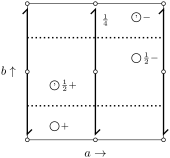
- P, the commonest space group of organic molecules: primitive, a axis along , and a -glide plane perpendicular to it; these generate centres of inversion. Absences: with odd, with odd.
9.5 Powder and single-crystal methods
Definition 9.18 (Powder diffraction pattern)
A finely ground sample contains crystallites in all orientations: every family of planes finds some in reflecting position, and the diffracted beams form cones. The intensity recorded against is its powder diffraction pattern, a fingerprint of the crystalline phase.
Method 9.19 (Indexing a cubic powder pattern)
- Compute for each line; for a cubic crystal with .
- Divide by the smallest value and look for the integer series: P gives (never 7); I gives ; F gives
- Choose the series that fits all lines; then , best from high-angle lines, where an error in matters least.
Method 9.20 (The number of formula units in the cell)
With the molar mass of a formula unit and the measured density , (for a cubic cell) must be a whole number; it tests a proposed structure.
Proposition 9.21 (Scherrer equation)
Crystallites of mean size broaden a line by (full width at half maximum in radians of , ).
Proof. Admitted at this level. ∎
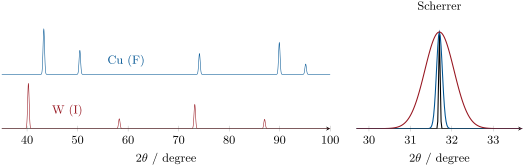
Below about the broadening becomes measurable; the Scherrer equation, derived in more advanced courses from the Fourier transform of a finite stack of planes, then estimates the size of nanocrystals (Chapter 23).
Definition 9.22 (Phase problem, R factor)
The intensities give but not the phases of the ; without them the electron density cannot be computed by inverting the Fourier series. This is the phase problem. A trial structure is refined by least squares until computed and observed moduli agree; the residual is its R factor — a few per cent for a good structure.
For a single crystal, a diffractometer measures thousands of reflections; direct methods (statistical relations between the phases of strong reflections) give a first electron-density map for most small molecules, and refinement places every atom to a few thousandths of a nanometre. The results are deposited as CIF files in open databases, from which the lattice parameters quoted in this series are taken.
In the lab — A powder measurement
The powder is ground in an agate mortar, pressed flat into a holder, and scanned from 5 to in with Cu K radiation; a nickel filter removes most of the K line. The pattern is compared with reference patterns from a database, and lattice parameters are refined with an internal standard such as silicon powder. X-ray instruments are enclosed and interlocked: the shutter cannot open when the door is.
History — The Braggs, 1913
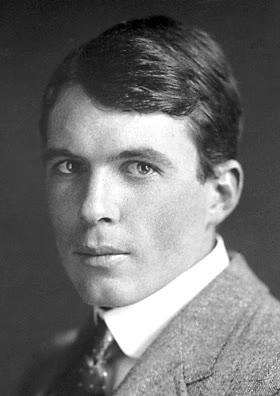
Max von Laue proposed in 1912 that crystals diffract X-rays, and Walter Friedrich and Paul Knipping recorded the first pattern. William Lawrence Bragg, twenty-two years old, explained the spots as reflections from lattice planes and, with his father William Henry Bragg, who built an X-ray spectrometer, solved the structures of , and diamond in 1913. Father and son shared the 1915 Nobel Prize in Physics.
9.6 Exercises
Exercise 9.1 ★
For (), compute , and .
Solution
Solution of Exercise 9.1.
: , , .
Exercise 9.2 ★
Copper is FCC with . With Cu K (), compute of its first two reflections, after naming them.
Solution
Solution of Exercise 9.2.
FCC: the first reflections are (111) and (200). : and .
Exercise 9.3 ★
Which of the reflections 100, 110, 111, 200, 210, 211, 220 are present for a cubic P, I and F lattice?
Solution
Solution of Exercise 9.3.
P: all seven. I ( even): 110, 200, 211, 220. F (unmixed): 111, 200, 220.
Exercise 9.4 ★
Give the reciprocal basis of a two-dimensional rectangular lattice of sides and , and draw the first reciprocal nodes.
Solution
Solution of Exercise 9.4.
, : a rectangular lattice of sides and , the long side of the direct lattice becoming the short one.
Exercise 9.5 ★★
A metal gives lines at , 58.26, 73.20, 87.01 and with Cu K. Index the pattern, find the lattice type and .
Solution
Solution of Exercise 9.5.
ratios , i.e. : body-centred (110, 200, 211, 220, 310). From the first line, and : tungsten.
Exercise 9.6 ★★
A crystal of () has a measured density of (data of the exercise). Find .
Solution
Solution of Exercise 9.6.
.
Exercise 9.7 ★★
The (200) line of a nanopowder () is wide, the instrument contributing nothing. Estimate the crystallite size.
Solution
Solution of Exercise 9.7.
, : .
Exercise 9.8 ★★
has at and at in a P cell. With the number of electrons, compute and and the ratio of their intensities (structure factor only). Why is not body-centred?
Solution
Solution of Exercise 9.8.
: , : intensities in the ratio 1 : 4. The centre is occupied by a different ion from the corners: the lattice is primitive (a body-centred lattice needs identical contents at both points), and 100 is present.
Exercise 9.9 ★★
Show that a C-centred lattice (extra node at ) makes the reflections with odd absent.
Solution
Solution of Exercise 9.9.
Each atom has a copy shifted by , multiplying by , zero for odd.
Exercise 9.10 ★★★
Explain why the 1980s discovery of alloys whose diffraction patterns show sharp spots with tenfold symmetry did not contradict the crystallographic restriction, and what it changed in the definition of a crystal.
Solution
Solution of Exercise 9.10.
Quasicrystals have long-range order without periodicity: they have no lattice, so the restriction, which concerns lattices, does not apply to them. Their sharp diffraction spots led to defining a crystal as any solid with an essentially discrete diffraction pattern, periodic or not.
Exercise 9.11 ★★★
Show that in P the glide plane makes the reflections with odd absent.
Solution
Solution of Exercise 9.11.
The glide maps to . For the two phase factors are and : their sum vanishes for odd .
Exercise 9.12 ★★★
A pure enantiomer can never crystallise in a space group containing an inversion centre, a mirror or a glide plane. Why? To which kind of space groups is it restricted, and what does Friedel’s law imply for determining its absolute configuration?
Solution
Solution of Exercise 9.12.
An inversion, a mirror or a glide turns a molecule into its mirror image, so a crystal containing one would contain both enantiomers. A pure enantiomer crystallises only in the 65 space groups built from rotations, screw axes and translations (Sohncke groups), such as P. By Friedel’s law the pattern of one enantiomer equals that of the other; the absolute configuration is obtained from the small deviations caused by anomalous scattering of heavier atoms.
9.7 Problem: Which White Powder?
Problem 9.1
Weekend problem — a powder pattern of an unknown cubic salt: spacings, indexing, the lattice parameter and the identity of the salt, and the size of its crystallites
An unknown white crystalline powder, known to be , or , gives with Cu K radiation () the lines (data of the problem, computed for this exercise):
| / degree | 28.342 | 40.512 | 50.178 | 58.632 | 66.380 | 73.692 |
| relative intensity | 100 | 92 | 38 | 20 | 61 | 49 |
No other line appears between 20 and . Reference lattice parameters: , , . Molar masses: K 39.1, Na 23.0, Cl 35.5, Br .
Part I — Spacings.
- Compute and for the first line.
- Compute for all lines.
- Compute the ratios .
- What series of integers do you find?
- Could the pattern be that of a primitive cubic lattice? With which ?
- For a primitive cubic lattice, which integer can never occur? Does the pattern tell the two interpretations apart so far?
Part II — The real lattice.
- All three candidates are F lattices. Index the lines with the F series.
- Deduce from the first line.
- Which candidate fits?
- For that salt, why are the all-odd reflections (111), (311) absent?
- Would show (111)? ?
- Explain why the primitive interpretation of Part I is a trap.
Part III — Density and contents.
- How many formula units does the cell contain?
- Compute the density from the cell.
- Give the coordination number of each ion.
- Compute the shortest K–Cl distance.
- What reflection would appear first above ?
- Why are intensities less useful than positions for identifying a phase?
Part IV — Refinement and crystallite size.
- Why is the lattice parameter best computed from a high-angle line?
- Compute from the (420) line.
- The (420) line is wide in (instrumental width negligible). Estimate the crystallite size.
- Would a crystallite size of broaden the line measurably?
- State the result: the lattice parameter refined from the (420) line, and the identity of the powder.
Solution
Solution of Problem 9.1.
1. , . 2. 314.64, 222.49, 181.66, 157.32, 140.71, . 3. 1.000, 2.000, 3.000, 4.000, 5.000, 6.000. 4. 1, 2, 3, 4, 5, 6. 5. Yes, as (100), (110), (111), (200), (210), (211) of a primitive cubic cell with . 6. (and 15, 23…), which is not a sum of three squares; the first difference would come at the eighth line. Six lines cannot tell a P cell of edge from an F cell of edge . 7. : (200), (220), (222), (400), (420), (422). 8. . 9. (). 10. for all-odd indices, and the two ions have 18 electrons each: the amplitudes cancel. 11. Yes for both: (10) and (18), (18) and (36) scatter differently; ’s (111) would be at , ’s at , both inside the recorded range. 12. X-rays see and as nearly identical; identical ions on a rock-salt arrangement form a simple cubic array of edge , an apparent cell. 13. Four . 14. . 15. Six and six (octahedra of the other ion). 16. . 17. (440), , at (the all-odd (333)/(511) being absent). 18. Intensities change with preferred orientation of the crystallites, absorption, the fall-off of scattering factors and thermal motion; positions depend only on the lattice. 19. From , : the same angular error gives a smaller relative error at large . 20. , . 21. . 22. No: , far below a typical instrumental width. 23. : the powder is potassium chloride, its odd reflections silenced by two ions with the same number of electrons.