All books

Professional

Apps About Coach Log in Start reading

Chemistry · Glossary

What is Thermal transitions?

Also known as: degree of crystallinity · glass transition temperature

Definition 29.17 University Chemistry — Year 2 · Chapter 29 — Polymers: Synthesis, Structure and Properties

The degree of crystallinity of a polymer is the mass fraction of it that lies in crystalline regions. The glass transition temperature TgT_g is the temperature below which the amorphous regions are a rigid glass, their chain segments unable to move, and above which they become rubbery; the crystalline regions melt at a higher temperature, TmT_m.

Modulus (stiffness) of an amorphous polymer against temperature, schematic. Below T_g the material is a glass; through the transition the modulus falls by orders of magnitude; on the rubbery plateau entangled chains behave as a rubber; at higher temperature a linear polymer flows (solid line), while a cross-linked one keeps its plateau until it decomposes (dashed).
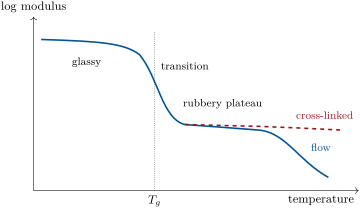
Modulus (stiffness) of an amorphous polymer against temperature, schematic. Below TgT_g the material is a glass; through the transition the modulus falls by orders of magnitude; on the rubbery plateau entangled chains behave as a rubber; at higher temperature a linear polymer flows (solid line), while a cross-linked one keeps its plateau until it decomposes (dashed).
Read in context →