University Chemistry — Year 2 · Bachelor Year 2
29Polymers: Synthesis, Structure and Properties
Nylon stockings went on sale in 1939. They came out of a laboratory that had set out, a few years earlier, to understand how small molecules join into long ones, and that had learnt along the way a lesson that surprises every chemist the first time: for a polymer made by linking molecules end to end, a 99 % yield is not enough. This chapter explains why, describes the two ways in which chains grow, and connects the structure of the chains to the properties of the materials.
You already know
The school volume: polymers, monomers and repeat units, addition and condensation polymers, thermoplastics and thermosets. The Year 1 volume: radicals and homolysis, carbocations and carbanions, the steady-state approximation. Chapter 24: esters and amides. Chapter 20: insertion into a metal–carbon bond.
29.1 Chains and their molar masses
Definition 29.1 (Polymer)
A polymer is a substance made of macromolecules, each built by the repeated linking of small molecules, the monomers. The repeat unit is the smallest group of atoms whose repetition makes up the chain; the degree of polymerisation of a chain is the number of monomer-derived units it contains.
A sample of a synthetic polymer is never made of identical chains: it is a mixture of chains of different lengths, and its molar mass is an average, which depends on how the chains are counted.
Definition 29.2 (Molar-mass averages)
For a sample containing chains of molar mass , the number-average molar mass and the mass-average molar mass are
where is the mass fraction of the chains of mass . The dispersity is at least 1, and equal to 1 only if all chains have the same mass. The averages and of the degree of polymerisation are defined in the same way.
The number average weights each chain once; the mass average weights each chain by its mass, so the long chains count more. That is the inequality (Cauchy–Schwarz), with equality only for equal .
Method 29.3 (Computing the averages)
- Turn the data into amounts (or numbers of chains) and masses ; from mass fractions, .
- ; equivalently, .
- .
- ; check that .
29.2 Step growth and chain growth
Definition 29.4 (Step and chain growth)
In a step-growth polymerisation, any two molecules carrying complementary functional groups (monomers, oligomers or long chains) can react, and the chains lengthen by joining one another: polyesters, polyamides. In a chain-growth polymerisation, a reactive centre (radical, ion or metal–carbon bond) adds monomer molecules one at a time to the end of a growing chain: the polymers of alkenes.
Method 29.5 (Step or chain?)
- A monomer with two functional groups that react with each other’s partner (acid and alcohol, acid and amine), often releasing a small molecule: step growth.
- A monomer with a double bond (or a strained ring) and an initiator: chain growth.
- Check with the course of the reaction: in step growth, monomer disappears early and long chains appear only at the very end; in chain growth, long chains appear from the start while monomer is consumed gradually.
Step growth
Take a balanced mixture of and monomers (a diamine and a diacid), or a single monomer. Call the extent of reaction: the fraction of the functional groups of one kind that have reacted.
Theorem 29.6 (Carothers equation)
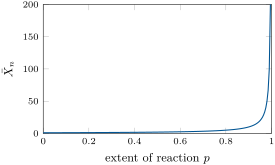
In a step-growth polymerisation of exactly balanced bifunctional monomers, the number-average degree of polymerisation, counted in monomer units, is
Proof. Start with monomer molecules, carrying groups and groups . Each reaction between an and a joins two molecules into one, so it lowers the number of molecules by one. After reactions there remain molecules sharing the monomer units: . ∎
Corollary 29.7 (Imbalance)
If the groups are not balanced, with and the extent of reaction of the minority groups ,
Proof. There are bifunctional monomer molecules at the start. Each linear molecule has two chain ends, each an unreacted group; after reaction there remain groups and groups , hence molecules. Dividing, with : . With this is the Carothers equation. ∎
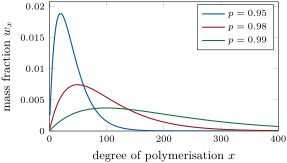
The equation explains the hook. At , a “99 % yield” of the linking reaction, ; a useful fibre needs about that or more, so the linking must go beyond 99 %, with pure monomers in exactly equal amounts and the small molecule released (water, methanol) removed to keep pushing the equilibrium. An excess of 1 % of one monomer caps at 201 even at complete conversion.
Theorem 29.8 (Flory distribution)
In a step-growth polymerisation at extent , if every group has the same reactivity whatever the length of its chain, the number fraction and the mass fraction of chains of units are
and , , so that , close to 2 at high conversion.
Proof. Follow a chain from one end (an monomer, for simplicity). Each link along it is formed with probability , independently. The chain has exactly units if the first links are formed and the next is not: probability , which is . With and its derivatives and : , , , and . ∎
Radical chain growth
Definition 29.9 (Steps of a chain polymerisation)
A radical chain polymerisation runs in three kinds of steps. In initiation, a radical initiator (a molecule with a weak bond, such as a peroxide or an azo compound) splits on heating into radicals, one of which adds to a monomer. In propagation, the radical at the chain end adds a monomer molecule and remains a radical. In termination, two radicals destroy each other, by combination (they bond) or disproportionation (one takes a hydrogen atom from the other).
Theorem 29.10 (Rate of radical polymerisation)
With an initiator decomposing with rate constant and efficiency (the fraction of radicals that start a chain), propagation constant and termination constant (termination rate ), the steady-state rate of polymerisation is
Proof. Let be the total concentration of chain radicals, whatever their length. They are created at the rate (two radicals per initiator molecule, a fraction of which start chains) and destroyed at the rate ; propagation turns one chain radical into another and does not change their number. The steady-state approximation on gives , so . Monomer is consumed essentially by propagation, at . ∎
Definition 29.11 (Kinetic chain length)
The kinetic chain length is the average number of monomer molecules added per radical that starts a chain: .
Proposition 29.12 (Chain length and initiator)
In the steady state, : more initiator gives faster polymerisation but shorter chains. With termination by combination, ; by disproportionation, .
Proof. . Each chain started adds monomers on average; combination joins two such chains into one molecule, disproportionation leaves two. ∎
Definition 29.13 (Living polymerisation)
A living polymerisation is a chain-growth polymerisation without termination or transfer: all chains start together and keep growing as long as monomer remains, and they resume when more monomer is added. The anionic polymerisation of styrene initiated by butyllithium in a dry, aprotic solvent is the classic example.
Proposition 29.14 (Narrow distributions)
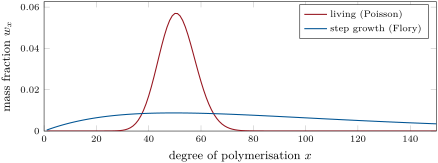
In a living polymerisation in which all chains start at once, the degree of polymerisation follows a Poisson distribution, and , where is the mean number of monomers added per chain.
Proof. Admitted at this level. ∎
The distribution is that of the number of additions, independent random events at a common rate, made by each chain during the same time; the dispersity follows from the mean and variance of a Poisson law, both equal to . A living chain of 100 units thus has , against nearly 2 for the same average made by step growth.
Definition 29.15 (Copolymer)
A copolymer is a polymer built from two or more different monomers. Its units may follow each other at random (statistical copolymer), alternately, in long runs of each (block copolymer, made by living polymerisation), or as side chains of one grafted onto a backbone of the other (graft copolymer).
29.3 Structure of the chains
Definition 29.16 (Tacticity)
In a vinyl polymer , every carbon is a stereocentre. The tacticity describes their relative configurations along the chain drawn as a planar zig-zag: in an isotactic chain all the groups lie on the same side of the plane, in a syndiotactic chain they alternate, and in an atactic chain they are placed at random.
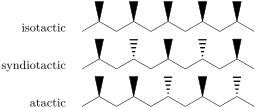
Regular chains can pack side by side into crystalline regions; irregular ones cannot. Isotactic polypropene, made with the metal catalysts of the Year 3 volume, is partly crystalline, hard and high melting; atactic polypropene is a soft, sticky amorphous material. A polymer is rarely fully crystalline: crystallites are embedded in amorphous regions where chains are tangled.
Definition 29.17 (Thermal transitions)
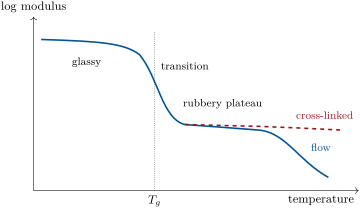
The degree of crystallinity of a polymer is the mass fraction of it that lies in crystalline regions. The glass transition temperature is the temperature below which the amorphous regions are a rigid glass, their chain segments unable to move, and above which they become rubbery; the crystalline regions melt at a higher temperature, .
Polystyrene and poly(methyl methacrylate) are amorphous with above room temperature: rigid, transparent glasses. Natural rubber has well below room temperature. Polyethene, with far below room temperature but highly crystalline, is tough and flexible: its crystallites hold the rubbery amorphous parts together.
29.4 Properties and uses
Definition 29.18 (Elastomer)
An elastomer is a polymer used above its glass transition temperature whose chains are lightly cross-linked: it can be stretched to several times its length and returns to its shape when released.
The four large classes of polymer materials follow from structure and transitions. Thermoplastics, linear or branched, glassy or semi-crystalline at room temperature, soften on heating and can be moulded again and again: polyethene, polypropene, polystyrene, PET. Elastomers are lightly cross-linked chains above their : vulcanised rubber, in which sulfur bridges link the chains. Fibres are chains aligned by drawing, with strong interactions between them: the hydrogen bonds between amide groups in nylon. Thermosets are densely cross-linked networks formed during moulding: epoxy and phenol–formaldehyde resins, which cannot be remelted. Only thermoplastics are recycled by melting; the school volume gave the scale of the problem.
History — A 99 % yield is not enough
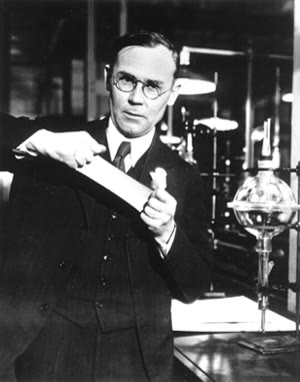
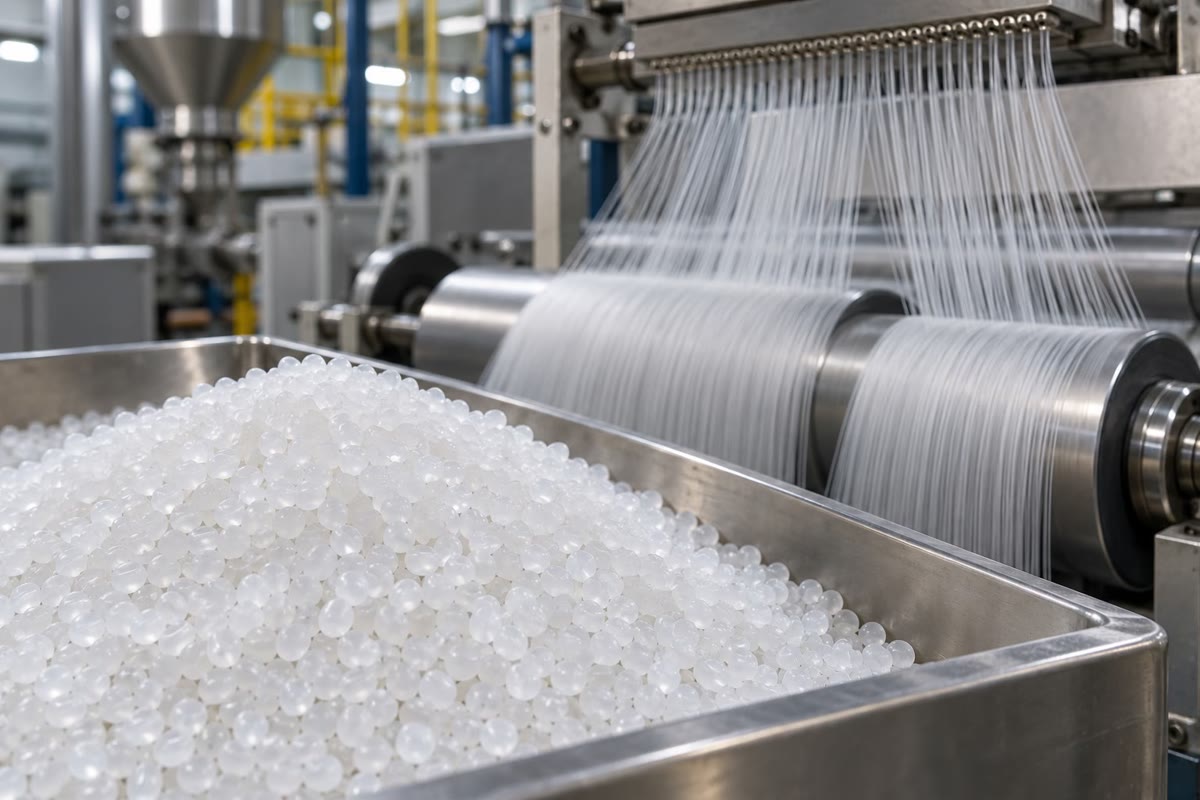
Wallace Carothers, a young university instructor recruited into an industrial laboratory for fundamental research, built long molecules from well-known reactions, and his results strongly supported the then-contested idea that polymers are ordinary molecules, only very long. His team made polyesters, then, from 1934, polyamides; the equation that bears his name explains why only extreme conversions gave fibres. Nylon went into production in 1939. (Photograph: unknown photographer, public domain; Wikimedia Commons.)
Safety


Styrene is flammable and a health hazard. Dibenzoyl peroxide is an explosive oxidiser when dry and is kept damp and cool. Hexane-1,6-diamine and hexanedioic acid are corrosive to the eyes.
29.5 Exercises
Exercise 29.1 ★
Draw the repeat units of polyethene, polypropene, poly(vinyl chloride), polystyrene and nylon-6,6.
Solution
Solution of Exercise 29.1.
Polyethene ; polypropene ; poly(vinyl chloride) ; polystyrene ; nylon-6,6 .
Exercise 29.2 ★
Step or chain growth: PET from ethane-1,2-diol and benzene-1,4-dicarboxylic acid; polystyrene; nylon-6,6; poly(methyl methacrylate); poly(lactic acid) from 2-hydroxypropanoic acid?
Exercise 29.3 ★
A polystyrene has . Compute , neglecting the end groups.
Solution
Solution of Exercise 29.3.
(styrene , ).
Exercise 29.4 ★
A polypropene chain drawn as a planar zig-zag has its methyl groups on the side of the reader, then away, then towards, then away, and so on. Name its tacticity. Could it crystallise?
Exercise 29.5 ★★
A sample is a mixture of equal masses of two fractions, of molar masses and . Compute , and the dispersity.
Solution
Solution of Exercise 29.5.
Mass fractions 0.5 and 0.5. , ; ; .
Exercise 29.6 ★★
Compute for a balanced step-growth polymerisation at and .
Solution
Solution of Exercise 29.6.
; .
Exercise 29.7 ★★
A diacid and a diamine are mixed with a 1 % excess (in moles) of the diamine. What is the largest that can be reached?
Solution
Solution of Exercise 29.7.
; at , .
Exercise 29.8 ★★
In a radical polymerisation the initiator concentration is doubled. By what factor do the rate of polymerisation and the kinetic chain length change?
Solution
Solution of Exercise 29.8.
: multiplied by . : divided by , about 0.71 times its former value.
Exercise 29.9 ★★
Poly(vinyl chloride) is rigid; garden hoses made of it are flexible because they contain a plasticiser, a small molecule mixed between the chains. Explain with the glass transition.
Solution
Solution of Exercise 29.9.
Pure PVC has its glass transition above room temperature: a rigid glass. The small plasticiser molecules sit between the chains, separate them and let segments move at lower temperature: falls below room temperature, and the material is rubbery and flexible in use.
Exercise 29.10 ★★★
Show that the Flory mass distribution , viewed as a function of a continuous , is largest at , and that this is close to when is close to 1.
Solution
Solution of Exercise 29.10.
, zero for (a maximum: the sign goes from to ). For close to 1, , so .
Exercise 29.11 ★★★
PET is made in two stages: dimethyl benzene-1,4-dicarboxylate with excess ethane-1,2-diol gives bis(2-hydroxyethyl) benzene-1,4-dicarboxylate and methanol; then this diester is heated under vacuum and polymerises, releasing ethane-1,2-diol. Write both stages and explain how the second stage solves the stoichiometry problem of the Carothers equation.
Solution
Solution of Exercise 29.11.
Stage 1, transesterification: , methanol distilled off. Stage 2: each diester molecule carries two ends; one end attacks an ester of another molecule and releases a molecule of ethane-1,2-diol, which is pumped off. The monomer carries both kinds of group in the right ratio, as an monomer does: the balance is built in, and removing the diol drives towards 1.
Exercise 29.12 ★★★
In a radical copolymerisation of monomers 1 and 2, the instantaneous composition of the copolymer is given by , where and are the reactivity ratios (exercise data: , ). Compute the ratio of units in the copolymer formed from an equimolar feed. What happens if ?
29.6 Problem: Nylon-6,6 by the Kilogram
Problem 29.1
Weekend problem — the monomers and the nylon salt, the Carothers equation, a deliberate imbalance, the Flory distribution and the water released
Nylon-6,6 is made from hexane-1,6-diamine and hexanedioic acid. End groups are neglected throughout. Molar masses (): C 12.011, H 1.008, N 14.007, O 15.999.
Part I — Monomers and repeat unit.
- Write the formulas of the two monomers.
- Write the equation of the formation of one amide link.
- The monomers are first combined as a 1 : 1 salt, crystallised from solution. Why?
- Give the repeat unit of nylon-6,6, its formula and its molar mass.
- What is the mean molar mass of a monomer-derived unit in the chain?
- What do the two numbers in the name “6,6” count?
Part II — The Carothers equation.
- Compute and at .
- The same at .
- Explain the remark “a 99 % yield is not enough”.
- Which extent of reaction gives ?
- How is the extent pushed so high in practice?
- Why must the monomers be very pure?
Part III — A deliberate imbalance.
- The diamine is used in 1 % molar excess. Compute .
- Compute the largest and that can then be reached.
- Compute at with this imbalance.
- Which groups end the chains at the end of the reaction?
- A little ethanoic acid is sometimes added. What does it do to the chains?
- Why would a manufacturer limit the chain length on purpose?
Part IV — Distribution and mass balance.
- For a balanced mixture at , give the dispersity.
- Compute at .
- At , what fraction of the molecules, and what fraction of the mass, is still unreacted monomer?
- Near which chain length is the mass distribution largest?
- Compute the mass of water released per kilogram of nylon-6,6.
- Why does melt spinning need within a window?
- State the extent of reaction that gives for a balanced mixture.
Solution
Solution of Problem 29.1.
1. and . 2. One water per link:
3. The salt contains exactly one diamine per diacid; weighing two separate liquids or solids would never reach the exactness the Carothers equation demands. 4. , , . 5. The repeat unit contains two monomer-derived units: . 6. The carbons of the diamine (6) and of the diacid (6). 7. , . 8. , . 9. With 99 % of the groups reacted, the average chain has only 100 units, too short for a strong fibre; each further step towards complete conversion doubles or triples the chain length. 10. ; . 11. By removing water: the melt is heated well above its melting point, finally under reduced pressure, so that the equilibrium keeps moving towards amide. 12. A monofunctional impurity caps chain ends, and any impurity upsets the 1 : 1 balance. 13. . 14. ; . 15. . 16. Amine groups: when the acid groups are used up, every chain ends in . 17. It turns an amine end into an amide that cannot react further: it caps chains, limiting and stopping further growth when the polymer is remelted. 18. To keep a reproducible melt viscosity for spinning and moulding, which would otherwise drift as chains keep reacting in the melt. 19. . 20. . 21. Number fraction , 1 % of the molecules; mass fraction , 0.01 % of the mass. 22. Near , that is near (exercise 10). 23. of repeat units, two amide links each: of water, . 24. Chains too short give a weak fibre; chains too long give a melt too viscous to be pushed through the fine holes of the spinneret. 25. and .