
All books

Professional

Apps About Coach Log in Start reading

Chemistry · Glossary

What is Zeolites?

Also known as: zeolite · molecular sieve · shape selectivity

Definition 23.12 University Chemistry — Year 3 · Chapter 23 — Inorganic Materials and Nanomaterials

A zeolite is a crystalline aluminosilicate whose framework of corner-sharing SiOX4\ce{SiO4} and AlOX4\ce{AlO4} tetrahedra encloses cages and channels of molecular size, with exchangeable cations and water inside. A molecular sieve is a porous solid that admits molecules according to their size; shape selectivity is the control of a reaction by the size and shape of the pores in which it takes place.
Left: a sodalite cage, the building unit of zeolite A, with a tetrahedral atom at each corner (oxygens, at the middle of each edge, not drawn); silicon (blue) and aluminium (orange) alternate, as Löwenstein’s rule requires when Si/Al = 1. Right: a layer of a metal–organic framework, schematic: Zn4O clusters (squares) joined by benzene-1,4-dicarboxylate linkers (rings) into a cubic grid with large pores. Left: a sodalite cage, the building unit of zeolite A, with a tetrahedral atom at each corner (oxygens, at the middle of each edge, not drawn); silicon (blue) and aluminium (orange) alternate, as Löwenstein’s rule requires when Si/Al = 1. Right: a layer of a metal–organic framework, schematic: Zn4O clusters (squares) joined by benzene-1,4-dicarboxylate linkers (rings) into a cubic grid with large pores.
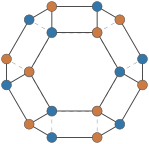
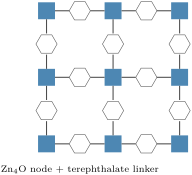
Left: a sodalite cage, the building unit of zeolite A, with a tetrahedral atom at each corner (oxygens, at the middle of each edge, not drawn); silicon (blue) and aluminium (orange) alternate, as Löwenstein’s rule requires when Si/Al = 1. Right: a layer of a metal–organic framework, schematic: ZnX4O\ce{Zn4O} clusters (squares) joined by benzene-1,4-dicarboxylate linkers (rings) into a cubic grid with large pores.
Read in context →