
All books

Professional

Apps About Coach Log in Start reading

Chemistry · Glossary

What is Ziegler–Natta catalysis?

Also known as: Ziegler--Natta catalyst · Cossee--Arlman mechanism · single-site catalyst

Definition 21.11 University Chemistry — Year 3 · Chapter 21 — Homogeneous Catalysis in Industry

A Ziegler–Natta catalyst polymerises alkenes at low pressure; it is made from a transition-metal halide, typically of titanium, and an alkylaluminium compound. The Cossee–Arlman mechanism of chain growth is the coordination of the alkene at a vacant site cis to the growing alkyl chain on the metal, followed by its migratory insertion into the metal–carbon bond, which leaves a vacant site again. A single-site catalyst has all its active centres identical, as in a molecular metallocene catalyst.
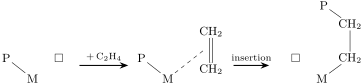
The Cossee–Arlman mechanism (P: the growing polymer chain; : a vacant site). The alkene binds next to the chain and inserts into the M–C bond through a four-membered transition state; the chain, longer by two carbons, now occupies the site where the alkene was, and the vacant site has moved.
The Cossee–Arlman mechanism (P: the growing polymer chain; □\square: a vacant site). The alkene binds next to the chain and inserts into the M–C bond through a four-membered transition state; the chain, longer by two carbons, now occupies the site where the alkene was, and the vacant site has moved.
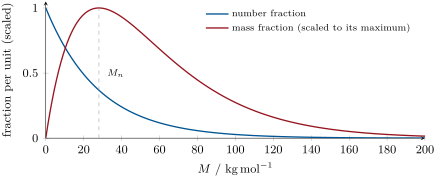
The most probable molar-mass distribution of a polyethylene made on a single-site catalyst (model: mean degree of polymerisation 1000): the number fraction falls exponentially, the mass fraction peaks at M_n 28\, kg/ mol; M_w = 2M_n. Classical Ziegler–Natta catalysts, with several kinds of sites, give broader distributions.
The most probable molar-mass distribution of a polyethylene made on a single-site catalyst (model: mean degree of polymerisation 1000): the number fraction falls exponentially, the mass fraction peaks at Mn≈28 kg/molM_n \approx 28\,\mathrm{kg}/\mathrm{mol}; Mw=2MnM_w = 2M_n. Classical Ziegler–Natta catalysts, with several kinds of sites, give broader distributions.
Read in context →