University Chemistry — Year 3 · Bachelor Year 3
21Homogeneous Catalysis in Industry
Most of the world’s acetic acid, the raw material of vinyl acetate, of cellulose acetate and of the purified terephthalic acid of plastic bottles, is made from methanol and carbon monoxide in a few very large plants. In each, a rhodium or iridium complex dissolved at low concentration in the reaction liquid turns over thousands of times an hour, for years. The same kind of chemistry hydrogenates, adds CO and hydrogen to alkenes, exchanges the ends of double bonds, joins aromatic rings and makes polyethylene and polypropylene by the million tonnes. This chapter reads the catalytic cycles of the main industrial processes with the tools of Chapter 20: electron counts, oxidation states, rate-determining steps, and the symmetry of the catalyst that sets the structure of a polymer.
You already know
The Year 2 volume introduced the elementary steps of organometallic reactions (oxidative addition, reductive elimination, migratory insertion, -hydride elimination, transmetalation), catalytic cycles, precatalysts, turnover number and frequency, and read the cycles of hydrogenation, hydroformylation and cross-coupling; it also defined tacticity and chain-growth polymerisation, conversion and selectivity. Chapter 20 counted electrons and described carbonyl and carbene ligands; Chapter 13 gave saturation kinetics; Chapter 4 the symmetry elements of molecules.
21.1 Hydrogenation
Method 21.1 (Reading a catalytic cycle)
- At each species, count the valence electrons and give the oxidation state and of the metal.
- Name each step (ligand loss or addition, oxidative addition, insertion, elimination) and check that the counts change as it requires (oxidative addition: in oxidation state and in electron count).
- Identify the resting state (the species that accumulates) and the rate-determining step; the rate law follows from the pre-equilibria between them.
Proposition 21.2 (Wilkinson kinetics)
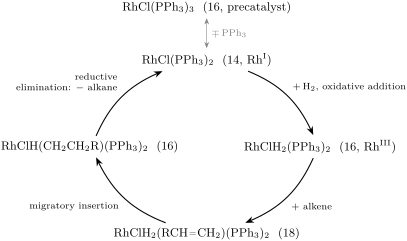
If () and () are fast equilibria and the reaction of the dihydride with the alkene (rate constant ) is rate-determining,
which saturates in hydrogen and is inhibited by added phosphine L.
Proof. and . Writing as the sum of the three species and solving for the dihydride gives ; the rate is times this and the alkene concentration. ∎
Wilkinson’s catalyst hydrogenates unhindered alkenes much faster than substituted ones and leaves carbonyl groups untouched: the selectivity of a crowded metal centre. Chiral diphosphines turn the same chemistry into asymmetric hydrogenation (Chapter 28).
21.2 Carbonylation processes
Definition 21.3 (Hydroformylation)
Hydroformylation is the addition of a hydrogen atom and a formyl group (CHO) across a C=C double bond, from and CO, turning an alkene into an aldehyde with one more carbon. The linear-to-branched ratio is the ratio of the straight-chain aldehyde to the branched one.
The first processes used at about 150 to and very high pressures. Rhodium with triphenylphosphine works at around and much lower pressures, and gives a higher linear-to-branched ratio: the bulky phosphines favour the insertion that puts the metal on the terminal carbon. Propene gives butanal, hydrogenated to butanol or converted to plasticiser alcohols.
Definition 21.4 (Carbonylation)
Carbonylation is the introduction of a carbonyl group into a molecule by reaction with carbon monoxide, catalysed by a metal complex through the migratory insertion of CO.
The carbonylation of methanol to acetic acid, , runs on rhodium (the Monsanto process) or iridium (the Cativa process) with methyl iodide as co-catalyst: hydrogen iodide turns methanol into methyl iodide, the metal inserts CO into the methyl group, and the acetyl iodide formed is hydrolysed, releasing HI again.
![The carbonylation cycle of methanol for M = Rh (Monsanto); valence electron counts in brackets, metal oxidation state I at the top, III elsewhere. With rhodium the oxidative addition of methyl iodide is rate-determining. With iridium (Cativa) it is much faster, the migratory insertion is slow, and promoters that remove one iodide from [CH3Ir(CO)2I3]- speed up the insertion.](/images/onecourse/chapters/chemistry-4/b3-homogeneous-catalysis/fig-1ceac772d602.svg)
Proposition 21.5 (Rate law of the rhodium process)
If the oxidative addition of methyl iodide to is rate-determining and this complex is the resting state, : zero order in CO and in methanol.
Proof. The rate is that of the slow step, , and almost all the rhodium is in the resting state. CO enters only after the slow step, and methanol only regenerates methyl iodide, whose steady concentration is set by the iodide charged to the reactor rather than by the methanol. ∎
Iridium won over rhodium in new plants for practical reasons: its complexes stay in solution at lower water concentrations, which saves energy in drying the product, and they give fewer by-products. The main side reaction of both is the water–gas shift, , catalysed by the same metal, which wastes carbon monoxide.
21.3 Olefin metathesis
Definition 21.6 (Olefin metathesis)
Olefin metathesis is the exchange of the alkylidene halves of two alkenes, , catalysed by metal carbene complexes through a metallacyclobutane, a four-membered ring of the metal and three carbons. Its synthetic forms are ring-closing metathesis (RCM), which joins two alkene ends of one molecule into a ring with loss of ethene, ring-opening metathesis polymerisation (ROMP) of strained cyclic alkenes, and cross metathesis between two different alkenes.
Definition 21.7 (Chauvin mechanism)
The Chauvin mechanism of metathesis is the cycloaddition of an alkene to a metal carbene, , giving a metallacyclobutane, followed by its cycloreversion in the other direction, which releases a new alkene and a new carbene.

Proposition 21.8 (Driving ring-closing metathesis)
For a ring closure , removing ethene from the solution drives the reaction to completion; the reaction is favoured by the entropy of releasing a gas molecule.
Proof. At equilibrium : if is kept low by purging or evacuating, grows without limit. The number of molecules increases by one in the reaction while the bonds made and broken (a C=C each) are alike: for an unstrained ring and , so is favourable. ∎
ROMP of strained rings, such as norbornene, runs the other way for the opposite reason: the release of ring strain pays for the loss of translational entropy. Robert Grubbs’s ruthenium carbenes tolerate water, air and most functional groups; Richard Schrock’s molybdenum and tungsten alkylidenes are more active and can be made enantioselective.
21.4 Palladium cross-coupling
Definition 21.9 (Cross-coupling reactions)
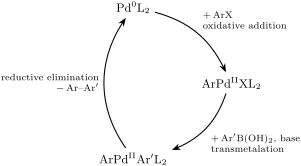
A cross-coupling reaction joins two different carbon fragments, an organic halide and an organometallic reagent or an alkene, on a metal catalyst, usually palladium. In the Heck reaction an aryl or vinyl halide couples with an alkene, giving a substituted alkene; in the Suzuki–Miyaura coupling it couples with an organoboron compound in the presence of a base.
Method 21.10 (Choosing a cross-coupling)
- Disconnect the target at the C–C bond to be made; one partner becomes the halide (iodide bromide triflate chloride in reactivity), the other the boronic acid (Suzuki–Miyaura), the alkene (Heck), the organozinc (Negishi) or the terminal alkyne with copper(I) (Sonogashira).
- Prefer the partner pair whose reagents are stable, available and least toxic: boronic acids for biaryls.
- Choose the ligand for the hardest step: electron-rich, bulky phosphines or N-heterocyclic carbenes speed the oxidative addition of chlorides.
- Plan the removal of palladium from the product to the low levels allowed in drugs (scavenger resins, crystallisation).
21.5 Polymerisation catalysis
Definition 21.11 (Ziegler–Natta catalysis)
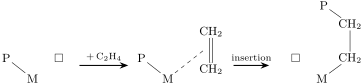
A Ziegler–Natta catalyst polymerises alkenes at low pressure; it is made from a transition-metal halide, typically of titanium, and an alkylaluminium compound. The Cossee–Arlman mechanism of chain growth is the coordination of the alkene at a vacant site cis to the growing alkyl chain on the metal, followed by its migratory insertion into the metal–carbon bond, which leaves a vacant site again. A single-site catalyst has all its active centres identical, as in a molecular metallocene catalyst.
Proposition 21.12 (Tacticity from catalyst symmetry)
For a metallocene catalyst on which the chain migrates between two coordination sites at each insertion, a -symmetric catalyst gives isotactic polypropylene and a -symmetric catalyst syndiotactic polypropylene.
Argued. The face of the propene that inserts is chosen by the chiral environment of the site. In a -symmetric catalyst the two sites are exchanged by the axis, which preserves handedness (Chapter 4): both sites select the same face, and successive methyl groups have the same configuration (isotactic). In a -symmetric catalyst the two sites are mirror images: they select opposite faces, and the configurations alternate (syndiotactic). A catalyst whose sites are achiral, such as unbridged with methylaluminoxane, gives atactic polymer. ∎
Proposition 21.13 (Schulz–Flory distribution)
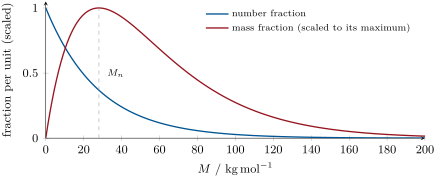
If each growing chain on a single-site catalyst adds a monomer with constant probability and is otherwise transferred (terminated), the number fraction of chains of units is , and the dispersity tends to 2 for long chains.
Proof. A chain of exactly units has grown times and stopped once: probability . Then (number average), and the mass fractions give the mass average . Their ratio is . ∎
In the lab — A Suzuki coupling and its palladium
The aryl bromide, the boronic acid (1.2 equivalents), potassium carbonate and a few tenths of a per cent of a palladium phosphine complex are stirred in a degassed mixture of toluene, ethanol and water under nitrogen at reflux. After work-up the crude biaryl is stirred with a thiol-functionalised silica that binds palladium, filtered and crystallised; the palladium left is measured by plasma mass spectrometry.
Safety


Methyl iodide: toxic by inhalation and ingestion, harmful in contact with skin, suspected carcinogen, volatile; handled in a fume hood. Carbon monoxide: extremely flammable, toxic by inhalation, may damage the unborn child, odourless; used with fixed detectors and alarms.
History — Ziegler, Natta, and metathesis
Karl Ziegler found in 1953 that titanium chloride and alkylaluminium compounds polymerise ethene at atmospheric pressure, and Giulio Natta in 1954 that such catalysts make stereoregular polypropylene; they shared the 1963 Nobel Prize in Chemistry. Yves Chauvin proposed the metallacyclobutane mechanism of metathesis in 1971; with Robert Grubbs and Richard Schrock, who made well-defined metathesis catalysts, he received the 2005 Nobel Prize in Chemistry.
21.6 Exercises
Exercise 21.1 ★
Give the valence electron count and the oxidation state of rhodium at each step of the Wilkinson cycle of the figure.
Solution
Solution of Exercise 21.1.
: 16, Rh(I) . : 14, Rh(I). : 16, Rh(III) . Alkene complex: 18, Rh(III). Alkyl hydride: 16, Rh(III). Reductive elimination returns to 14, Rh(I).
Exercise 21.2 ★
Name the two aldehydes formed by hydroformylation of propene. Which is the linear one?
Solution
Solution of Exercise 21.2.
Butanal, (linear), and 2-methylpropanal, (branched).
Exercise 21.3 ★
Diethyl diallylmalonate, , undergoes ring-closing metathesis. Give the product and the size of its ring.
Solution
Solution of Exercise 21.3.
Diethyl cyclopent-3-ene-1,1-dicarboxylate, a five-membered ring, with loss of ethene: the two terminal groups leave as and the two internal CH carbons join.
Exercise 21.4 ★
Give the product of the Heck reaction of iodobenzene with methyl acrylate, and its configuration.
Solution
Solution of Exercise 21.4.
Methyl (E)-3-phenylprop-2-enoate (methyl cinnamate): the aryl adds to the terminal carbon, and -hydride elimination, syn, from the more stable conformer gives the E alkene.
Exercise 21.5 ★★
Starting from the cycle of the rhodium process, derive its rate law, and explain why the methanol conversion does not change the rate until it is nearly complete.
Solution
Solution of Exercise 21.5.
The oxidative addition is slow and is the resting state, so . Methanol only regenerates methyl iodide by a fast reaction with HI; the total iodide charged sets , so the rate does not depend on the methanol concentration until there is too little methanol left to convert HI back into methyl iodide.
Exercise 21.6 ★★
Propose two Suzuki–Miyaura disconnections of 4-methylbiphenyl and choose one.
Solution
Solution of Exercise 21.6.
Phenylboronic acid with 4-bromotoluene, or 4-methylphenylboronic acid with bromobenzene. Both work; the first uses the cheapest boronic acid and a stable, common aryl bromide.
Exercise 21.7 ★★
Predict the tacticity of polypropylene made with a -symmetric bridged bis(indenyl)zirconium catalyst, a -symmetric one, and unbridged .
Solution
Solution of Exercise 21.7.
-symmetric: isotactic (both sites select the same face). -symmetric: syndiotactic (mirror-image sites alternate). Unbridged : atactic (achiral sites).
Exercise 21.8 ★★
With of catalyst, a hydrogenation reaches 98 % conversion in . Compute the turnover number and the mean turnover frequency.
Solution
Solution of Exercise 21.8.
; mean .
Exercise 21.9 ★★
Draw the repeating unit of the polymer made by ring-opening metathesis of norbornene, and explain why the reaction goes to completion.
Solution
Solution of Exercise 21.9.
The repeating unit is with the two CH groups on carbons 1 and 3 of a cyclopentane ring (poly(1,3-cyclopentylenevinylene)). The release of the strain of the bicyclic ring makes strongly negative, which outweighs the loss of translational entropy; no gas is formed, so the driving force is enthalpic.
Exercise 21.10 ★★★
A single-site catalyst gives chains with . Compute the number-average degree of polymerisation and the dispersity. Why is a Ziegler–Natta polymer broader?
Solution
Solution of Exercise 21.10.
; . A Ziegler–Natta catalyst has several kinds of sites, each with its own ; the sum of several Schulz–Flory distributions with different means is broader (dispersity often 4 to 8).
Exercise 21.11 ★★★
Show from the Wilkinson rate law that the rate is first order in at low pressure and independent of it at high pressure, and that adding phosphine slows the reaction.
Solution
Solution of Exercise 21.11.
At low pressure : , first order in . At high pressure the term dominates: , independent of . appears only in the denominator: added phosphine lowers by pushing rhodium back into the saturated precatalyst.
Exercise 21.12 ★★★
Explain why bulky phosphines raise the linear-to-branched ratio in rhodium hydroformylation, and why a high ratio matters for the plasticiser alcohols made from the aldehydes.
Solution
Solution of Exercise 21.12.
The insertion that puts rhodium on the internal carbon builds a secondary alkyl next to a crowded metal; bulky phosphines (and an excess of them, which keeps two on the metal) make that transition state worse than the one giving the primary alkyl, which leads to the linear aldehyde. Linear butanal is the one converted by aldol condensation and hydrogenation into the branched alcohol used in plasticisers; 2-methylpropanal is a lower-value by-product.
21.7 Problem: From Methanol to Vinegar
Problem 21.1
Weekend problem — from methanol to vinegar on an iridium cycle: the counts and steps of the cycle, its rate-determining step and promoters, a plant’s turnover frequency, and the carbon monoxide lost to the water–gas shift
An acetic acid plant (data of the problem) produces of acetic acid a year in of operation, with of reaction liquid containing of iridium. Its selectivity on carbon monoxide is 94 %: the rest is converted by the water–gas shift.
Part I — The cycle.
- Count the electrons of and give its oxidation state.
- Oxidative addition of : product, count, oxidation state?
- Loss of iodide and addition of CO: what neutral complex forms?
- Migratory insertion: product and count?
- Addition of iodide, then reductive elimination of acetyl iodide: what is regenerated?
- Write the two organic steps that close the cycle with water and methanol.
- Write the overall reaction.
Part II — Kinetics.
- Which step is rate-determining with iridium, and how does that differ from rhodium?
- How do promoters that capture iodide accelerate the cycle?
- What dependence on the iodide concentration does this predict?
- Why is the rate independent of the methanol concentration?
Part III — The plant.
- Compute the amount of acetic acid made per year.
- Compute the amount per hour.
- Compute the amount of iridium in the reactor, and its mass.
- Compute the turnover frequency.
- Compute the turnover number per year.
- Compute the space–time yield in kilograms per cubic metre per hour.
Part IV — The water–gas shift.
- Write the water–gas shift reaction.
- Compute the CO consumed per mole of acetic acid.
- Compute the formed per mole of acetic acid.
- Compute the mass of emitted per tonne of acetic acid.
- Why does running at lower water concentration help, and what limits it?
- What other product does the shift make, and why is it a problem in the reactor?
- State the result: the turnover frequency of the iridium catalyst.
Solution
Solution of Problem 21.1.
1. Ir(I), : electrons (neutral counting, with the charge).
2. , 18 electrons, Ir(III).
3. , 18 electrons, Ir(III).
4. , 16 electrons, Ir(III).
5. (18) eliminates , regenerating .
6. ; .
7. .
8. With iridium the migratory insertion is slow; the oxidative addition of methyl iodide, rate-determining with rhodium, is much faster on the more electron-rich iridium.
9. They remove one iodide from , giving the neutral tricarbonyl, in which the metal back-donates less and the methyl migrates faster onto a more electrophilic CO.
10. An inverse dependence on the free iodide concentration: iodide pushes the pre-equilibrium back to the slow anionic complex.
11. Methanol enters only after the rate-determining step, converted into methyl iodide by a fast reaction with HI.
12. : per year.
13. .
14. of iridium, .
15. , about .
16. per year.
17. .
18. .
19. of CO per mole of acetic acid.
20. of per mole of acetic acid.
21. One tonne is ; of .
22. Water is a reactant of the shift: less water slows it and saves the energy of drying the acid. Water is still needed to hydrolyse acetyl iodide and to keep the catalyst active and dissolved; with rhodium, low water precipitates rhodium iodide.
23. Hydrogen: it builds up in the gas, lowers the partial pressure of CO (so gas must be vented, losing CO), and can hydrogenate intermediates into by-products such as propionic acid.
24. The iridium catalyst turns over about : each iridium atom makes a thousand molecules of acetic acid an hour, some eight million a year.