All books

Professional

Apps About Coach Log in Start reading

Computer Science · Glossary

What is ASCII?

Definition 5.3 High School Computer Science · Chapter 5 — Text Encodings: From ASCII to UTF-8

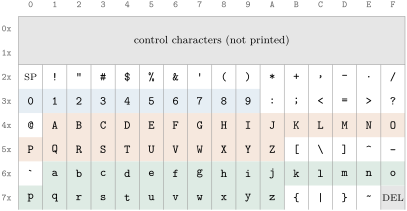
ASCII (American Standard Code for Information Interchange, 1968) is a code table of 128128 characters, numbered from 00 to 127127, so that each fits in 77 bits. Codes 00 to 3131 and 127127 are control characters (line feed, tabulation, …), which are not printed; codes 3232 to 126126 are the space, the digits, the English letters in both cases and punctuation. As an encoding, ASCII stores each character in one byte whose leftmost bit is 00.

The ASCII table in rows of 16: the row gives the first hexadecimal digit, the column the second. Digits (blue) start at 30, capital letters (orange) at 41 and small letters (green) at 61, exactly 20 hexadecimal, that is 32, further on.
The ASCII table in rows of 1616: the row gives the first hexadecimal digit, the column the second. Digits (blue) start at 30, capital letters (orange) at 41 and small letters (green) at 61, exactly 20 hexadecimal, that is 3232, further on.
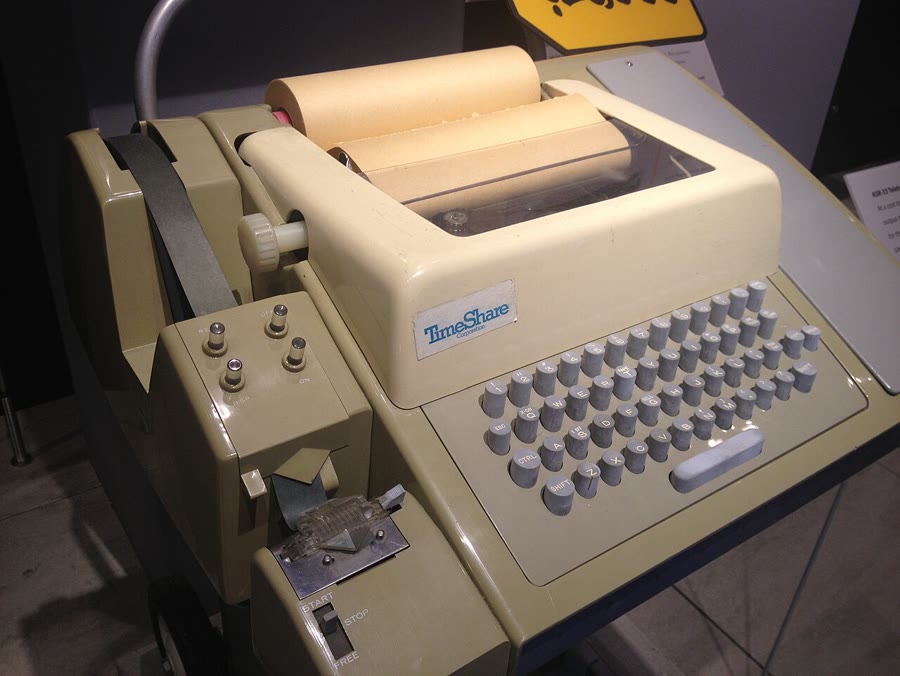
A Teletype ASR-33 teleprinter at the Computer History Museum: a keyboard below, and a printer on a roll of paper above. Photograph: Arnold Reinhold, CC BY-SA 3.0.
Read in context →