All books

Professional

Apps About Coach Log in Start reading

Earth and Space Sciences · Glossary

What is Airmass, atmospheric extinction coefficient?

Also known as: airmass · atmospheric extinction coefficient

Definition 2.3 University Earth and Space Sciences — Year 1 · Chapter 2 — Telescopes, Detectors and Photometry

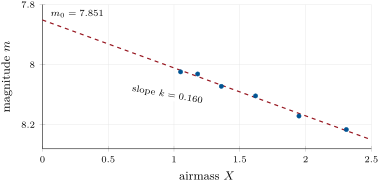
The airmass XX of an observation is the optical depth of the line of sight divided by the optical depth at the zenith: X=τ(z)/τ0X = \tau(z)/\tau_0. It equals 1 at the zenith and, for a plane-parallel atmosphere, X=sec⁡zX = \sec z. The atmospheric extinction coefficient kk in a given band is the dimming, in magnitudes, produced by one airmass, so that a star of magnitude m0m_0 above the atmosphere is observed at

m=m0+kX.m = m_0 + kX .
An extinction line: the magnitude of one star at six airmasses (dots) and the least-squares line, extrapolated to X = 0, the magnitude above the atmosphere. Magnitudes increase downward: a fainter star sits lower.
An extinction line: the magnitude of one star at six airmasses (dots) and the least-squares line, extrapolated to X=0X = 0, the magnitude above the atmosphere. Magnitudes increase downward: a fainter star sits lower.
Read in context →