University Earth and Space Sciences — Year 1 · Bachelor Year 1
2Telescopes, Detectors and Photometry
Everything astronomy knows about the stars, apart from a few meteorites and the samples brought back from the Moon and from asteroids, it has learnt from the light they send. That light crosses the Earth’s atmosphere, which absorbs whole ranges of wavelength and blurs the rest; it is gathered by a mirror whose size limits both how faint and how fine the details can be; it is counted by a detector that turns photons into electrons, and every count carries a statistical uncertainty. Before a brightness becomes a luminosity or a distance, each of these steps has to be understood and corrected. This chapter follows the light from the star to the number: the windows of the atmosphere and the extinction law, the telescope and the seeing, the detector and its noise, then the magnitudes, parallaxes and colours that turn measured fluxes into the properties of stars. The same atmosphere, seen from below, is the subject of the climate chapters (Chapter 27); the same photometry, applied to planets, opens the next chapter (Chapter 3).
You already know
A telescope’s objective collects light over its aperture and forms an image at its focus; diffraction by an aperture of diameter limits the smallest angle it separates to about , the Rayleigh criterion (the physics books’ Year 1 volume). A grating disperses light by wavelength (Year 2), and a source moving along the line of sight shifts its spectral lines by the Doppler effect (grade 12). A body in thermal equilibrium emits the black-body spectrum, whose peak obeys Wien’s law (Year 2). In chemistry, the absorbance of a solution grows in proportion to the path length.
2.1 The atmosphere’s windows
The atmosphere is transparent to some wavelengths and opaque to others. Radiation is absorbed mainly by water vapour, carbon dioxide and ozone, and at the shortest wavelengths by the atoms and molecules of the upper atmosphere themselves.
Definition 2.1 (Atmospheric window)
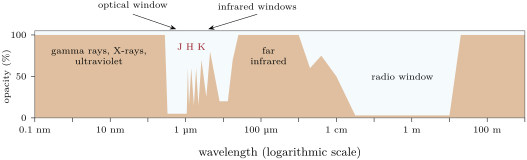
An atmospheric window is a range of wavelengths in which the atmosphere transmits most of the radiation that reaches its top down to the ground. The optical window extends from the near ultraviolet to the near infrared; the radio window from wavelengths of about a centimetre to about ten metres.
The figure below sketches the opacity of the atmosphere from gamma rays to long radio waves. Gamma rays, X-rays and ultraviolet below about never reach the ground: they are observed from space. Visible light passes, with some blurring. Most of the infrared is absorbed by water vapour and carbon dioxide, except in narrow windows that ground observatories at high, dry sites exploit; the near-infrared photometric bands sit in them, at , and . Wavelengths from about to a millimetre are blocked again; radio waves of a few centimetres to about ten metres pass, even through clouds; longer ones are reflected by the ionosphere.
Extinction
Even inside the optical window the atmosphere removes part of the light, by absorption and by scattering off molecules and aerosols. A thin layer of thickness along the ray removes a fraction of the intensity proportional to : , where the extinction coefficient (per metre) depends on the wavelength and on the composition of the air at that height. This is the law of the absorbance of a solution, applied to a column of air.
Proposition 2.2 (Bouguer’s law)
Along a ray through an absorbing medium, the intensity decreases as
where is the intensity entering the medium and , the optical depth of the path, is a pure number. For a plane-parallel atmosphere, a star at the zenith distance (the angle between its direction and the vertical) is seen through the optical depth , where is the optical depth at the zenith.
Proof. The equation separates: integrating from the top of the atmosphere (, ) to the observer gives . In a plane-parallel atmosphere depends on the height alone, and a ray inclined at to the vertical travels to climb . Hence . ∎
Definition 2.3 (Airmass, atmospheric extinction coefficient)
The airmass of an observation is the optical depth of the line of sight divided by the optical depth at the zenith: . It equals 1 at the zenith and, for a plane-parallel atmosphere, . The atmospheric extinction coefficient in a given band is the dimming, in magnitudes, produced by one airmass, so that a star of magnitude above the atmosphere is observed at
Magnitudes are defined in Section 2.4; all that is needed here is that a dimming by the factor adds magnitudes, so that . The plane-parallel airmass is excellent down to an altitude of about () and fails near the horizon, where grows without limit while the true path through a curved atmosphere stays finite; observers avoid low altitudes for that reason and for the blurring that grows with the path.
Method 2.4 (The extinction line)
To find the magnitude that a star would have above the atmosphere:
- measure the magnitude of the star, or of a standard star, at several airmasses through the night, as it rises or sets;
- compute each airmass from the zenith distance, ;
- plot against and fit a straight line by least squares;
- the slope is the extinction coefficient of the night in that band; the intercept at is .
The same then corrects every other star observed that night in the same band: .
Example 2.5
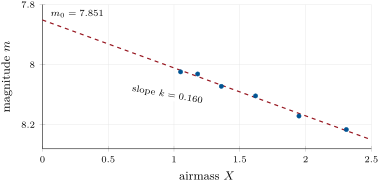
One night, a star was measured six times in the V band:
| 1.05 | 1.18 | 1.36 | 1.62 | 1.95 | 2.31 | |
| 8.024 | 8.031 | 8.072 | 8.104 | 8.171 | 8.216 |
The least-squares line, drawn in the figure below, has slope per airmass and intercept . The points scatter about it by magnitudes, the precision of a good night’s photometry. At the zenith the star is dimmed by magnitudes, a loss of of its light.
Seeing
The air above a telescope is never still. Cells of air of slightly different temperatures, and therefore of slightly different refractive indices, drift across the beam and bend it by small random angles, changing many times a second. The eye sees a star twinkle; a long exposure records a blurred spot much larger than the diffraction pattern of the telescope.
Definition 2.6 (Seeing)
The seeing at a site is the angular diameter of the image of a point source blurred by atmospheric turbulence in a long exposure, measured as the full width at half maximum of the image, in seconds of arc.
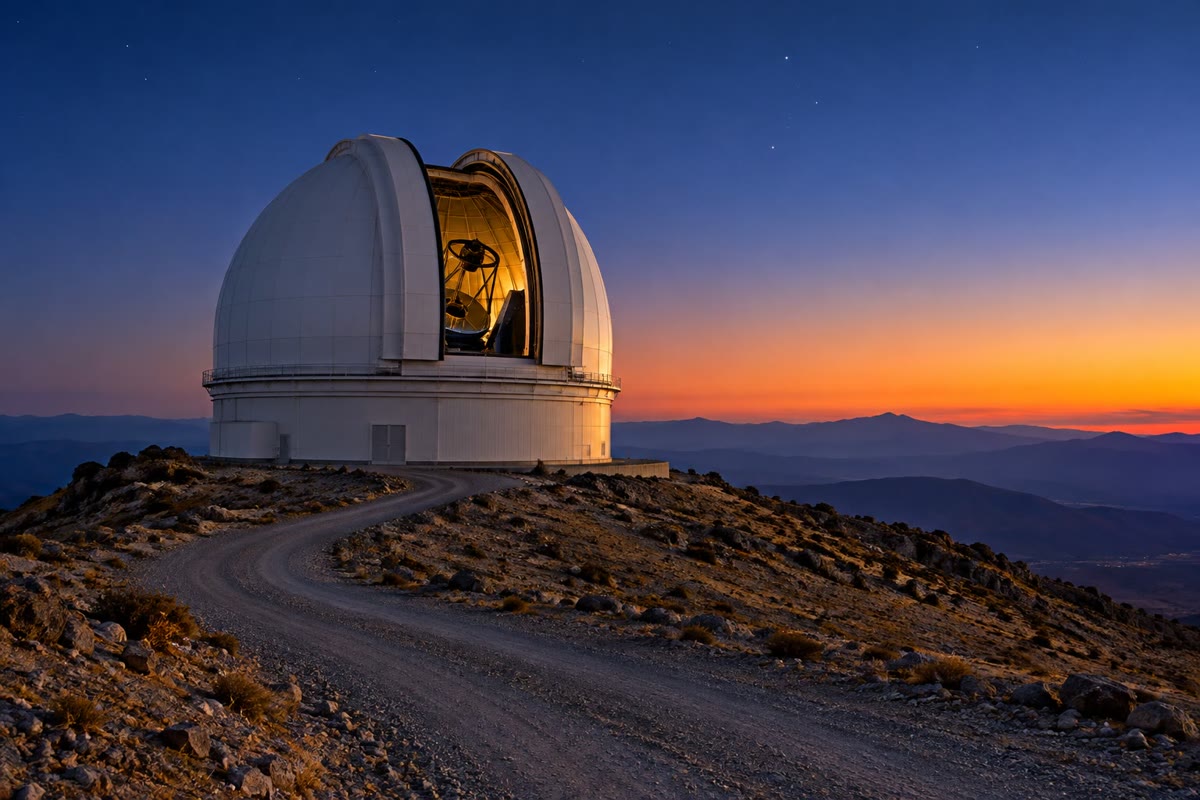
The seeing changes from night to night and from hour to hour. Sites are chosen for it: on the summit of Maunakea, at , the median seeing of the free atmosphere is about , from about in winter to in summer, with the best tenth of the nights below about ; the same site has a median of only of precipitable water vapour above it, which opens its infrared windows.
2.2 Telescopes and resolution
A telescope does two things: it collects light over the area of its objective, and it forms an image in which details are separated. The collecting area grows as : a mirror twice as wide gathers four times as many photons in the same time and reaches stars four times fainter. The resolution is limited by diffraction to about , and by the seeing.
Example 2.7
The Canada–France–Hawaii Telescope on Maunakea has an aperture of . At its diffraction limit is
ten times finer than the median seeing of at the same site. The two limits are equal for a mirror of diameter : any ground telescope wider than about is limited by the seeing, not by its own optics, at visible wavelengths.
A large ground telescope therefore gains collecting area, not sharpness, unless it corrects the turbulence. Adaptive optics does that: a sensor measures, many times a second, how the wavefront from a bright star (or from an artificial star made by a laser in the upper atmosphere) is distorted, and a thin mirror bent by many small actuators cancels the distortion. The correction works best in the infrared, where the turbulence is slower and weaker, and over a small field round the guide star. In space there is no seeing at all.
2.3 Detectors
The eye integrates light for a fraction of a second and responds to a small fraction of the photons that enter it. Photographic plates integrated for hours but recorded only a small fraction of the light. Modern astronomy uses photon detectors made of semiconductors, in which each absorbed photon of enough energy frees an electron.
Definition 2.8 (Quantum efficiency, signal-to-noise ratio)
The quantum efficiency of a detector at a given wavelength is the fraction of the incident photons that it records, as photoelectrons: . The signal-to-noise ratio of a measurement is the measured signal divided by its standard deviation, the typical size of its random error.
The charge-coupled device (CCD) is the standard detector of the optical window. It is a thin slab of silicon divided into a grid of pixels, each a potential well that stores the electrons freed by the photons absorbed in it during the exposure. At the end of the exposure, voltages applied in sequence to the electrodes shift the charges from pixel to pixel, row by row, to a single amplifier that measures them one by one; the image is the table of the counts. A CCD records a large fraction of the incident photons over most of the visible, its response is proportional to the light received up to a maximum charge per pixel (its full well), and it can integrate for hours. Infrared arrays work on the same principle with other semiconductors, read pixel by pixel.
Photons arrive at random. If a source sends on average photoelectrons during an exposure, the count actually recorded fluctuates from one exposure to the next with the standard deviation (Poisson statistics, admitted from probability: the counts of rare independent events).
Proposition 2.9 (Photon noise)
When photon noise from the source alone dominates, a source giving photoelectrons per second is measured in a time with the signal-to-noise ratio
it grows as the square root of the exposure time, and as the diameter of the telescope (since ). The error on the magnitude is then .
Proof. The signal is and its standard deviation . For the magnitude, , so a small error gives . ∎
To measure a magnitude to takes an SNR of about 109, that is about photoelectrons. For faint sources two other terms enter. The sky itself glows, and every pixel of the star’s image collects sky photons as well, at a rate ; and the amplifier adds a read noise to each pixel read. The full expression,
over the pixels of the image, reduces to for a bright star and to for a source fainter than the sky. Since grows with the area of the seeing disc, good seeing pays twice: a sharper image both separates more and collects less sky (Exercise 2.11).
In the field — A night at the telescope
Photometry is done with calibrations as much as with stars. Before the night an observer at a professional observatory takes bias frames (exposures of zero length, which record the electronic offset of each pixel) and flat fields (images of the evenly lit inside of the dome or of the twilight sky, which map how the sensitivity varies from pixel to pixel and across the field); the science images are corrected by subtracting the bias and dividing by the flat. Through the night, standard stars of known magnitudes are observed at several airmasses to fix the extinction line and the zero point that converts counts into magnitudes. A night is called photometric when the extinction stays steady enough for this correction to hold; on the summit of Maunakea, of the nights are photometric.
2.4 Fluxes and magnitudes
Definition 2.10 (Flux, luminosity)
The flux received from a source is the power of its radiation crossing a unit area held perpendicular to its direction, in watts per square metre; restricted to a band of wavelengths, it is the flux in that band. The luminosity of the source is the total power it radiates, in watts.
Proposition 2.11 (Inverse-square law)
A source of luminosity radiating equally in all directions, seen at a distance through empty space, gives the flux
Proof. In a steady state with no absorption, the power crossing any sphere centred on the source is the same, , by conservation of energy. By symmetry it is spread evenly over the sphere’s area . ∎
Example 2.12
The Sun’s luminosity is . At one astronomical unit, , its flux is : the solar irradiance that the Earth receives at the top of its atmosphere.
Fluxes span an enormous range, and astronomers compare them on a logarithmic scale inherited from the classes into which the stars visible to the eye were once sorted, the brightest of the first magnitude, the faintest of the sixth.
Definition 2.13 (Apparent magnitude, photometric band)
A photometric band is a range of wavelengths selected by a standard filter, named by a letter: U (ultraviolet), B (blue), V (visual), R (red), I (near infrared), and J, H, K in the infrared windows. The apparent magnitude of a source in a band is defined from its flux in that band by
with the zero point fixed by standard stars, close to the magnitude of the star Vega in each band. A difference of 5 magnitudes is a factor of exactly 100 in flux; one magnitude is a factor . Brighter sources have smaller, and possibly negative, magnitudes.
The pivot wavelengths of the standard U, B, V, R and I filters are , , , and .
In the V band, the Sun has the apparent magnitude , Sirius, the brightest star of the night sky, , and Vega . The Sun is therefore times brighter than Sirius in our sky; that says nothing yet about which of the two shines more, for which the distances are needed.
Parallax and the parsec
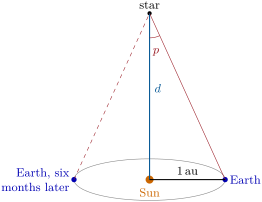
As the Earth goes round the Sun, a nearby star seems to move against the far more distant background stars, tracing in a year a small ellipse. That apparent motion is the most direct measurement of stellar distances: it uses the Earth’s orbit as a surveyor’s baseline.
Definition 2.14 (Annual parallax, parsec)
The annual parallax of a star is the angle subtended at the star by the radius of the Earth’s orbit, one astronomical unit, seen perpendicular to the line of sight; it is the semi-major axis of the yearly ellipse the star appears to trace. The parsec () is the distance at which one astronomical unit subtends one second of arc:
Since is tiny, in radians, and the distance follows at once:
Sirius has a parallax of , so it lies at , . Even the nearest stars have parallaxes below one second of arc, smaller than the seeing: the parallax is found from the shift of the centre of the star’s image, which many photons locate far more precisely than the width of the image. A space mission described at the end of this chapter has measured the positions of nearly two billion objects in this way.
Definition 2.15 (Absolute magnitude, distance modulus)
The absolute magnitude of a star in a band is the apparent magnitude it would have at the distance of , seen through empty space. The difference is its distance modulus.
Proposition 2.16 (The distance modulus)
For a star at the distance seen through empty space,
If the light is dimmed on its way by magnitudes of extinction, . In a band, the ratio of the luminosities of two stars is .
Proof. By the inverse-square law the flux at and the flux at are in the ratio . The definition of magnitudes gives . Extinction multiplies the flux by , which adds to . At the common distance of , fluxes are in the ratio of luminosities, and . ∎
The Sun has the absolute magnitude and the luminosity . Comparing a star’s absolute magnitude in V with the Sun’s gives its luminosity in V in solar units, — a V-band luminosity, since a star much hotter or cooler than the Sun puts a different share of its power outside the V band.
Colour
Definition 2.17 (Colour index)
The colour index of a star is the difference of its magnitudes in two bands, the bluer first; the most used is . A small or negative marks a blue star, a large one a red star.
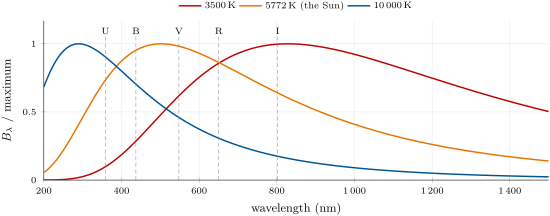
The colour index does not depend on the distance, since the inverse-square law dims both bands alike; it measures the shape of the spectrum, hence the temperature of the star’s surface. A star radiates roughly as a black body whose spectrum peaks at (Wien’s law, with , admitted from the physics books’ Year 2 volume). The figure below draws three black-body spectra: a cool body at peaks in the near infrared and gives more flux in V than in B; the Sun’s effective temperature, , puts its peak at , between B and V; a body at peaks in the ultraviolet and is brighter in B than in V. The ratio of the B and V radiances rises steadily with temperature, from to and for the three curves, which is why falls as rises.
Four bright stars show the range of colours:
| star | parallax () | |||
|---|---|---|---|---|
| Rigel | 0.13 | 0.10 | 3.78 | |
| Altair | 0.76 | 0.98 | 0.22 | 194.95 |
| Polaris | 2.02 | 2.62 | 0.60 | 7.54 |
| Betelgeuse | 0.42 | 2.27 | 1.85 | 6.55 |
Rigel is blue-white and Betelgeuse, in the same constellation, orange-red: a colour difference visible to the naked eye. Their spectral types, B8 and M1–M2, say the same in the language of spectra, the subject of the Year 3 volume.
2.5 Spectrographs
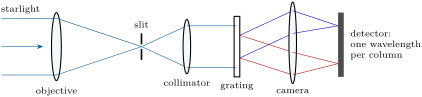
Photometry measures the light in a few broad bands; a spectrograph spreads it into a spectrum. Light from the telescope’s focus passes through a narrow slit, is made parallel by a collimator, is dispersed by a grating (or a prism), and is focused by a camera onto a detector, where each wavelength falls on a different column of pixels (see the figure below). A grating with lines illuminated, used in the order , separates two wavelengths apart when , its resolving power (recalled from the physics books’ Year 2 volume).
A spectrum carries three kinds of information. Its lines, dark where atoms and ions of the star’s atmosphere absorb, bright where a hot thin gas emits, identify the chemical elements present. The shape of its continuum, and the relative strengths of lines formed at different temperatures, give the temperature of the gas. And the Doppler shift of the lines gives the velocity along the line of sight: a line of rest wavelength is shifted by for a radial velocity much smaller than . Measuring to needs a resolving power of the order of , or a moderate resolving power and many lines measured together. How spectra reveal the structure, composition and motions of stars and galaxies is the subject of the Year 3 volume.
2.6 Observing from space
Above the atmosphere there are no closed windows, no extinction, no seeing, and in the infrared no glow of warm air. Space telescopes pay for this with cost, with the limited mass and size that a rocket can launch, and, for most of them, with the impossibility of repair. They are used where the ground cannot compete: for gamma rays, X-rays and ultraviolet light, which never reach the ground; for the infrared beyond the narrow windows; for images at the diffraction limit over a wide field; and for measurements, such as the parallaxes of very many stars, that need a stable instrument outside the turbulent air.
Figures as of 2026
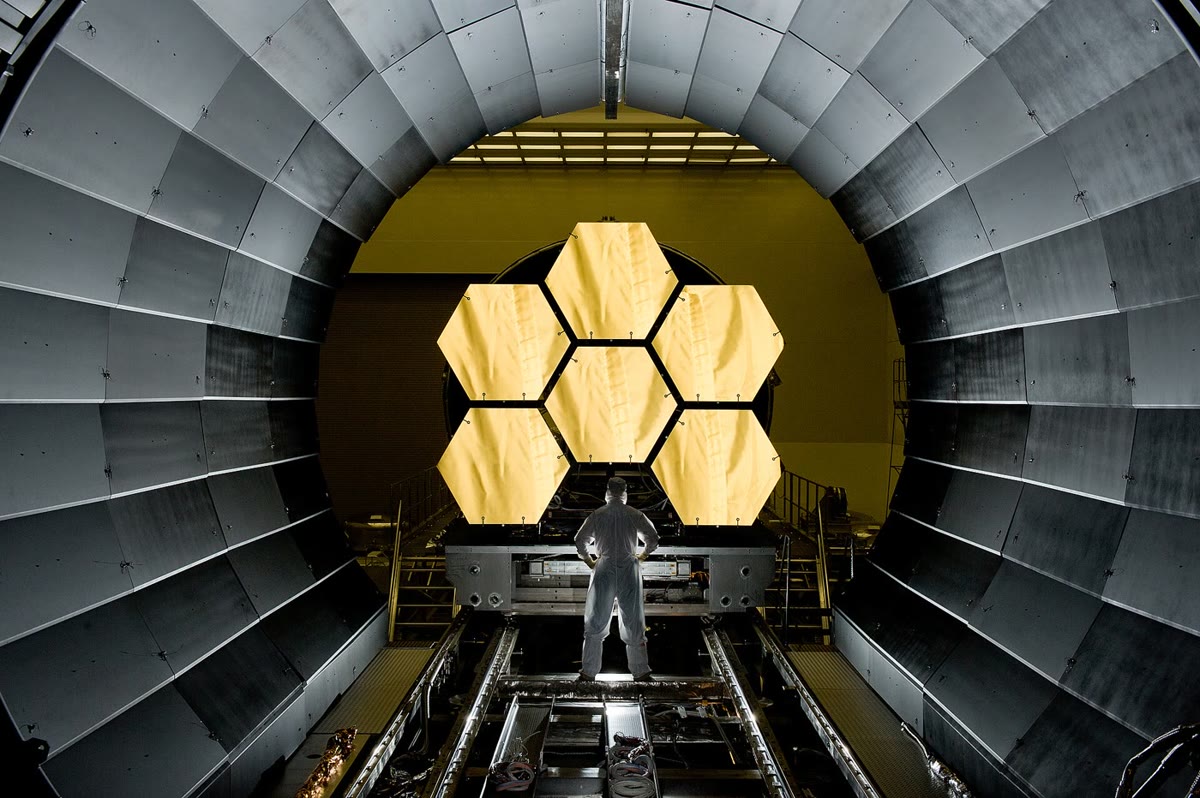
Three space observatories show the range. The Hubble Space Telescope, launched in 1990, has a primary mirror across. The James Webb Space Telescope, launched on 25 December 2021, has a primary mirror across made of 18 hexagonal segments, with a collecting area of ; it works from to and orbits the Sun near the second Lagrange point, L2, million kilometres from the Earth on the side away from the Sun. Gaia, launched on 19 December 2013 to the same region, used two telescopes on a common focal plane of CCDs to map the positions and motions of nearly two billion objects in three dimensions; its observations are finished, and its catalogues are being released.
2.7 Exercises
Exercise 2.1 ★
What is the ratio of the fluxes of two stars of magnitudes 1.0 and 6.0? Of Rigel () and Polaris ()? Which is brighter in the sky?
Solution
Solution of Exercise 2.1.
A difference of 5 magnitudes is a factor of 100: the star of magnitude 1.0 sends 100 times more flux. Rigel and Polaris: ; Rigel, with the smaller magnitude, is brighter.
Exercise 2.2 ★
The parallax of Altair is . Give its distance in parsecs, in astronomical units and in light-years.
Solution
Solution of Exercise 2.2.
, that is and .
Exercise 2.3 ★
Compute the diffraction limit of a space telescope at , in seconds of arc, and compare it with a seeing of . Do the same for a telescope at .
Solution
Solution of Exercise 2.3.
, about seven times finer than a seeing of : in space the telescope reaches its diffraction limit. For at : .
Exercise 2.4 ★
From the table of the four bright stars, rank Rigel, Altair, Polaris and Betelgeuse from the hottest surface to the coolest. Why can the colour index be compared between stars at very different distances?
Solution
Solution of Exercise 2.4.
rises from Rigel () to Altair (0.22), Polaris (0.60) and Betelgeuse (1.85): the hottest is Rigel, then Altair, Polaris and Betelgeuse. Distance dims both bands by the same factor, so is unchanged by it (as long as no dust reddens the light on the way).
Exercise 2.5 ★★
A star is measured at the magnitude 6.412 at the zenith distance and at 6.590 at on the same night. Assuming a plane-parallel atmosphere, compute the two airmasses, the extinction coefficient and the magnitude of the star above the atmosphere.
Exercise 2.6 ★★
A star gives 400 photoelectrons in a exposure, and photon noise from the star alone dominates. What is the signal-to-noise ratio? How long must one expose to reach an SNR of 100? To measure the magnitude to ?
Solution
Solution of Exercise 2.6.
. The SNR grows as : for 100, . An error of magnitude needs , so .
Exercise 2.7 ★★
Rigel has and a parallax of . Neglecting extinction between it and us, compute its distance, its absolute magnitude and its V-band luminosity in solar units ().
Exercise 2.8 ★★
Compare the collecting areas of a circular mirror (ignore its central obstruction) and of the Webb telescope (). How much shorter is the exposure in which the Webb telescope collects the same number of photons? What fraction of a full disc across does its collecting area represent, and why is it less than one?
Solution
Solution of Exercise 2.8.
, and : the Webb telescope collects the same number of photons in an exposure 5.5 times shorter. A full disc across would have ; the real mirror has of it, because 18 hexagons leave the edge of that disc uncovered and the gaps between segments and the central opening collect nothing.
Exercise 2.9 ★★
(a) From the Sun’s luminosity, , compute its flux at . (b) The Sun’s apparent and absolute magnitudes are and . Use the distance modulus to recover the Sun–Earth distance, in astronomical units.
Solution
Solution of Exercise 2.9.
(a) , and , times less than at the Earth. (b) , so , that is .
Exercise 2.10 ★★★
Show from Proposition 2.2 that . For the night of the extinction line (), compute the zenith optical depth and the fraction of the light that reaches the telescope at the zenith and at . What would a plane-parallel atmosphere predict for the airmass at a zenith distance of , and why should that value not be trusted?
Solution
Solution of Exercise 2.10.
Above the atmosphere the flux is ; below, . Then , which is with . For : . At the zenith of the light arrives, ; at , , . At , ; but the plane-parallel model makes the path infinite at the horizon, whereas the path through a curved atmosphere stays finite, and refraction bends the ray as well: near the horizon the formula overestimates the airmass and its errors grow fast.
Exercise 2.11 ★★★
A faint galaxy gives photoelectrons per second in a telescope, and the sky in the area of its image gives per second when the seeing is . Read noise is negligible. (a) How long must one expose for an SNR of 10? (b) The sky in the image grows as the area of the seeing disc. Repeat for a seeing of . (c) Show that, for a source much fainter than the sky, the exposure time needed for a given SNR varies as , where is the seeing and the diameter of the telescope.
Solution
Solution of Exercise 2.11.
(a) , so . (b) Halving the seeing divides the area of the image, hence , by 4: and . (c) For , . The source rate grows as ; the sky rate grows as the collecting area times the sky area of the image, . Hence : halving the seeing is worth as much as doubling the diameter.
Exercise 2.12 ★★★
A grating with 1200 lines per millimetre is illuminated over and used in the first order. (a) What is its resolving power, and the smallest separable wavelength difference at ? (b) What radial velocity does that difference correspond to? (c) The Earth moves round the Sun at . By how much can that motion shift a line at , and how many resolution elements is that? What must an observer measuring a star’s velocity therefore do?
Solution
Solution of Exercise 2.12.
(a) lines; in the first order the resolving power is , and . (b) . (c) , about 12 resolution elements. The observer must compute, for the date and time of the observation, the component of the Earth’s orbital velocity toward the star, and subtract it, to give the star’s velocity relative to the Sun.
2.8 Problem: Weighing the light of Sirius
Problem 2.1
Weekend problem — how far Sirius is, how bright it looks and how many photons it sends, and how many suns it outshines
Sirius, the brightest star of the night sky, has a faint companion, the white dwarf Sirius B. Use the data:
| object | parallax | |
|---|---|---|
| Sirius | ||
| Sirius B | — | |
| Vega | ||
| the Sun | — |
with in V, , and an extinction coefficient per airmass at the observatory.
Part I — How far is Sirius?
- Compute the distance of Sirius in parsecs.
- Express it in astronomical units and in metres.
- Express it in light-years. How long ago did the light we see tonight leave Sirius?
- Over a year, by what total angle does the direction of Sirius swing from side to side? Compare it with a seeing of . Why can the swing still be measured to a small fraction of the seeing?
- If the parallax were wrong by , by what fraction would the distance be wrong, and by how many light-years?
Part II — How bright does it look?
- Compute the ratio of the fluxes of Sirius and Vega in V.
- Compute the ratio of the fluxes of the Sun and Sirius.
- Compute the ratio of the fluxes of Sirius and of Sirius B.
- From the Paranal Observatory, Sirius crosses the meridian at an altitude of (Chapter 1). Compute the airmass, the extinction, and the magnitude measured at that moment.
- Repeat at an altitude of . What fraction of the light is lost on the way?
- Why would the formula mislead an observer measuring Sirius just after it rises?
Part III — Counting photons. A camera on a telescope records photoelectrons per second from a star of magnitude , once corrected for extinction. Each pixel holds at most electrons (its full well).
- How many photoelectrons per second does the camera record from Sirius B?
- How long an exposure gives Sirius B an SNR of 1000, with photon noise from the star alone? What is then the error on its magnitude?
- How many photoelectrons per second does the camera record from Sirius?
- If of the light of Sirius falls in its brightest pixel, how long does that pixel take to fill?
- On the image, the faint wings of Sirius’s image deposit, at the place of Sirius B, of the light of Sirius per pixel, and Sirius B’s brightest pixel collects of its own light. Compare the two rates in that pixel.
- What is the longest exposure that does not saturate that pixel? Compute the SNR of Sirius B in that pixel in an exposure of , counting the photon noise of both sources. Is Sirius B detectable, and what makes it hard?
Part IV — How many suns?
- Compute the distance modulus of Sirius.
- Deduce the absolute magnitude of Sirius in V, to two decimals.
- Compute the distance and the absolute magnitude of Vega.
- Which of Sirius and Vega is intrinsically more luminous in V, and by what factor?
- What would be the apparent magnitude of the Sun seen from the distance of Sirius? Taking 6.0 as the faintest magnitude visible to the naked eye on a dark night, would it be visible?
- Out to what distance would Sirius remain visible to the naked eye?
- Compute the V-band luminosity of Sirius in solar units: how many suns does Sirius outshine?
Solution
Solution of Problem 2.1.
1. .
2. ; .
3. : the light left Sirius 8.6 years ago.
4. The direction swings by , about twice the seeing. The swing is measured from the position of the centre of the image, not from its edge: averaged over many photons, the centre is found to a small fraction of the image’s width, the more precisely the more photons are counted.
5. , that is .
6. .
7. .
8. .
9. , ; extinction magnitude; measured .
10. , ; extinction 0.30 magnitude, . The fraction transmitted is : of the light is lost.
11. At rising and is infinite, while the real path through the curved atmosphere is long but finite; refraction also bends the ray. Near the horizon the extinction is large and changes fast, and the plane-parallel correction is wrong.
12. photoelectrons per second.
13. An SNR of 1000 needs photoelectrons: . The magnitude error is .
14. photoelectrons per second.
15. per second in the brightest pixel, which fills in , less than half a millisecond.
16. The wings of Sirius give per second; Sirius B gives per second. The glare of Sirius is 4.6 times brighter than the peak of Sirius B.
17. The pixel receives per second and fills in . In : signal , total , noise , so . Sirius B is detectable as far as photon noise goes; what makes it hard is that the glare must be known and subtracted to much better than a fifth of its value, while the core of Sirius saturates in under a millisecond.
18. .
19. .
20. ; , so .
21. Vega, with the smaller absolute magnitude, by the factor . Sirius looks brighter only because it is nearer.
22. : the Sun would be a fairly bright naked-eye star.
23. , so , about .
24. : in the V band, Sirius outshines about 23 suns.