সব বই

পেশাদার

1 Markets I: The Ecosystem and Exchange-Traded Marketsবাজার অনলাইন 2 Markets II: Rates, FX and Creditবাজার অনলাইন 3 Markets III: Commodities, Energy and Cryptoবাজার অনলাইন 4 Quantitative Methodsপদ্ধতি অনলাইন 5 Derivatives and Volatilityডেরিভেটিভস অনলাইন 6 Rates, Credit, XVA and Riskসুদহার, ঋণ ও ঝুঁকি অনলাইন 7 Research Craft: Predictors, Backtests, Measurement, Portfoliosগবেষণা অনলাইন 8 Strategies I: Equities and Futuresকৌশল অনলাইন 9 Strategies II: Volatility, Relative Value, Macro and the Bank Desksকৌশল অনলাইন 10 Microstructure and Executionএক্সিকিউশন অনলাইন 11 Market Making and High-Frequency Tradingমার্কেট মেকিং অনলাইন 12 Machine Learning for Marketsমেশিন লার্নিং অনলাইন 13 Low-Latency Softwareপ্রযুক্তি অনলাইন 14 Networks, Hardware and Trading Infrastructureপ্রযুক্তি অনলাইন 15 Research, Data and Risk Platformsপ্রযুক্তি অনলাইন 16 The Desk and the Firmপ্রতিষ্ঠান অনলাইন 17 The Industry: Firms, Roles and Careersক্যারিয়ার অনলাইন 18 Interviews I: Maths, Probability and Speedক্যারিয়ার অনলাইন 19 Interviews II: Markets, Trading Games and the Final Roundক্যারিয়ার অনলাইন 20 Interviews III: Codeক্যারিয়ার অনলাইন
অ্যাপ পরিচিতি Coach সাইন ইন পড়া শুরু করো

বইগুলো এখনো বাংলা ভাষায় পাওয়া যায় না — ইংরেজি সংস্করণ দেখানো হচ্ছে।

Earth and Space Sciences · পরিভাষা

Apparent resistivity; electrode array; vertical electrical sounding; electrical resistivity tomography কী?

অন্য নাম: apparent resistivity · electrode array · vertical electrical sounding · electrical resistivity tomography

Definition 31.10 University Earth and Space Sciences — Year 3 · অধ্যায় 31 — Field and Lab Methods III
  • The apparent resistivity of a four-electrode measurement is ρa=K ΔVMN/I\rho_a = K\,\Delta V_{MN}/I, with the geometric factor K=2π/(1/AM−1/BM−1/AN+1/BN)K = 2\pi/(1/AM - 1/BM - 1/AN + 1/BN): the resistivity of the uniform ground that would give the same reading.
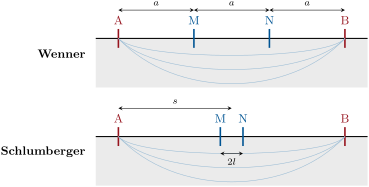
  • An electrode array is a rule that places the four electrodes: the Wenner array puts them equally spaced, aa apart, in the order AMNB; the Schlumberger array puts M and N, 2l2l apart, at the centre of a much longer AB, of half-length ss; dipole–dipole, pole–dipole and pole–pole arrays separate the current pair from the potential pair or send one electrode far away.
  • A vertical electrical sounding expands an array about a fixed centre and plots ρa\rho_a against the spacing on logarithmic scales: the larger the spacing, the deeper the current flows.
  • Electrical resistivity tomography plants many electrodes along a line, measures many four-electrode combinations, and inverts them together for a section of resistivity.
The two sounding arrays. Current enters at A and leaves at B (red); the potential difference is measured between M and N (blue); the faint lines are lines of current. The Wenner array keeps the three spacings equal; the Schlumberger array keeps MN short and expands AB.
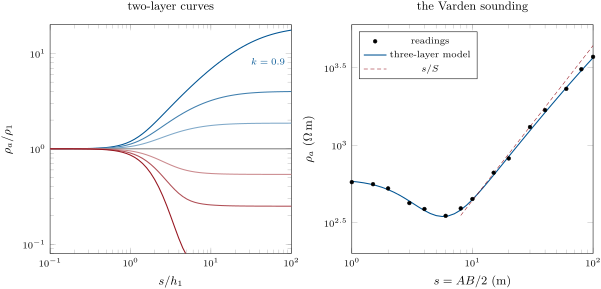
Left: Schlumberger curves over two layers, for reflection factors k from 0.9 (resistive base, blue, top) to -0.9 (conductive base, red, bottom). Right: the sounding on the Varden valley floor, its readings and the model that produced them (dry alluvium over saturated alluvium over granite), with the line _a = s/S of the whole alluvium.
Left: Schlumberger curves over two layers, for reflection factors kk from 0.90.9 (resistive base, blue, top) to −0.9-0.9 (conductive base, red, bottom). Right: the sounding on the Varden valley floor, its readings and the model that produced them (dry alluvium over saturated alluvium over granite), with the line ρa=s/S\rho_a = s/S of the whole alluvium.
প্রসঙ্গসহ পড়ো →