
All books

Professional

Apps About Coach Log in Start reading

Earth and Space Sciences · Glossary

What is Base level and knickpoint?

Also known as: base level · knickpoint

Definition 18.13 University Earth and Space Sciences — Year 3 · Chapter 18 — Quantitative Geomorphology

The base level of a river is the elevation of its outlet, below which it cannot cut: the sea, a lake, or the trunk river it joins. A knickpoint is a place where the gradient of a river’s long profile increases abruptly, from a steepened reach to a waterfall.
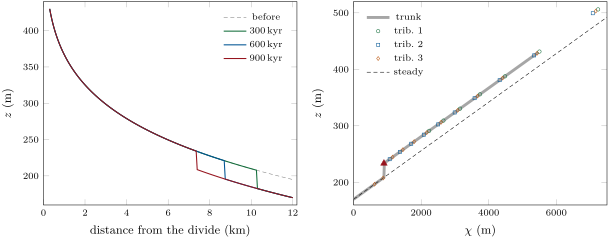
Left, the upland river after a fall of 25\, m of its base level (n = 1): the knickpoint, a waterfall of constant height, reaches 1.7, 3.3 and 4.6\, km above the outlet after 300, 600 and 900\, kyr; below it the river has the old shape, 25\, m lower. Right, chi plot (A_0 = 1\, km2, = 0.5) of the trunk and three tributaries at 900\, kyr: below = 900\, m every channel lies on the steady-state line through the outlet (dashed), above it on the old line, 25\, m higher. The waterfalls of the trunk and of tributary 3 sit at the same  (red triangle); tributaries 1 and 2 join the trunk above it and have not yet been reached.
Left, the upland river after a fall of 25 m25\,\mathrm{m} of its base level (n=1n = 1): the knickpoint, a waterfall of constant height, reaches 1.7, 3.3 and 4.6 km4.6\,\mathrm{km} above the outlet after 300, 600 and 900 kyr900\,\mathrm{kyr}; below it the river has the old shape, 25 m25\,\mathrm{m} lower. Right, chi plot (A0=1 km2A_0 = 1\,\mathrm{km}^{2}, θ=0.5\theta = 0.5) of the trunk and three tributaries at 900 kyr900\,\mathrm{kyr}: below χ=900 m\chi = 900\,\mathrm{m} every channel lies on the steady-state line through the outlet (dashed), above it on the old line, 25 m25\,\mathrm{m} higher. The waterfalls of the trunk and of tributary 3 sit at the same χ\chi (red triangle); tributaries 1 and 2 join the trunk above it and have not yet been reached.
Read in context →