
All books

Professional

Apps About Coach Log in Start reading

Earth and Space Sciences · Glossary

What is Calcareous ooze, siliceous ooze?

Also known as: calcareous ooze · siliceous ooze

Definition 22.5 University Earth and Space Sciences — Year 1 · Chapter 22 — Carbonate, Siliceous and Evaporite Sediments

An ooze is a fine-grained pelagic sediment, laid down in the open ocean, made mostly of the skeletons of plankton. It is a calcareous ooze when they are of calcium carbonate, chiefly coccoliths and foraminifera, and a siliceous ooze when they are of opal, hydrated amorphous silica, chiefly diatoms and radiolarians.
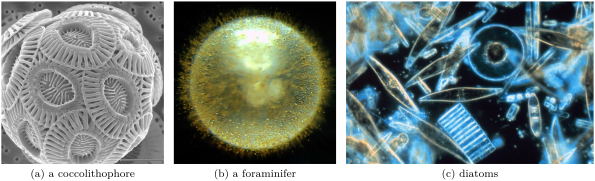
The makers of oozes. (a) A single cell of Emiliania huxleyi armoured with coccoliths, its plates of calcite (scanning electron microscope; Alison R. Taylor, University of North Carolina Wilmington, CC BY 2.5, via Wikimedia Commons). (b) A living planktonic foraminifer, Orbulina universa, its calcite shell surrounded by spines (light microscope; H. Takagi and co-authors, 2019, CC BY 4.0, via Wikimedia Commons). (c) Living diatoms from the sea ice of McMurdo Sound, Antarctica, each in its frustule of opal (light microscope; Gordon T. Taylor, Stony Brook University, NOAA, public domain, via Wikimedia Commons).
Read in context →