书籍暂未推出简体中文版——当前显示英文版。
University Earth and Space Sciences — Year 1 · 本科一年级
22Carbonate, Siliceous and Evaporite Sediments
The white cliffs of chalk that face each other across the narrow sea between England and France look like the most ordinary of rocks. Under the electron microscope they turn out to be made of countless tiny plates of calcite, shed by single-celled algae that floated in the sea that covered the region. A reef seen from a boat is the same story at the other end of the scale: a limestone in the making, built by corals and algae that take calcium and carbonate from the water and turn them into stone. Not all sediments are carried; many are made where they lie, by living things or by the water itself as it evaporates. This chapter follows the three great families of these sediments — carbonates, siliceous oozes and evaporites — from the chemistry of the sea that feeds them to the rocks they leave.
You already know
Limestone is a sedimentary rock made of calcite, often from shells, and it fizzes in dilute acid (Book 1, grade 6). Calcite and aragonite are the two polymorphs of , of densities and , and dolomite , of density , is the carbonate of calcium and magnesium (Chapter 7). The salinity of seawater is the mass of salt dissolved in a kilogram of it (Book 1, grade 8). In water, carbon dioxide, hydrogen carbonate and carbonate ions are linked by acid–base equilibria, and the alkalinity measures the bases able to take up hydrogen ions (the chemistry books); the ocean’s carbonate system takes part in the carbon cycle (the biology books). The sea floor deepens with age as (Theorem 13.7).
22.1 The carbonate factory
Seawater holds calcium and dissolved inorganic carbon, mostly as hydrogen carbonate. Calcium carbonate forms from them by the reactions
the first releasing a molecule of carbon dioxide for each one of carbonate laid down. Warm surface water of the tropics is supersaturated in calcium carbonate, but it seldom precipitates by itself: almost all of it is made by living things, which pay the energy to build their shells and skeletons and control the mineral they use. Corals and green algae build aragonite; red algae and many foraminifera build calcite, some of it rich in magnesium; molluscs use one or both.
Definition 22.1 (Carbonate factory)
The carbonate factory of a sea is the set of organisms and processes that produce calcium carbonate sediment where it is found, rather than bringing it from elsewhere. Its products are skeletal grains (whole or broken shells and skeletons), carbonate mud, coated grains and the rigid frameworks of reefs.
The richest factory works in warm, clear, shallow and sunlit water, far from the mud of rivers, which would bury the producers and cloud the light the algae need. Its sediment is made by the sea floor itself: coral and algal debris, the shells of molluscs and of the single-celled foraminifera that live on the bottom, and needles of aragonite shed by green algae, which settle as a lime mud. Where the water is agitated and supersaturated, grains rolled about by the waves and tides grow coats of carbonate, layer on layer, around a nucleus, a sand grain or a fragment of shell, into round ooids (Definition 22.3). A second factory works in the open ocean, far from any shore: the plankton that live in the sunlit surface layer build tiny calcite shells and plates that rain down to the deep sea floor (Section 22.3).
How fast a factory builds is measured by its carbonate budget, the mass of carbonate produced and kept in place each year on a square metre, after the losses to boring organisms, grazers and the waves. It turns into a vertical rate of growth by a mass balance.
Proposition 22.2 (Accretion from a carbonate budget)
Let a sea floor keep in place the net mass of calcium carbonate per unit area and per unit time, as a deposit whose solid grains have the density and whose porosity, the fraction of its volume taken by pores, is . Then the floor rises at the rate
Proof. In the time a unit area receives the mass of solid carbonate, which fills the volume of grains. These grains make up the fraction of the new layer, whose thickness is therefore . Dividing by gives . ∎
The product is the dry bulk density of the deposit. On the reefs of the Chagos Archipelago in the Indian Ocean, 28 reefs measured in 2015 had an average budget of of per square metre and per year, and those dominated by branching Acropora corals , growing at about a year; with the proposition, these two numbers together mean a dry bulk density of , that is a reef framework about a third pore space (Exercise 22.3). The same reefs had lost more than nine tenths of their corals in the warming event of 1998, and their budgets show how fast a reef can rebuild.
22.2 Reefs and platforms
Where the factory builds a rigid framework, it can stand up from the sea floor against the waves.
Definition 22.3 (Reef, carbonate platform, ooid)
A reef is a carbonate build-up whose framework of organisms, corals, algae or others, grown in place and bound and cemented together, stands above the surrounding sea floor and resists the waves. A carbonate platform is a thick body of shallow-water carbonate whose flat top lies close to sea level and which is bounded by a slope down to deeper water. An ooid is a round grain of sand size made of concentric layers of calcium carbonate grown around a nucleus as it rolled in agitated water; a rock made of ooids is an oolite.
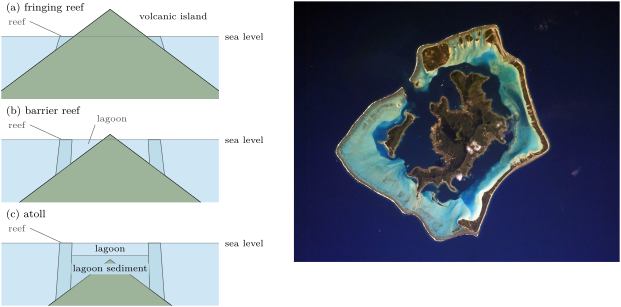
Modern coral reefs come in three kinds, named by the voyagers who mapped them long before anyone drilled through one. A fringing reef is attached to the shore of an island or a continent. A barrier reef is separated from the land by a lagoon, which can be wide and tens of metres deep: the barrier off north-eastern Australia runs, with breaks, for nearly a thousand miles, enclosing a sea 10 to 25 fathoms deep, about 18 to . An atoll is a ring of reef, bearing low islands of coral sand, around a lagoon with no land in it at all.
History — Reefs on sinking foundations, 1837–1842
In the course of the voyage of the Beagle, Charles Darwin sailed among the reefs of the Pacific and Indian Oceans. He reasoned from one fact: reef-building corals, he concluded, do not in ordinary cases flourish deeper than between 20 and 30 fathoms, about 37 to . Yet barrier reefs and atolls rise from deep water, far below that limit. Their foundations, he argued, must have sunk, slowly enough for the corals to keep their tops at the surface by growing upward: a reef that fringes a volcanic island becomes a barrier as the island sinks inside it, and an atoll when the island has disappeared. He read his theory before the Geological Society of London on 31 May 1837 and published it in 1842 in The Structure and Distribution of Coral Reefs, with a map of all the reefs of the world sorted into the three kinds. Why ocean islands sink, and how far, is a matter of the cooling of the plate under them, taken up in the Year 2 volume.
A reef survives only if its top stays in the shallow water where its builders live. Sea level changes, and the foundation may subside; what matters is the sum of the two, the relative rise of sea level.
Proposition 22.4 (Keep up or drown)
Let the top of a reef lie at the depth below sea level and grow upward at the rate , while the relative sea level rises at the rate , both constant. Then the depth of water over the reef after the time is
If , the reef keeps up with the sea (when its top reaches the surface, and from then on it can only grow sideways); if it falls behind, and if its builders cannot live deeper than , it drowns after the time .
Proof. Measure heights upward from a fixed mark on the foundation. The top of the reef is at and the sea surface at , so the depth of water over the top is . When , reaches zero at and the reef cannot grow above the sea. When , grows linearly and reaches when . ∎
A reef whose top has drowned is not dead at once, but the light dims, the builders change and the factory slows, so that a reef that starts to fall behind falls further: drowned reefs and platforms, capped by deep-water sediments, are found on the slopes of many oceanic islands and in the rock record.
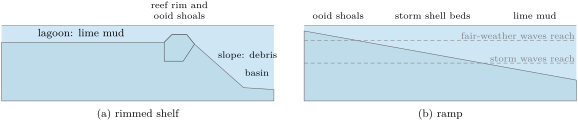
Over millions of years the factories build carbonate platforms, thick bodies of shallow-water carbonate that grow as their foundations subside. Two shapes recur (see the figure below). A rimmed shelf has a flat top, protected behind a rim of reefs and shoals of ooids at its edge, which breaks the waves; behind it lies a quiet lagoon of lime mud, and in front a steep slope where blocks and debris shed from the rim fall to the basin. A ramp slopes very gently from the shore to the basin without a break: ooid shoals and shell banks where the waves stir the floor, then beds of shell debris swept out by storms, then lime mud below the reach of the waves. A rimmed shelf grows mostly upward and outward from its rim, a ramp by moving its belts of sediment shoreward or seaward as the sea rises or falls.
22.3 Pelagic oozes and the carbonate compensation depth
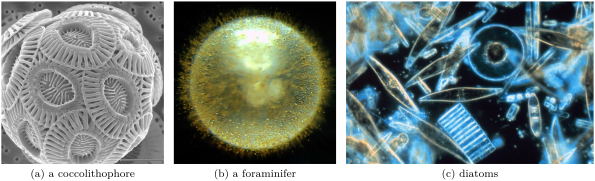
Far from land, the sea floor receives almost nothing from the continents but the finest windblown dust. What falls on it instead are the skeletons of the plankton that lived in the sunlit water kilometres above: the calcite plates of coccolithophores and the shells of foraminifera, the opal frustules of diatoms and the skeletons of radiolarians (pictured a little further on). The long rain of coccoliths to the sea floor is the main process that makes chalk and much of the world’s limestone.
Definition 22.5 (Calcareous ooze, siliceous ooze)
An ooze is a fine-grained pelagic sediment, laid down in the open ocean, made mostly of the skeletons of plankton. It is a calcareous ooze when they are of calcium carbonate, chiefly coccoliths and foraminifera, and a siliceous ooze when they are of opal, hydrated amorphous silica, chiefly diatoms and radiolarians.
Calcareous oozes cover about half of the world’s sea floor, but only above a certain depth: below about they disappear. The shells do not stop falling there; they dissolve. The deep ocean is cold and the pressure is high, and the solubility of calcite increases with depth, mainly because of the pressure, while the concentration of carbonate ion in the water generally decreases with depth (the chemistry of these equilibria is recalled from the chemistry books). Below a certain depth deep water is undersaturated in calcite, and the shells that reach the floor dissolve faster the deeper they lie.
Definition 22.6 (Lysocline, carbonate compensation depth)
The lysocline is the depth in the ocean below which the dissolution of calcite on the sea floor first becomes apparent in the sediment and its rate increases sharply. The carbonate compensation depth (CCD) is the depth at which the rate of dissolution of calcite equals the rate at which calcite rains on the sea floor; below it no calcium carbonate accumulates. In practice it is placed where the calcium carbonate content of the surface sediment falls below by weight.
The CCD lies generally hundreds of metres below the lysocline. It is not a fixed level: it is set by a balance between supply and dissolution, so it lies deeper where the plankton produce more carbonate and where the deep water is less corrosive. In the Atlantic it lies about deeper than in the Pacific, the result of both a higher supply of carbonate and a slower dissolution; within the western Pacific alone it lies at about in the north-west and at about in the central Pacific. Aragonite, more soluble than calcite, dissolves at shallower depths still. Over geological time changes in the supply, in productivity and in dissolution have moved the CCD by more than .
Method 22.7 (Locating the lysocline and the CCD)
- Collect the top few centimetres of sediment at sites of different depths in one region, far enough from land and from upwelling for dilution by clay or by opal to be small.
- Measure the weight per cent of of each sample and plot it against the water depth.
- The lysocline is the depth where the content starts to fall steeply, and where the shells show the first signs of dissolution (broken, etched foraminifera).
- The CCD is the depth where the content falls to : read it by linear interpolation between the two samples on either side.
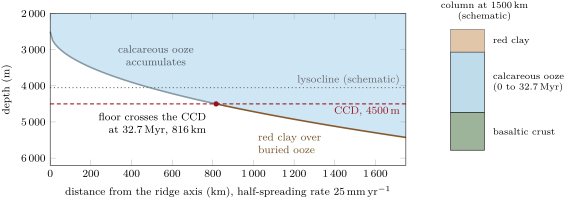
On the flank of a mid-ocean ridge, the sea floor is young and shallow near the axis and sinks as it ages and moves away. A piece of floor born above the CCD collects calcareous ooze until it sinks below the CCD; from then on it receives only what does not dissolve: the dust that settles from the air above, iron and manganese oxides, the teeth of fish. This slow, brown deposit is the red clay of the deep basins.
Proposition 22.8 (Crossing the CCD)
Let the sea floor of age lie at the depth (Theorem 13.7), with a ridge axis at the depth shallower than a carbonate compensation depth that stays constant. Then the floor passes below the CCD at the age
and a site of age carries, from the bottom up, the volcanic crust, calcareous ooze laid down during the time , and red clay laid down during the time .
Proof. The depth increases with , and gives , hence . Before the floor lies above the CCD, where calcite rains faster than it dissolves and ooze accumulates; after it lies below, where no carbonate accumulates and only the insoluble clay is added. The ooze, once buried under clay, is protected from the corrosive water above, so the order of the layers is that of the times. ∎
With (metres, in millions of years), a CCD at is crossed at the age ; at a half-spreading rate of a year that is from the axis (figure below). Drilling into old ocean floor finds this order again and again: basalt, then calcareous ooze or chalk, then red clay, a record of the floor’s journey down the flank. Where the plate has since moved under a belt of high productivity, near the equator, the clay can be capped by a new layer of ooze, which is how cores record the motion of the plates as well as the depth of the CCD.
22.4 Siliceous oozes and cherts
Diatoms, single-celled algae of the plankton, and radiolarians, single-celled members of the zooplankton, build their skeletons of opal, which they take from the silicic acid dissolved in seawater. Unlike the calcite of the surface ocean, the opal is not protected by supersaturation: seawater is undersaturated in it at all depths, and most of the opal dissolves as soon as the organism dies, first in the water as it sinks and then on the sea floor. Of the 255 teramoles of silicon built into opal each year by the plankton of the world ocean, only about 9.2 are buried in the sediment for good: a preservation of . A silicon atom brought to the sea by a river is taken up and released again by the plankton some sixteen times before it is buried, and it stays about years in the ocean.
So siliceous oozes form where the production of opal is so high that even of it adds up, and where little else dilutes it: around the Southern Ocean, in the North Pacific, along the equator in the Pacific and on continental margins, the places where deep water rich in nutrients rises to the surface (Chapter 29). They also dominate below the CCD under productive waters, where the calcite that fell with them has dissolved.
Definition 22.9 (Chert)
A chert is a hard, dense sedimentary rock of microcrystalline quartz, formed in most cases from biogenic opal that dissolved and recrystallised after burial; it occurs as beds, often from siliceous oozes, or as nodules, of which flint, in chalk, is the best known.
A diatom ooze that has not been recrystallised becomes diatomite, a light, white, porous rock, almost pure opal. With burial and time the opal turns into other forms of silica and finally into quartz, and the silica migrates: it leaves the chalk, for instance, and gathers in nodules of flint along certain beds. How this happens belongs to diagenesis (Chapter 23).
22.5 Evaporites
Where a body of seawater loses more water by evaporation than it receives, its salts concentrate until they precipitate one after another. The composition of seawater is the same, in its major ions, in all the oceans (Table 22.1).
| ion | mass fraction of sea salt | per of seawater | per |
|---|---|---|---|
| chloride | 0.5503 | 19.353 | 545.9 |
| sodium | 0.3066 | 10.781 | 469.0 |
| sulfate | 0.0771 | 2.712 | 28.2 |
| magnesium | 0.0365 | 1.284 | 52.8 |
| calcium | 0.0117 | 0.412 | 10.3 |
| potassium | 0.0113 | 0.399 | 10.2 |
| hydrogen carbonate | 0.0030 | 0.105 | 1.72 |
| bromide | 0.0019 | 0.067 | 0.84 |
| all solutes | 1 | 35.165 |
Definition 22.10 (Evaporite, evaporation sequence, sabkha)
An evaporite is a sediment or sedimentary rock of salts precipitated from a natural brine concentrated by evaporation: chiefly gypsum and anhydrite , halite , and the potassium and magnesium salts. The evaporation sequence is the order in which the minerals precipitate from evaporating seawater, the least soluble first: calcium carbonate, then gypsum, then halite, then the potassium and magnesium salts. A sabkha is a coastal salt flat, at or just above the level of the highest tides, where gypsum, anhydrite and halite grow within the sediment from the evaporating brine that soaks it.
The sequence was watched as early as 1849 by Usiglio, who evaporated a vessel of seawater to dryness; the most precise measurements come from the salt works of Great Inagua in the Bahamas, where seawater is led through a series of ponds of increasing concentration. Calcium carbonate begins to precipitate when the brine is 1.8 times as concentrated as seawater, gypsum at 3.8 times, halite at 10.6 times; in the laboratory magnesium sulfate followed at about 70 times and potassium salts above 90 times. Since the salts precipitated before are a negligible part of the mass, a concentration factor of 10.6 means that , about , of the water is left: halite comes only when nine tenths of the water have gone (figure below, panel a). The brine grows denser as it concentrates, from for seawater to about when gypsum forms, with halite and more than with the bittern salts, the last salts of all.
How much of each salt a kilogram of seawater can give follows from Table 22.1 by counting the ion that runs out first. Calcium carbonate is limited by the carbonate and hydrogen carbonate, , about . Gypsum takes the remaining calcium, , , sulfate being in excess. Halite takes all the sodium, , , chloride being in excess. What is left, about of magnesium, potassium, sulfate, chloride and bromide, makes the bittern salts. Halite is of the whole: an evaporite basin dried out is above all a mass of rock salt.
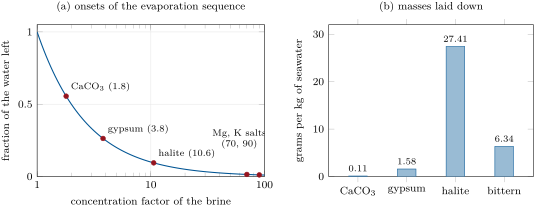
From these masses the thickness of salt that a given body of water can leave follows at once.
Proposition 22.11 (Salt from a column of seawater)
A column of seawater of height and density , evaporated to dryness, lays down a layer of a mineral of density whose thickness is
where is the mass of that mineral laid down per unit mass of seawater.
Proof. A unit area of the column holds the mass of seawater, which lays down the mass of the mineral. Spread over the same unit area as a layer of density , it has the thickness . ∎
With , and the density of halite, , a column of seawater high leaves of halite; with gypsum, of density , it leaves of gypsum. This is the thickness problem of evaporites: salt beds hundreds of metres or kilometres thick cannot be the residue of a single filling of any basin, however deep.
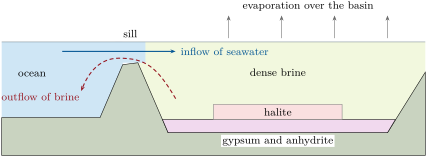
The answer is a basin that keeps receiving seawater. A basin separated from the ocean by a sill, a shallow strait or a barrier, in a dry climate, loses water by evaporation over its whole area; seawater flows in over the sill to replace it, bringing new salt, and the denser brine may flow out at depth over the sill (figure below). The concentration of the brine is set by the balance of these flows.
Proposition 22.12 (The barred basin)
Let a well-mixed basin of area lose the volume of water per unit time by net evaporation, receive seawater at the volume rate and return brine to the ocean at the volume rate , in a steady state. For an ion that does not precipitate, the brine is concentrated by the factor
with respect to seawater (the volumes counted as if of equal density).
Proof. In a steady state the volume of the basin does not change, so the inflow balances the outflow and the evaporation: . The ion enters at the concentration of seawater and leaves only with the brine, at its concentration ; since it does not precipitate, its mass in the basin is steady when . Hence , and substituting gives the second form. ∎
The outflow controls what the basin lays down. If more than a tenth of the inflow returns to the ocean as brine, stays below 10.6 and the basin lays down carbonate and gypsum but never halite; if the outflow is smaller, the brine reaches halite saturation and the basin fills with salt; if the strait is closed altogether, the basin dries out and its level falls at the rate .
The largest young evaporite of the world lies under the floor of the Mediterranean. Between 5.97 and 5.33 million years ago, in the Messinian age, the exchanges of water between the Mediterranean and the Atlantic were restricted, and evaporites up to thick were laid down in the deep basins, their halite mostly in a short interval between 5.60 and 5.55 million years ago. How it happened is still debated. In one model the sea was largely cut off and its level fell by about , the deep basins becoming salt lakes and the rivers cutting deep canyons into the dry margins; in others the basin stayed connected and full, a barred basin on a vast scale. Both must explain kilometres of salt, which one filling of the sea could never give.
22.6 Exercises
Exercise 22.1 ★
Seawater of the reference composition holds of salt per kilogram, of which the mass fractions of chloride, sodium, sulfate and magnesium are 0.5503, 0.3066, 0.0771 and 0.0365. Compute the mass of each ion in a kilogram of seawater, and the fraction of the salt made of sodium and chloride together.
Solution
Solution of Exercise 22.1.
Chloride ; sodium ; sulfate ; magnesium . Sodium and chloride together make , that is of the salt.
Exercise 22.2 ★
Calcium carbonate, gypsum, halite and magnesium sulfate begin to precipitate from seawater concentrated 1.8, 3.8, 10.6 and 70 times. For each, compute the fraction of the original water left and the fraction already evaporated.
Solution
Solution of Exercise 22.2.
The fraction left is : calcium carbonate left, evaporated; gypsum left, evaporated; halite left, evaporated; magnesium sulfate left, evaporated.
Exercise 22.3 ★
On reefs dominated by Acropora the carbonate budget is of per square metre and per year and the reef grows by a year. (a) With Proposition 22.2, compute the dry bulk density of the reef. (b) What is its porosity if its grains are of aragonite, of density ? of calcite, of density ? (c) At the same bulk density, how fast would a reef with the average budget of grow?
Solution
Solution of Exercise 22.3.
(a) . (b) With aragonite, , a porosity of ; with calcite, . (c) , a year.
Exercise 22.4 ★
Surface sediments from one region of the ocean floor contain the following weight per cent of : 88 at , 85 at , 80 at , 62 at , 35 at , 12 at , 6 at and 2 at . With Method 22.7, locate the lysocline and the CCD.
Exercise 22.5 ★★
(a) Write the balanced equation of the precipitation of calcium carbonate from calcium and hydrogen carbonate ions, and compute the mass of carbon dioxide released per kilogram of laid down (molar masses and ). (b) How much would a reef with a budget of release per square metre and per year, by this equation? (c) Why does a reef, which turns dissolved carbon into rock, release carbon dioxide?
Solution
Solution of Exercise 22.5.
(a) : one mole of per mole of , so of per kilogram of . (b) of per square metre and per year. (c) Of the two hydrogen carbonate ions used, only one carbon goes into the mineral; the other leaves as carbon dioxide. Calcification takes alkalinity out of the water and lowers its capacity to hold dissolved carbon; how much of the reaches the air depends on the buffering of seawater, a matter of the carbonate equilibria of the chemistry books.
Exercise 22.6 ★★
Take the sea floor at the depth (metres, in millions of years), spreading from its ridge at the half-rate a year. (a) At what age and at what distance from the axis does it cross a CCD at ? (b) The same for a CCD at , as in the central Pacific. (c) How long would floor old have received red clay in each case?
Solution
Solution of Exercise 22.6.
(a) ; at per million years, from the axis. (b) , . (c) Floor old has received red clay for in the first case, and for only in the second.
Exercise 22.7 ★★
A reef grows at a year. (a) Can it keep up with a relative rise of sea level of a year? (b) Its top lies below the sea when the relative rise becomes a year. If its builders cannot live deeper than , how long until it drowns? (c) Why may it in fact drown sooner?
Solution
Solution of Exercise 22.7.
(a) Yes: , and the reef gains a year on the sea until its top reaches the surface. (b) grows by a year; from 2 to it takes years. (c) Because its growth rate falls as the water deepens: less light reaches the algae that live in the corals and feed them, so decreases and the reef falls behind faster and faster.
Exercise 22.8 ★★
Buried under a few hundred metres of sediment, gypsum (, density ) loses its water and becomes anhydrite (, density ). (a) Write the reaction. (b) Compute the molar volumes of the two minerals and the change of volume of the solid. (c) What fraction of the mass of the gypsum leaves as water? What can this water do in the rocks around?
Solution
Solution of Exercise 22.8.
(a) The reaction is . (b) The molar volumes are and , so the solid loses of its volume. (c) : of the mass leaves as water. Released at depth, this water raises the pressure in the pores of the rocks around; under a seal it can make the rocks weaker and help faults slip, and it can dissolve and carry other salts.
Exercise 22.9 ★★
The plankton of the world ocean build 255 teramoles of silicon into opal a year, and 9.2 are buried. (a) Compute the fraction preserved and the fraction dissolved. (b) Why can siliceous ooze nevertheless form, and where? (c) Why is the record of diatoms in the sediment a biased picture of the diatoms that lived in the water?
Solution
Solution of Exercise 22.9.
(a) preserved, dissolved. (b) Where production is very high, a few per cent of it is still a large flux, and where little clay or carbonate dilutes it: under the upwelling waters of the Southern Ocean, the North Pacific and the equatorial Pacific, and below the CCD. (c) Thin, delicate frustules dissolve first and robust ones survive: the sediment keeps a selection of the sturdiest species, not the community that lived in the water.
Exercise 22.10 ★★★
A barred basin of area loses by net evaporation of water a year. (a) Compute the volume evaporated each year. (b) With Proposition 22.12, compute the concentration factor of the brine when the inflow over the sill is a year, and when it is a year. Which minerals can precipitate in each case? (c) Up to what inflow does the basin lay down halite?
Solution
Solution of Exercise 22.10.
(a) a year. (b) With , and : past the gypsum threshold (3.8) but not that of halite (10.6), so calcium carbonate and gypsum precipitate. With , and , for an ion that stays in solution such as magnesium: the brine passes the halite threshold, so halite precipitates too, but not the magnesium salts (70). (c) Halite requires , that is a year: the inflow may exceed the evaporation by at most about a tenth.
Exercise 22.11 ★★★
Seawater holds of bromide per kilogram. When halite precipitates, it takes up bromide in proportion to its concentration in the brine: the bromide content of the halite is times that of the brine. (a) Compute the bromide content of the brine, in milligrams per kilogram, and of the first halite, when the brine is 10.6 times as concentrated as seawater. (b) The same when the brine has reached 30 times. (c) Bromide is hardly removed from the brine by the halite: why? (d) In a thick bed of halite, the bromide content rises upward, then suddenly falls back. What happened to the basin?
Solution
Solution of Exercise 22.11.
(a) Seawater holds of bromide per kilogram; at 10.6 times, the brine holds and the first halite . (b) At 30 times, in the brine and in the halite. (c) The halite takes only 3.2 hundredths of the concentration of the brine, so nearly all of the bromide stays in solution and keeps concentrating as the water evaporates. (d) The rise records the concentration of the brine; the sudden fall records its dilution, by a new inflow of seawater into the basin, or of fresh water, before the halite went on growing.
Exercise 22.12 ★★★
A site on the flank of a ridge has the depth and is now old. Suppose that calcareous ooze accumulates at per thousand years above the CCD and red clay at per thousand years below it, and neglect compaction. (a) Compute the thickness of ooze and of red clay at the site for a CCD at . (b) The same for a CCD deeper, as in the Atlantic. (c) A core at the site shows a thin layer of ooze within the red clay. Give two possible explanations.
Solution
Solution of Exercise 22.12.
(a) , so of ooze ( thousand-year intervals at ) and of red clay. (b) : of ooze and of red clay. A deeper CCD gives a much thicker ooze, and the red clay of the deep Atlantic floor is thinner than that of the Pacific of the same age. (c) The CCD may have been deeper for a while, so that the site rose above it again; or the plate carried the site under a belt of high productivity, such as the equator, where more carbonate rained down; or the layer was brought by a slide or a turbidity current from a higher part of the sea floor.
22.7 Problem: Salt from a vanished sea
Problem 22.1
Weekend problem — how much seawater it takes to make a salt basin, and how long
An inland sea of area , deep, is joined to the ocean by a strait over a shallow sill. Its floor, now buried, carries of halite. Take for seawater the density and the masses laid down per kilogram computed in the chapter: of , of gypsum, of halite and of bittern salts; for the minerals the densities: calcite , gypsum , anhydrite , halite . Treat the sea as a box with vertical walls.
Part I — One filling.
- Compute the mass of seawater above one square metre of the floor, and the mass of salt it holds ().
- Compute the mass of gypsum and of halite laid down on one square metre when the sea evaporates to dryness.
- With Proposition 22.11, compute the thickness of calcium carbonate, of gypsum and of halite.
- Buried, the gypsum becomes anhydrite. What is then the thickness of the sulfate layer?
- What fraction of the dry salt is halite? Why is a dried-out sea mostly rock salt?
- In what order, from the bottom up, do the layers lie? Why?
Part II — The brine as the sea dries.
- At what depth of brine, in the box, do calcium carbonate, gypsum and halite begin to precipitate?
- What fraction of the water has evaporated when halite appears?
- Below what depth of brine do the magnesium and potassium salts begin?
- How dense is the brine at each stage? What does this mean for a brine that meets fresh seawater flowing in?
- Why is the first deposit, the carbonate, rarely seen as a separate layer in an evaporite basin?
- The bromide content of the halite rises from the base to the top of the halite layer of one filling. Why?
Part III — How many fillings?
- How many fillings of the basin, evaporated each time to dryness, would be needed to lay down the of halite?
- How much anhydrite would accompany it, and how would it be distributed in the section?
- How thick would the bittern salts be, if they were all kept, with a mean density of ? Why are they so often missing?
- How would the bromide content of the halite record each refilling?
- The Messinian evaporites reach . How many fillings of a sea would their halite need, if they were all halite?
Part IV — Inflow and time.
- Seawater flows in over the sill at and no brine flows out; the level stays constant. Compute the net evaporation rate over the sea, in metres a year (a year of days).
- Compute the mass of salt that enters the sea each year.
- If all its halite is laid down evenly on the floor, how thick a layer of halite forms each year?
- How long does the of halite take to form?
- The strait closes. How fast does the level fall, and how long until the sea dries out, if the evaporation rate stays the same?
- How long after the closure does halite begin to precipitate?
- To the nearest whole number, how many fillings of the basin did its salt require?
Solution
Solution of Problem 22.1.
1. of seawater, holding of salt.
2. Gypsum ; halite .
3. Calcium carbonate ; gypsum ; halite .
4. The anhydrite has the mass and the thickness .
5. Dry, the salt is per kilogram, of which halite is : sodium and chloride make most of the dissolved salt, and halite takes nearly all of them.
6. From the bottom up: calcium carbonate, gypsum, halite, the bittern salts. Each mineral starts to precipitate when the brine reaches its saturation, the least soluble first, and settles on what was laid down before.
7. The depth of brine is : for calcium carbonate, for gypsum, for halite.
8. .
9. for magnesium sulfate, for the potassium salts.
10. About when calcium carbonate forms, 1.13 with gypsum, 1.22 with halite and more than 1.30 with the bitterns, against 1.03 for seawater. Seawater flowing in floats on the dense brine, which stays at the bottom; in a barred basin the brine can flow back to the ocean below the inflow.
11. It is only thick, against of halite; and it forms on the margins, where the inflowing water first concentrates, more than in the centre, so it is mixed with the base of the gypsum or replaced by it.
12. The halite takes only a small part of the bromide of the brine (exercise 22.11), so the brine becomes richer in bromide as the halite grows, and each new layer of halite takes up more.
13. : 116 fillings.
14. of anhydrite, not as one bed but as 116 layers, each a little under half a metre thick, at the base of the halite of its filling: a cyclic succession of anhydrite and halite.
15. Per filling, , so for 116 fillings. They are the most soluble salts: the next inflow of seawater redissolves them, and a basin whose brine flows out before the end never reaches them.
16. At each refilling the brine is diluted: the bromide content drops sharply at the base of the new halite and rises again upward, a saw-tooth profile with one tooth per filling.
17. fillings.
18. a year, spread over : a year.
19. of salt a year.
20. of halite a year, that is , about a year over the floor.
21. years.
22. The level falls at a year; of water is gone in years.
23. Halite appears when of the water has gone, after years.
24. The of halite took the salt of 116 fillings of the basin (115.3, to be rounded up), whether they came one after the other as the basin dried and refilled, or continuously over the sill, as in question 21, at the rate of one basin of seawater every years.