
全部书籍

专业

应用 关于 Coach 登录 开始阅读

书籍暂未推出简体中文版——当前显示英文版。

Earth and Space Sciences · 术语表

什么是 Cepheid variable; Leavitt law?

又称: Cepheid variable · Leavitt law

Definition 29.16 University Earth and Space Sciences — Year 3 · 第 29 章 — The Milky Way and Galaxies

A Cepheid variable is a young, luminous, pulsating star whose brightness varies with a strictly regular period, from about a day to several weeks. The Leavitt law, or period–luminosity relation, is the linear relation between the mean absolute magnitude of a Cepheid and the logarithm of its period, longer periods for brighter stars.
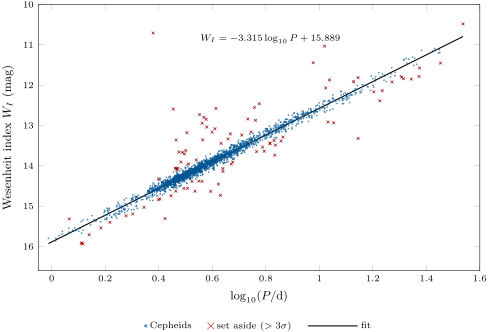
The Leavitt law in the Large Magellanic Cloud: the Wesenheit index of 2315 Cepheids pulsating in their fundamental mode against the logarithm of their period (OGLE survey, Soszyński and others, 2015, via the CDS). Brighter stars are higher. A straight line fitted by least squares, after setting aside 92 stars more than three standard deviations from it, reproduces the published relation (-3.314, 15.888). With the Cloud’s distance modulus, 18.477, the line gives the absolute Wesenheit magnitude of any Cepheid from its period.
The Leavitt law in the Large Magellanic Cloud: the Wesenheit index of 2315 Cepheids pulsating in their fundamental mode against the logarithm of their period (OGLE survey, Soszyński and others, 2015, via the CDS). Brighter stars are higher. A straight line fitted by least squares, after setting aside 92 stars more than three standard deviations from it, reproduces the published relation (−3.314-3.314, 15.88815.888). With the Cloud’s distance modulus, 18.477, the line gives the absolute Wesenheit magnitude of any Cepheid from its period.
在原文中阅读 →