书籍暂未推出简体中文版——当前显示英文版。
University Earth and Space Sciences — Year 3 · 本科三年级
29The Milky Way and Galaxies
In the Solar System, the planets far from the Sun move slowly: Mercury circles it at , Neptune at , as Kepler’s third law requires of bodies held by one central mass. The stars of the Galaxy do not behave that way. Measured from the motions of more than twenty thousand red giants, the speed of their circular orbits is at from the centre, at the Sun, and still at , where hardly any stars or gas remain. If the mass we see were all there is, the outer stars would be far slower. Something unseen holds them. This chapter describes the Galaxy we live in, weighs it from its rotation, sorts the other galaxies into types, and climbs the chain of methods by which their distances, and the expansion of the Universe, are measured.
You already know
The Milky Way, the Doppler effect, Kepler’s laws, Newton’s theorem on the attraction of a spherical shell, dark matter, black holes and their Schwarzschild radius, supernovae, white dwarfs, the 21-cm line of atomic hydrogen and Hubble’s law are in the physics books. The annual parallax, the parsec, flux and luminosity, apparent and absolute magnitudes, the distance modulus, photometric bands and the colour index are in the Year 1 volume, in its chapter on telescopes and photometry. The interstellar medium and its dust are in the Year 2 volume, in its chapter on the interstellar medium and star formation.
29.1 The structure of the Galaxy
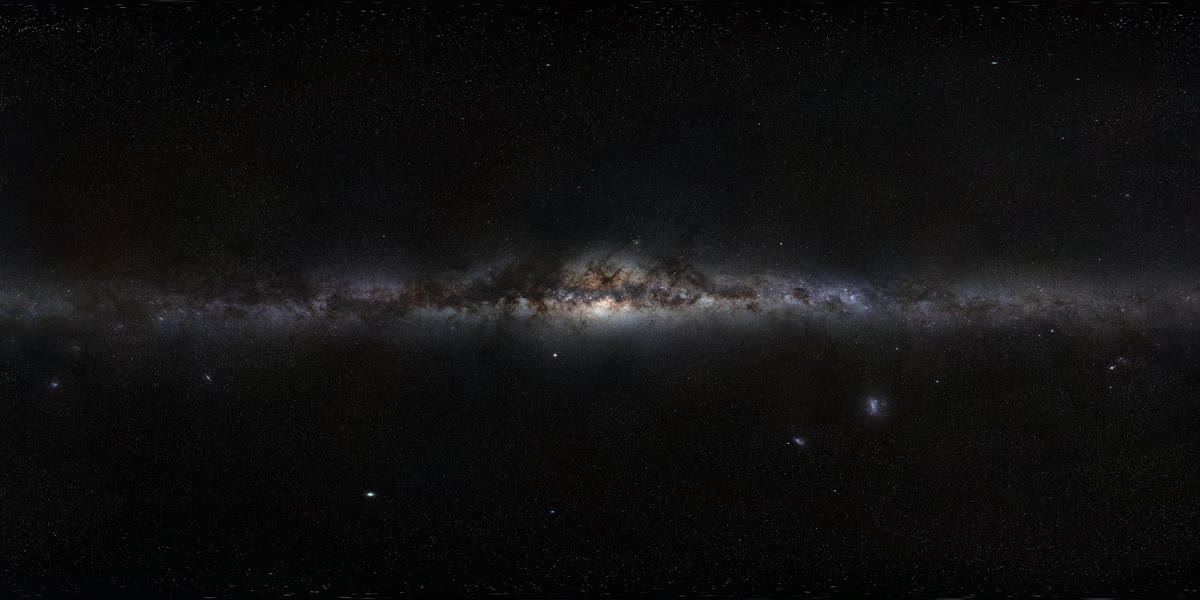
Seen from the Earth, the Galaxy is the Milky Way: a band of light around the whole sky, crossed by dark lanes of dust and brightest towards the constellation Sagittarius, where its centre lies. The band is the disc in which the Sun sits, seen edge-on from inside.
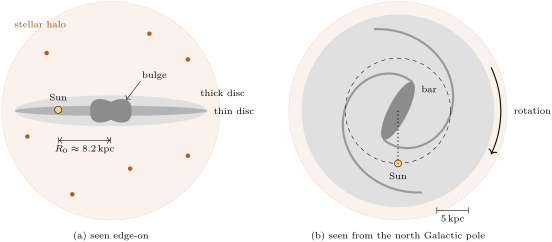
Definition 29.1 (Galactic disc, thick disc, bulge and stellar halo)
The Galactic disc is the flattened component of the Galaxy, made of stars, gas and dust in nearly circular orbits about its centre; its density falls off roughly exponentially with height above its mid-plane and with distance from its centre, over a scale height and a scale length. The thick disc is a second, older disc component of larger scale height and smaller mass. The Galactic bulge is the central concentration of stars that swells out of the disc. The stellar halo is the sparse, roughly spheroidal component of old stars and globular clusters that surrounds the disc and the bulge.
The Galaxy is a barred spiral. In the neighbourhood of the Sun the thin disc has a scale height of about and the thick disc of about ; their scale lengths are about and . The thick disc holds some solar masses, roughly a fifth of the thin disc. Seen from the side, the bulge is a box or a peanut: it is the thickened inner part of a bar of stars about in half-length, whose long axis makes an angle of with the line from the Sun to the centre. The stellar halo holds only about one percent of the stars. All together, the stars of the Galaxy weigh about solar masses.
Definition 29.2 (Stellar population)
A stellar population is a group of stars of a galaxy that share a range of ages, of chemical compositions and of orbits. The young stars of the thin disc, rich in elements heavier than helium and on nearly circular orbits, are traditionally called population I; the old stars of the halo and of the globular clusters, poor in heavy elements and on orbits of large random motions with little net rotation, population II.
The thick disc lies in between: its stars are mostly older than those of the thin disc and, at a given iron content, richer in the light elements that astronomers call alpha elements, measured relative to iron. The stellar halo is a fossil record: much of it was assembled from small galaxies that fell into the Galaxy and were torn apart by its tides, and some of their streams of stars can still be followed across the sky.
Definition 29.3 (Galactic coordinates)
The Galactic coordinates of a direction are its Galactic latitude , the angle from the Galactic plane (positive towards the north Galactic pole), and its Galactic longitude , measured in the plane from the direction of the Galactic Centre () through , the direction towards which the Galaxy’s rotation carries the Sun. The plane was defined in 1958 as the principal plane of the Galaxy’s atomic hydrogen; the north Galactic pole lies at right ascension () and declination (equinox 1950).
The Sun is not quite in the plane: it lies some north of it. Its distance from the centre, , was long the most uncertain number of Galactic astronomy. It is now measured geometrically: the star S2 circles the central black hole of the Galaxy on a -year orbit, whose angular size on the sky and velocity along the line of sight, followed for 27 years, give the distance to the centre directly: , with a statistical error of and a systematic one of . A review of all methods gives .
29.2 Rotation and the dark halo
Definition 29.4 (Local standard of rest)
The local standard of rest (LSR) is the frame of reference that moves on the circular orbit about the Galactic Centre passing through the Sun’s present position. Velocities of nearby stars and gas are quoted relative to it.
The Sun moves relative to the LSR by about towards the Galactic Centre, in the direction of rotation and towards the north Galactic pole: a small peculiar motion on top of an orbit at a speed of a few hundred kilometres per second. Seen from the Earth, the radio source at the centre of the Galaxy drifts along the Galactic plane by a year; nearly all of that drift is the reflex of the Sun’s orbit, and it gives the Sun’s total speed about the centre, (Exercise 29.2).
Definition 29.5 (Rotation curve; Oort constants)
The rotation curve of a disc galaxy is the speed of a circular orbit in its plane as a function of the distance from its centre. For the Galaxy, with and at , the Oort constants are
measures the shear of the disc’s rotation and its vorticity: in a disc turning as a solid body and ; on a flat rotation curve . Their difference is the angular speed of the LSR, , and their sum the slope, .
Theorem 29.6 (Oort’s formulas)
A star at a distance from the Sun, in the Galactic plane at longitude , on a circular orbit, has relative to the LSR the radial velocity and the transverse velocity (positive in the direction of increasing )
to first order in .
Proof. Let be the angular speed of the orbit at . Put the Galactic Centre at the origin, the Sun at distance , and let the star be at distance from the centre, its position seen from the centre making the angle with the Sun’s. Projecting the star’s velocity and the LSR’s velocity on the line of sight, a little trigonometry in the triangle Sun–star–centre (the sine rule gives ) gives the exact result . Likewise, on the direction perpendicular to the line of sight, . For a nearby star, and . Then and, keeping first-order terms, . With , and . ∎
The radial velocities of nearby stars therefore vary as around the sky, and their proper motions as about a mean set by . From the proper motions and parallaxes of stars of the first Gaia catalogue, at a typical distance of , the Oort constants are and . Two further terms that an axisymmetric disc would not have, called and , came out at about : the local disc is stirred by the bar and the spiral arms.
The rotation curve from the 21-cm line
Atomic hydrogen fills the disc and emits the 21-cm line, at ; radio waves cross the dust that hides the distant disc at visible wavelengths. Along a line of sight in the plane, every cloud of gas adds its line at the Doppler shift of its radial velocity, and the profile of the line is a spectrum of velocities. Inside the solar circle one velocity is singled out.
Theorem 29.7 (Tangent-point method)
Let gas move on circular orbits with an angular speed that decreases outwards. Along a line of sight at longitude , the radial velocity relative to the LSR is largest at the tangent point, where the line of sight is tangent to an orbit, at , and its largest value is
Proof. By the proof of Oort’s formulas, gas at distance from the centre on the line of sight has . With and decreasing, is largest where is smallest. Along the line of sight, is smallest at the foot of the perpendicular from the centre, where . There and . ∎
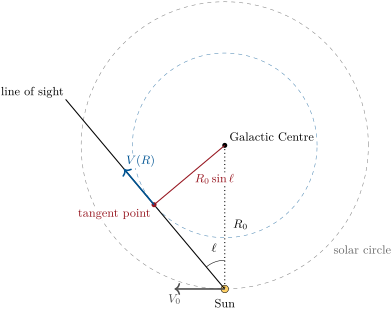
The highest velocity in each 21-cm profile thus gives at , and a sweep of longitudes from to gives the rotation curve from the centre out to the Sun. Beyond the solar circle no line of sight is tangent to an orbit, and the method fails: there, the distance of each tracer must be measured as well as its velocity. Since 2014 a satellite has measured the parallaxes of more than a billion stars, and the outer rotation curve is now traced by stars.
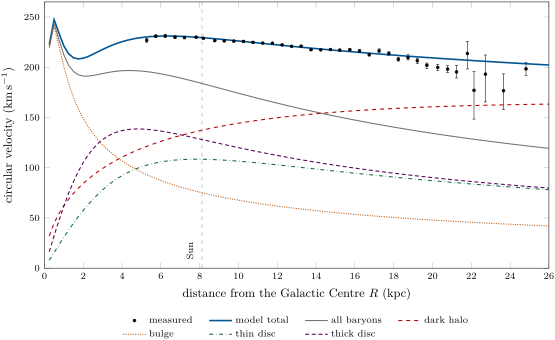
The curve in the figure above was measured from the positions, distances and velocities of more than twenty-three thousand luminous red giants, with the equation of stellar hydrodynamics that relates the mean motions of a population of stars to the gravity holding them (the Jeans equation). At the Sun it gives , with a systematic uncertainty of two to five percent; beyond, it declines gently, by per kiloparsec. It does not fall the way the visible mass requires.
Weighing the Galaxy
The gravity of a disc is not that of a sphere, but the velocity curve of a mass model is easily computed when each component has a potential in closed form. The potentials in the plane below are those of a published model of the Galaxy’s stars.
Proposition 29.8 (Circular velocities of three mass models)
In the plane , the circular velocity is, for
a Plummer sphere of mass and core radius , of potential :
a Miyamoto–Nagai disc of mass , scale length and scale height , of potential :
- a Navarro–Frenk–White halo of density , : the mass within is and .
For several components the squares of the velocities add.
Proof. For the first two, differentiate the potential with respect to at . For the halo, integrate from 0 to : with , ; a spherical mass acts on an orbit at as if all its mass within were at the centre (Newton’s theorem). The potentials add, hence their radial derivatives. ∎
The model used in the figure has a Plummer bulge of solar masses with , a thin disc and a thick disc of solar masses each, with and . With per solar mass, its stars alone would give the Sun an orbital speed of , and a star at one of ; the measured speeds are 229 and . A halo fitted to the measurements, with the stars held fixed, has and solar masses per cubic kiloparsec, the same as the halo its authors fitted (, solar masses per cubic kiloparsec). The halo dominates beyond about .
Definition 29.9 (Dark-matter halo)
The dark-matter halo of a galaxy is the roughly spherical distribution of dark matter in which its stars and gas are embedded, much larger and more massive than its visible components, and inferred from its gravity: from the rotation curve, from the motions of satellite galaxies and of halo stars, and from the bending of light.
Theorem 29.10 (Mass within a radius)
For a spherical distribution of mass, the circular velocity at radius gives the mass within it, . A flat rotation curve, constant, implies and a density .
Proof. By Newton’s theorem the gravity at is , and it supplies the centripetal acceleration of a circular orbit. If is constant, . ∎
For the flattened discs, is not exactly the mass within , but it is the mass a sphere would need to produce the same orbit, and it is used here, as is common, as the dynamical mass. The figure below compares it for the stars and the whole Galaxy.
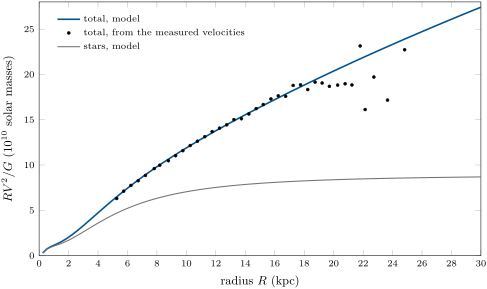
How far the halo extends, and how much it weighs in all, the rotation curve of the disc cannot say. Extrapolated with its fitted profile to its virial radius, about , the halo fitted by the authors of the measurement holds about solar masses; a review of other estimates gives , of which the baryons are only some seven percent. The dark matter near the Sun is thin: about of mass-energy per cubic centimetre, a third of the mass of a proton, which is why it is felt only by its accumulated gravity.
29.3 Galaxies
Definition 29.11 (Hubble sequence; elliptical, lenticular, spiral and irregular galaxies)
The Hubble sequence classifies galaxies by their appearance. An elliptical galaxy (type E) is a smooth system of stars, with brightness falling steadily from the centre and no disc; it is labelled E, with and the apparent axis ratio, from E0 (round) to E7. A spiral galaxy has a disc with spiral arms around a central bulge; it is labelled Sa, Sb, Sc in order of a decreasing bulge, more open arms and arms more broken into star-forming knots, and SBa, SBb, SBc if a bar crosses its centre. A lenticular galaxy (S0) has a disc and a bulge but no arms. An irregular galaxy (Irr, Im) has no organized structure.
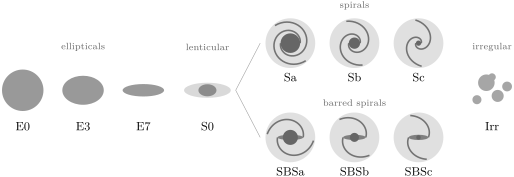
The classes describe shapes seen on the sky, and a single label hides a range: an elliptical seen along its shortest axis looks round whatever its true flattening, and the boundaries between neighbouring classes are a matter of judgement. In a catalogue of the galaxies near us, the Galaxy is listed as an S(B)bc, a spiral between Sb and Sc with a bar; its large neighbour Andromeda (M31) is an Sb, the Triangulum galaxy (M33) an Sc, and the Large and Small Magellanic Clouds are irregulars.
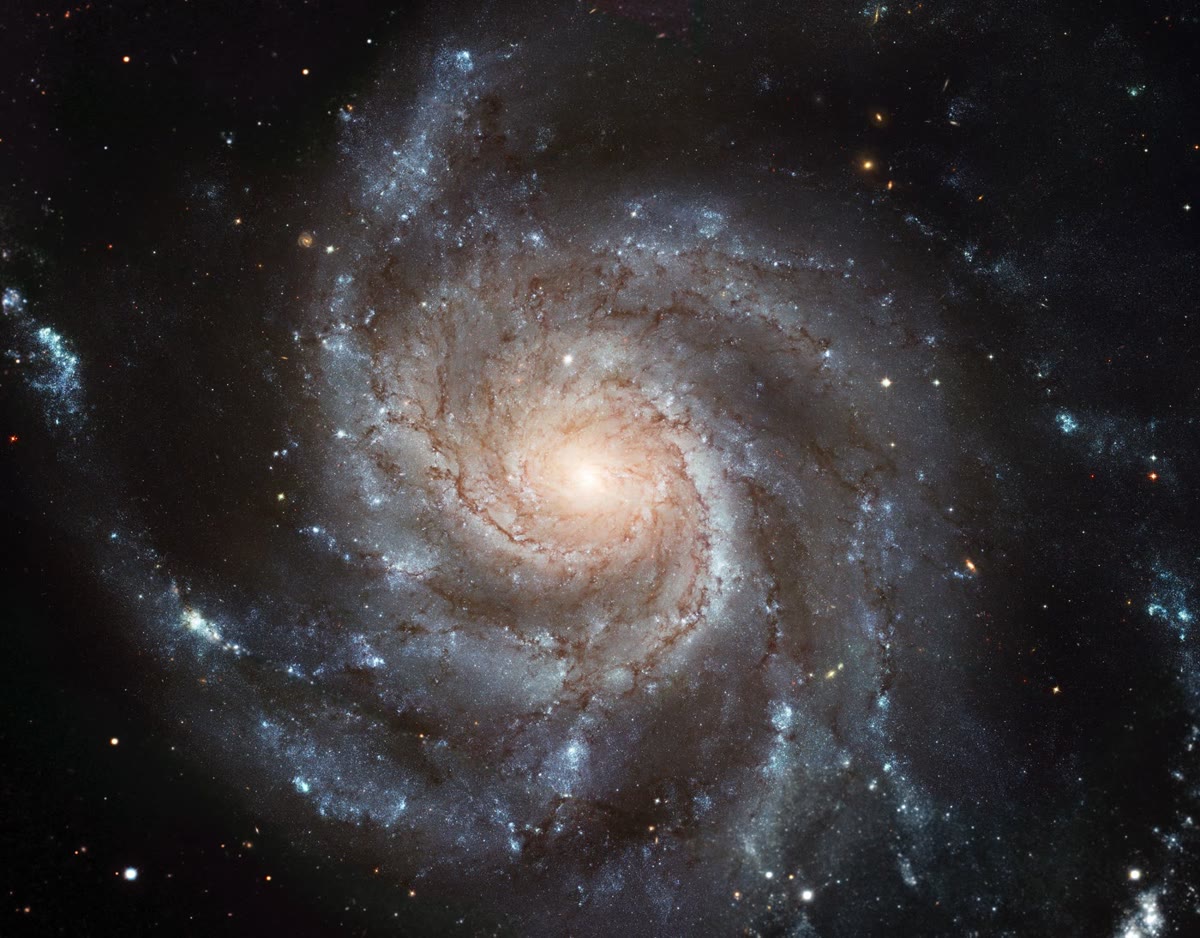
Why are spiral arms not wound up? In a disc whose rotation curve is flat, a star at half the distance from the centre goes round in half the time. A spiral of stars would wind tighter at each turn, and after a few turns of the disc it would be a tight coil (Exercise 29.11).
Definition 29.12 (Density-wave theory)
The density-wave theory explains spiral arms as a wave of higher density in a disc, a spiral pattern that turns rigidly at its own angular speed, the pattern speed, while the stars and the gas move through it, slowing as they enter the crowded arm and speeding up as they leave, as cars move through a traffic jam.
The theory, proposed in 1964, frees the arms from the winding problem. Gas entering an arm is compressed, and stars form there: the arms are picked out by young stars and glowing gas, while the old stars are spread far more evenly. Whether the arms are long-lived waves is still debated; computer simulations of discs more often grow arms that are transient, dissolving and re-forming, and a passing galaxy or a bar can drive a two-armed spiral.
Definition 29.13 (Supermassive black hole)
A supermassive black hole is a black hole of a million solar masses or more at the centre of a galaxy.
At the centre of the Galaxy, the compact radio source Sagittarius A* (Sgr A*) sits among stars on tight, fast orbits. Their orbits require a central mass of about four million suns, solar masses in a review of the measurements. Sgr A* hardly moves relative to distant galaxies: once the Sun’s orbit is removed, its residual motion is at most a few kilometres per second, so it holds at least a quarter of that mass. Its size is comparable to its Schwarzschild radius, and its density, above solar masses per cubic parsec, is very close to that expected of a black hole: the evidence that Sgr A* is one is overwhelming.
Definition 29.14 (Local Group; galaxy cluster)
The Local Group is the gravitationally bound group of galaxies dominated by the Milky Way and Andromeda, each with its satellite galaxies. A galaxy cluster is one of the largest gravitationally bound systems: many galaxies held, with a hot gas that radiates X-rays, in a common well of mostly dark matter.
More than a hundred galaxies lie within of the Sun, most of them dwarfs. The Large Magellanic Cloud is at about , Andromeda at and approaching us at , and the bound members of the group lie within about of its centre of mass, between the Galaxy and Andromeda, where they turn away from the expansion of the Universe. Its mass, from the motion of the two big galaxies towards each other, is of order solar masses. In a massive galaxy cluster the hot gas, at about , holds about ten times the mass of the stars; galaxies and gas together are too light for the depth of the gravitational well, and most of the cluster’s mass, of order solar masses, is dark.
29.4 The distance ladder
A parallax gives a distance by geometry alone, but parallaxes shrink with distance. The best catalogue of them measures a parallax with an uncertainty of 0.02 to for stars brighter than magnitude 15, so a distance to out to about ; the Large Magellanic Cloud, at , has a parallax of . Beyond, distances rest on objects whose luminosity is known.
Definition 29.15 (Standard candle; distance ladder)
A standard candle is a class of objects whose absolute magnitude is known, or can be inferred from a property measured independently of distance, so that its apparent magnitude gives its distance modulus. The distance ladder is the chain of methods, each calibrated on objects close enough to be measured also by the method before it, that carries distances from parallaxes out to the expanding Universe.
Definition 29.16 (Cepheid variable; Leavitt law)
A Cepheid variable is a young, luminous, pulsating star whose brightness varies with a strictly regular period, from about a day to several weeks. The Leavitt law, or period–luminosity relation, is the linear relation between the mean absolute magnitude of a Cepheid and the logarithm of its period, longer periods for brighter stars.
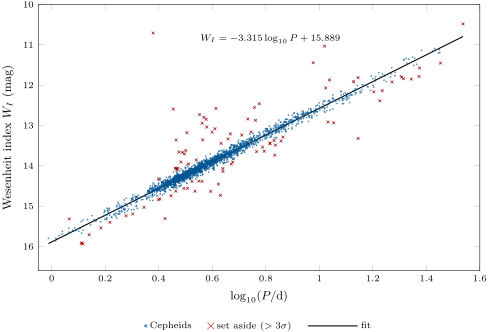
The relation was discovered in the Small Magellanic Cloud, whose stars are all at nearly the same distance, in 1908. Dust in the galaxy that hosts a Cepheid dims and reddens it; but the dimming is larger in the visible than in the near infrared, in a fixed ratio for a given kind of dust, and the combination of the magnitudes in the I and V bands, the Wesenheit index, is chosen so that the dimming cancels. The figure below shows it for 2315 Cepheids of the Large Magellanic Cloud: the Leavitt law is a tight line, with a scatter of , that is, in distance for a single star.
Definition 29.17 (Tip of the red giant branch)
The tip of the red giant branch (TRGB) is the sharp upper limit of the luminosities of the red giants of an old stellar population, set by the ignition of helium in their cores, the helium flash; in the I band it lies at nearly the same absolute magnitude in every old population, at a colour , depending only weakly on chemical composition.
The tip is measured in the sparse haloes of galaxies, where there is little dust and little crowding; it uses old halo stars where Cepheids use young disc stars, and the two methods share no physics. Cepheids and the TRGB reach a few tens of megaparsecs, into galaxies where a rare and far brighter standard candle has gone off: a Type Ia supernova, the thermonuclear explosion of a white dwarf recalled from the physics books, whose peak absolute magnitude, once corrected for the shape of its light curve and its colour, is . Such supernovae are seen across hundreds of megaparsecs.
Definition 29.18 (Tully–Fisher relation)
The Tully–Fisher relation is the correlation between the luminosity, or better the mass of stars and gas, of a spiral galaxy and the speed of its flat rotation curve; in its baryonic form, , it holds from about 30 to .
The 21-cm spectrum of a galaxy gives its maximum rotation speed, the relation its luminosity, independently of its distance, and its flux then gives the distance: a rung for spiral galaxies too far for single stars. The Galaxy, by its luminosity and rotation, falls on the relation.
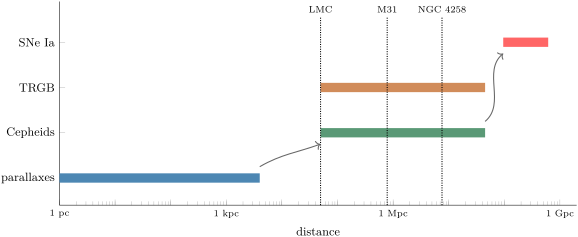
At the top of the ladder, the supernovae measure the expansion of the Universe. Hubble’s law, recalled from the physics books, makes the recession speed of a distant galaxy proportional to its distance , for small redshifts ; the Hubble constant is the slope, and the supernovae, with their distances from the ladder, give it.
Definition 29.19 (Hubble tension)
The Hubble tension is the disagreement between the value of the Hubble constant measured locally with the distance ladder and the value inferred from the cosmic microwave background with the standard cosmological model.
Figures as of 2022
The Cepheids of the hosts of 42 Type Ia supernovae, anchored on Gaia parallaxes, the masers of NGC 4258 and the eclipsing binaries of the Large Magellanic Cloud, give . The tip of the red giant branch, calibrating about a hundred supernovae, gave in 2019 (statistical and systematic). The Planck satellite’s map of the cosmic microwave background, read with the standard cosmological model, implies . The Cepheid value and the background value differ by five standard deviations; the TRGB value lies between them. The source of the discrepancy is not known: an error not yet found in one of the ladders, or physics missing from the model.
In the lab — An astrometric satellite and its catalogue
The satellite Gaia scans the sky along a commanded pattern, so that every star is measured again and again over the mission. On the ground, the coordination units of a data-processing consortium turn these measurements into a position, a parallax and a proper motion for each of more than a billion sources: of the small motions of a star on the sky, the parallax is the part that repeats each year and the proper motion the part that accumulates. Each catalogue is released with papers that describe its processing and its validation, and every distance in the figures of this section that rests on a parallax rests on such a catalogue.
Figures as of 2022
The third Gaia catalogue, released on 13 June 2022 from 34 months of observations, gives positions, parallaxes and proper motions for about 1.46 billion sources, from magnitude 3 to 21, and mean radial velocities for 33 million stars. Its parallax uncertainties are 0.02 to for stars brighter than magnitude 15, at magnitude 17, and at magnitude 20.
29.5 Exercises
Exercise 29.1 ★
The Sun’s Galactic year. (a) With and , compute the period of the Sun’s orbit about the Galactic Centre, in millions of years. (b) How many times has the Sun gone round since the Solar System formed, ago?
Solution
Solution of Exercise 29.1.
(a) ; at this takes , that is . (b) : about twenty turns.
Exercise 29.2 ★
The reflex motion of Sgr A*. (a) A proper motion of a year at is a transverse speed of a year: express it in kilometres per second. (b) Sgr A*, assumed at rest at the Galactic Centre at , drifts along the Galactic plane by a year. Compute the Sun’s speed about the centre and compare it with the review value, . (c) Subtract the Sun’s peculiar motion in the direction of rotation, , and compare with from the rotation curve.
Solution
Solution of Exercise 29.2.
(a) . (b) , within the review’s . (c) , some above the of the red giants: the two rest on different values of (8.178 and ), and the LSR itself may stream by up to about relative to a truly circular orbit.
Exercise 29.3 ★
Classifying ellipticals. (a) An elliptical galaxy’s isophotes have an axis ratio of 0.6: give its class. (b) What axis ratio does an E7 have? (c) Why may an E0 galaxy be a flattened system?
Solution
Solution of Exercise 29.3.
(a) : E4. (b) . (c) The class uses the apparent axis ratio: a flattened ellipsoid seen along its short axis has a circular outline and is classified E0.
Exercise 29.4 ★
Anchors. Compute the distances of the Large Magellanic Cloud (), Andromeda () and NGC 4258 (). What parallax would a star of the Cloud have, and why can the Cloud’s distance not be measured by parallaxes?
Solution
Solution of Exercise 29.4.
pc: the LMC , Andromeda , NGC 4258 . A star of the Cloud has a parallax of , the size of the best catalogue’s uncertainty for bright stars: a single parallax gives no distance at all, and the Cloud is placed by other means (eclipsing binaries), from which the Cepheid scale starts.
Exercise 29.5 ★★
From the Oort constants and : (a) compute the angular speed of the LSR and, with , the circular velocity ; (b) compute the slope of the rotation curve at the Sun. (c) Compare with the rotation curve of the red giants (, slope per kiloparsec) and suggest why the two differ, given that the same measurement found non-zero and .
Solution
Solution of Exercise 29.5.
(a) and . (b) : a gently falling curve. (c) Both are below the red-giant values (229 and per kiloparsec); the authors of that curve found the same, a about two standard deviations lower from and these Oort constants. Oort’s formulas assume circular orbits in an axisymmetric disc; non-zero and show that the local velocity field is perturbed by the bar and the spiral arms, and the local and carry those perturbations.
Exercise 29.6 ★★
A flat rotation curve and the local density. (a) For a spherical galaxy with a flat rotation curve at , compute the density at , in solar masses per cubic parsec ( per solar mass). (b) Show that one solar mass per cubic parsec is , and express the local dark-matter density, , in solar masses per cubic parsec. (c) Why is the density of (a) larger?
Solution
Solution of Exercise 29.6.
(a) solar masses per cubic kiloparsec, or per cubic parsec. (b) , and : the ratio is . Then solar masses per cubic parsec. (c) The flat-curve density counts all the mass that holds the orbits, stars and gas included, as if it were spread in a sphere; the dark matter is only part of it, about half here.
Exercise 29.7 ★★
A Cepheid distance. In an invented spiral galaxy a Cepheid of period has a mean Wesenheit index . (a) Using the Leavitt law of the Large Magellanic Cloud, , and the Cloud’s distance modulus 18.477, compute the Cepheid’s absolute Wesenheit magnitude. (b) Compute the galaxy’s distance. (c) The law’s scatter is : what is the relative distance error from one Cepheid, and from fifty?
Solution
Solution of Exercise 29.7.
(a) , so . (b) and . (c) for one star, for fifty, if their errors are independent (the error of the Cloud’s own distance adds to all of them alike).
Exercise 29.8 ★★
A TRGB distance. In the halo of an invented galaxy the tip of the red giant branch is found at ; the dust along the line of sight dims the I band by . With , compute the distance modulus and the distance. What does an uncertainty of on the tip mean in distance?
Solution
Solution of Exercise 29.8.
, so . An error of is in distance.
Exercise 29.9 ★★
The Hubble constant from supernovae. For a supernova of the smooth expansion, , the intercept of the supernovae’s Hubble diagram, and the distance modulus is . (a) Show that ( in kilometres per second per megaparsec). (b) With and , compute . (c) What would give ? By how many magnitudes, and by what fraction of the distances, do the two calibrations differ?
Solution
Solution of Exercise 29.9.
(a) gives , so ; with , , which is the result. (b) , so . (c) : supernovae brighter by , hence all distances larger by a factor , the ratio . The tension is a disagreement of eight percent in the scale of distances.
Exercise 29.10 ★★★
Where the Tully–Fisher law comes from. (a) A disc galaxy of mass and radius rotates at : show that . (b) If all spiral galaxies had the same mean surface density , show that . (c) Two invented galaxies on the same baryonic relation rotate at 100 and : what is the ratio of their masses? (d) Two galaxies rotate at the same speed and have the same luminosity; one gives four times the flux of the other. Compare their distances.
Solution
Solution of Exercise 29.10.
(a) A star at the edge, in a circular orbit, has (spherical approximation). (b) , so and ; with a common mass-to-light ratio, too. (c) : the faster galaxy is 27 times more massive. (d) Same luminosity: the flux falls as , so the fainter one is twice as far.
Exercise 29.11 ★★★
The winding problem. A disc rotates with a flat curve at . (a) Convert this speed to kiloparsecs per billion years. (b) A straight arm of stars runs at time zero from 4 to . Compute the orbital periods at both ends. (c) After , by what angle has its inner end gone ahead of its outer end? How many turns of a spiral is that, and what would the arm look like? (d) How does a density wave avoid this?
Solution
Solution of Exercise 29.11.
(a) , so is . (b) : at , at . (c) , 6.2 turns: the arm would be a coil of six tight turns between 4 and , far tighter than observed arms, and tighter still at each further rotation. (d) In a density wave the pattern turns at one angular speed, as a solid body; the stars and gas pass through it, so the shape of the arms does not wind up.
Exercise 29.12 ★★★
The black hole at the centre. Take the central mass to be solar masses and . (a) The star S2 orbits it in years: compute the semi-major axis of its orbit in astronomical units (Kepler’s third law in solar units, with in au, in years and in solar masses) and its angular size seen from the Earth. (b) Compute the Schwarzschild radius of the black hole in metres and in astronomical units, and the angle that its diameter subtends from the Earth, in microarcseconds. (c) Compute the mean density of the mass within its Schwarzschild radius, in solar masses per cubic parsec, and compare it with the lower bound set by the motion of Sgr A*, solar masses per cubic parsec.
Solution
Solution of Exercise 29.12.
(a) ; at it subtends (an au at one parsec subtends one arcsecond). (b) ; the diameter subtends arcsecond, about . (c) , and solar masses per cubic parsec, forty times the lower bound set by the motion and size of Sgr A*: the bound comes within a factor forty of the density of the black hole itself.
29.6 Problem: Weighing the Galaxy
Problem 29.1
Weekend problem — from the motions of stars and gas to the dark matter within
Take , per solar mass, and for a proper motion of a year at . All velocities are relative to the LSR. Use the Oort and tangent-point theorems of the chapter, and the spherical approximation for dynamical masses.
Part I — The local rotation. An invented survey of red-clump stars, all at in the Galactic plane, gives a mean radial velocity of at and at , and mean proper motions in longitude of a year at and a year at .
- What does Oort’s formula predict for the radial velocities at , , and ?
- Compute from the two radial velocities.
- Compute from the proper motion at .
- Compute again from the proper motion at , and compare.
- Compute the angular speed of the LSR and the circular velocity .
- Compute the slope of the rotation curve at the Sun. Is the curve rising, flat or falling?
- Compute the period of the Sun’s orbit and the number of turns in .
Part II — The inner rotation curve. Take . The highest radial velocities in the 21-cm profiles at , , and are 82.9, 55.6, 32.4 and .
- Why does the tangent-point method need (or the mirror quadrant), and why does it fail beyond the solar circle?
- Compute the radius of the tangent point for each longitude.
- Compute at each tangent point.
- By how much, in kilohertz, is the line of the gas at the tangent point at shifted from its rest frequency, , and in which direction?
- Compare with the red-giant curve, which gives at and at . Is the inner curve rising, flat or falling?
- If the speed at the tangent point at were that of a point mass at the centre carrying the Sun at , what would it be? What does the comparison say about the distribution of the mass?
Part III — The visible mass. Use the mass model of the chapter, in units of solar masses and kiloparsecs: a Plummer bulge , ; a thin Miyamoto–Nagai disc , , ; a thick one of the same mass with , .
- Compute the total visible mass of the model and compare it with the review value of the Galaxy’s stellar mass, solar masses.
- Compute the circular velocity of the bulge alone at .
- Compute those of the thin and of the thick disc at .
- Compute the circular velocity of all the visible mass at .
- Compute the same at , and compare with .
- If all the visible mass were concentrated at the centre, what would the velocity be at ? Why is the model’s value close to it?
Part IV — The dark matter. The red giants give a circular velocity of at .
- Compute the dynamical mass within .
- Compute the dynamical mass of the visible matter within .
- Compute the mass of dark matter within , and show that its fraction is .
- The NFW halo fitted to the whole curve has solar masses per cubic kiloparsec and . Compute its mass within and the dark fraction it implies. Why does it differ from the previous answer?
- Compute the density of that halo at , in solar masses per cubic parsec and in (one solar mass per cubic parsec is ).
- Give the dark-matter fraction of the mass within found from the measured velocity, in per cent, to two significant figures.
Solution
Solution of Problem 29.1.
Part I.
1. : at , 0 at , at , 0 at .
2. .
3. At , , so .
4. At , , so : the two agree within .
5. and .
6. : gently falling.
7. : ; turns.
Part II.
8. The tangent point needs a line of sight that passes closer to the centre than the Sun is, with (or the mirror quadrant, , where the largest velocity is the most negative). Outside the solar circle the distance to the centre grows all along the line of sight: no point is singled out, and the velocity alone does not say where the gas is.
9. : .
10. : , , , .
11. , towards lower frequencies: the gas recedes.
12. Within about of the red giants: between 5 and the curve is flat.
13. A point mass gives at the first tangent point, much faster than the found: the mass is not concentrated at the centre, much of it lies between 5 and and beyond.
Part III.
14. solar masses, nearly twice the review’s ; the model’s stars may be too heavy, which would make the dark matter found below an underestimate.
15. , .
16. Thin: , , . Thick: , .
17. .
18. At : 74.8, 108.4 and , together , against : the visible mass falls short already at the Sun.
19. . The model’s is close, because at , four to six disc scale lengths out, nearly all the visible mass lies inside the orbit: the visible curve has become Keplerian.
Part IV.
20. solar masses.
21. solar masses.
22. ; since both masses are at the same , the fraction is .
23. , , solar masses; the dark fraction is . The halo is fitted to the whole curve, which at it overshoots: the measurements dip there by about below the smooth model ().
24. , solar masses per cubic kiloparsec, per cubic parsec, or , the value the authors of the fit quote.
25. : the dark-matter fraction of the mass within is .
本章定义的术语
- Cepheid variable; Leavitt law
- Dark-matter halo
- Density-wave theory
- Galactic coordinates
- Galactic disc, thick disc, bulge and stellar halo
- Hubble sequence; elliptical, lenticular, spiral and irregular galaxies
- Hubble tension
- Local Group; galaxy cluster
- Local standard of rest
- Rotation curve; Oort constants
- Standard candle; distance ladder
- Stellar population
- Supermassive black hole
- Tip of the red giant branch
- Tully–Fisher relation