সব বই

পেশাদার

1 Markets I: The Ecosystem and Exchange-Traded Marketsবাজার অনলাইন 2 Markets II: Rates, FX and Creditবাজার অনলাইন 3 Markets III: Commodities, Energy and Cryptoবাজার অনলাইন 4 Quantitative Methodsপদ্ধতি অনলাইন 5 Derivatives and Volatilityডেরিভেটিভস অনলাইন 6 Rates, Credit, XVA and Riskসুদহার, ঋণ ও ঝুঁকি অনলাইন 7 Research Craft: Predictors, Backtests, Measurement, Portfoliosগবেষণা অনলাইন 8 Strategies I: Equities and Futuresকৌশল অনলাইন 9 Strategies II: Volatility, Relative Value, Macro and the Bank Desksকৌশল অনলাইন 10 Microstructure and Executionএক্সিকিউশন অনলাইন 11 Market Making and High-Frequency Tradingমার্কেট মেকিং অনলাইন 12 Machine Learning for Marketsমেশিন লার্নিং অনলাইন 13 Low-Latency Softwareপ্রযুক্তি অনলাইন 14 Networks, Hardware and Trading Infrastructureপ্রযুক্তি অনলাইন 15 Research, Data and Risk Platformsপ্রযুক্তি অনলাইন 16 The Desk and the Firmপ্রতিষ্ঠান অনলাইন 17 The Industry: Firms, Roles and Careersক্যারিয়ার অনলাইন 18 Interviews I: Maths, Probability and Speedক্যারিয়ার অনলাইন 19 Interviews II: Markets, Trading Games and the Final Roundক্যারিয়ার অনলাইন 20 Interviews III: Codeক্যারিয়ার অনলাইন
অ্যাপ পরিচিতি Coach সাইন ইন পড়া শুরু করো

বইগুলো এখনো বাংলা ভাষায় পাওয়া যায় না — ইংরেজি সংস্করণ দেখানো হচ্ছে।

Earth and Space Sciences · পরিভাষা

Condensation temperature, condensation sequence কী?

অন্য নাম: condensation temperature · condensation sequence

Definition 2.3 University Earth and Space Sciences — Year 2 · অধ্যায় 2 — Planet Formation and Meteorites

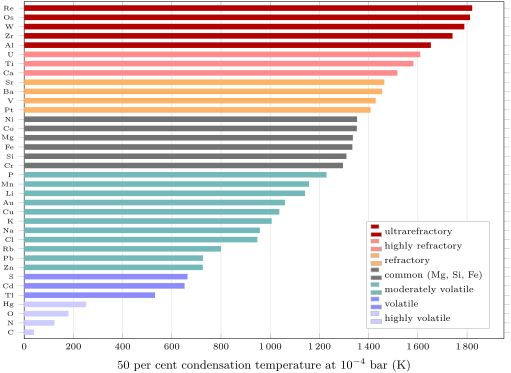
The condensation temperature of an element in a cooling gas of given composition and pressure is the temperature at which half of it has passed into solids at chemical equilibrium (the 50 per cent condensation temperature; the temperature at which its first solid appears is the appearance temperature). The condensation sequence is the order in which the elements and their solid compounds appear as the gas cools.

solidformulaappears at (K)
corundumAlX2OX3\ce{Al2O3}1677
hiboniteCaAlX12OX19\ce{CaAl12O19}1659
perovskiteCaTiOX3\ce{CaTiO3}1593
spinelMgAlX2OX4\ce{MgAl2O4}1397
iron–nickel metalFe\ce{Fe}, with Ni\ce{Ni}, Co\ce{Co}, Cr\ce{Cr}1357
forsteriteMgX2SiOX4\ce{Mg2SiO4}1354
schreibersiteFeX3P\ce{Fe3P}1248
troiliteFeS\ce{FeS}704
magnetiteFeX3OX4\ce{Fe3O4}371
water iceHX2O\ce{H2O}182
ammonia hydrateNHX3 ⋅ HX2O\ce{NH3.H2O}131
methane clathrateCHX4 ⋅ 7 HX2O\ce{CH4.7H2O}78
Table 2.1. The condensation sequence of a gas of solar-system composition at 10−410^{-4} bar: the temperature at which each solid first appears. Sodium and potassium enter feldspar; nickel, cobalt and chromium dissolve in the metal. Data: Lodders (2003).
The 50 per cent condensation temperatures of 36 elements in a gas of solar-system composition at 10-4 bar, coloured by Lodders’ volatility groups (oxygen: as water ice; carbon: as methane clathrate and ice). Data: Lodders (2003).
The 50 per cent condensation temperatures of 36 elements in a gas of solar-system composition at 10−410^{-4} bar, coloured by Lodders’ volatility groups (oxygen: as water ice; carbon: as methane clathrate and ice). Data: Lodders (2003).
প্রসঙ্গসহ পড়ো →