University Earth and Space Sciences — Year 2 · Bachelor Year 2
2Planet Formation and Meteorites
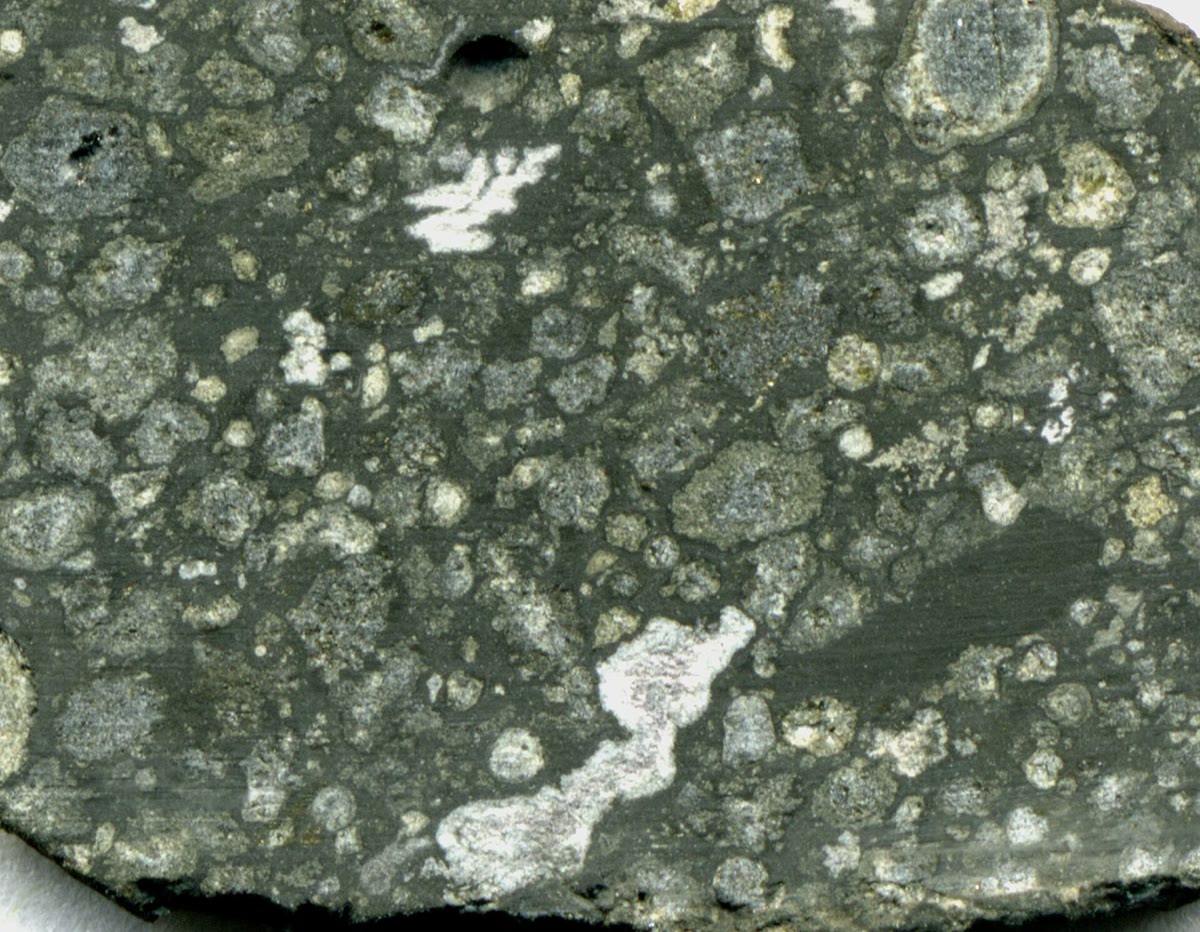
Every year some fifteen thousand tonnes of dust from space enter the Earth’s atmosphere; most of it burns up or settles as microscopic spherules, and once in a while a stone the size of a fist falls with a fireball and a sonic boom. Most of these stones are pieces of asteroids, and many have hardly changed since they formed. Cut one open and polish it, and it shows millimetre-sized beads of once-molten rock, white irregular grains of calcium and aluminium minerals, flakes of metal, all held in a dark, fine-grained cement. The white grains are the oldest solids of the Solar System: lead isotopes date them to 4567 million years. A second clock, the decay of a radioactive isotope of aluminium that has long since vanished, dates the other components relative to them to within a fraction of a million years. This chapter follows the disc of the previous chapter as it turns into planets: which solids condense from the cooling gas, and where; how dust grows into bodies kilometres across and then into planets; what the meteorites are, and how they date these events; and why some of the first bodies melted and grew iron cores while others stayed as they had formed.
You already know
Young stars are surrounded by protoplanetary discs, which disappear within a few million years; a grain in starlight at the distance from a star of luminosity settles at (Chapter 1). Asteroids are the small rocky or metallic bodies of the Solar System, most of which orbit between Mars and Jupiter (Year 1 volume). A radioactive nucleus decays with the probability per unit time: ; the half-life is , and the mean life (physics). In a closed system, cogenetic samples of different parent-to-daughter ratios lie on a straight line, the isochron, whose slope gives the age and whose intercept is the initial ratio (Year 1 volume). Heating a mass of specific heat capacity by takes the energy (physics).
2.1 The solar nebula
Definition 2.1 (Solar nebula)
The solar nebula is the protoplanetary disc of gas and dust that surrounded the young Sun and from which the planets, their satellites, the asteroids and the comets formed.
How much matter did it hold? A lower limit comes from the planets themselves. Add to each planet enough hydrogen and helium to give it the composition of the Sun, spread the result over a ring centred on its orbit, and the surface density, the mass per unit area of the disc, falls off with the distance from the Sun. This reconstruction is the minimum-mass solar nebula. In a widely used version the surface density of the gas is
and that of the solids , where is the fraction of the condensable matter actually solid: where only rock and metal have condensed, about where water ice has joined them, beyond the place where methane freezes. The numbers are uncertain: the heavy-element content of Jupiter is known only to within a factor of four, and the planets need not have formed where they orbit now.
Proposition 2.2 (Mass of a disc)
A disc of surface density holds, inside the radius , the mass
Most of the mass lies far out: doubling the radius adds to the mass.
Proof. A ring of radius and width has the area , so
which is the formula; the integral converges at . Doubling multiplies by . ∎
With at , the minimum-mass nebula holds solar masses inside (Exercise 2.5). The discs observed around stars a million years old, weighed by the millimetre glow of their dust, hold solar masses: the minimum-mass nebula sits comfortably among them.
Almost all of this mass is gas that will never condense. The Sun was born with a mass fraction of hydrogen , of helium and of all heavier elements together only . Cooling a gas of this composition until everything that can freeze has frozen turns only of its mass into solids: of rock and metal, and of ices of water, methane and ammonia, water ice alone being . All the rocky planets, and the cores of the giants, were built from this small fraction.
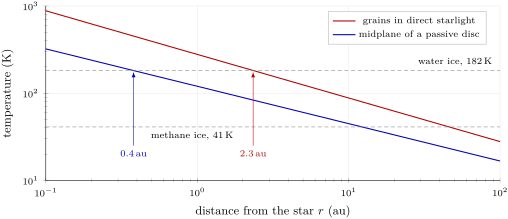
The temperature of the disc decides what is solid where. A disc heated only by its star, a passive disc, is warm at its surface, where the grains see the star directly (the proposition of Chapter 1), and much colder in its midplane, which receives only the infrared re-emitted by those surface grains. For a young star of one solar mass a model of such a disc gives the midplane temperature
Accretion of gas through the disc, which releases gravitational energy, makes the midplane hotter, especially early on and close to the star (figure below).
2.2 The condensation sequence
Imagine the gas of the nebula, close to the young Sun, hot enough for every element to be vapour, and let it cool slowly enough for gas and solids to remain in chemical equilibrium. As the temperature falls, each element leaves the gas for a solid in turn, either as a compound of its own or dissolved in a solid that has already formed.
Definition 2.3 (Condensation temperature, condensation sequence)
The condensation temperature of an element in a cooling gas of given composition and pressure is the temperature at which half of it has passed into solids at chemical equilibrium (the 50 per cent condensation temperature; the temperature at which its first solid appears is the appearance temperature). The condensation sequence is the order in which the elements and their solid compounds appear as the gas cools.
Calculations for a gas of solar composition are made at a total pressure of bar, typical of the nebula near . The first solids are oxides of aluminium and calcium (table below), which form at about ; the bulk of the rock-forming matter, magnesium silicate and iron metal, condenses near ; iron sulfide waits until , and water ice until .
| solid | formula | appears at (K) |
|---|---|---|
| corundum | 1677 | |
| hibonite | 1659 | |
| perovskite | 1593 | |
| spinel | 1397 | |
| iron–nickel metal | , with , , | 1357 |
| forsterite | 1354 | |
| schreibersite | 1248 | |
| troilite | 704 | |
| magnetite | 371 | |
| water ice | 182 | |
| ammonia hydrate | 131 | |
| methane clathrate | 78 |
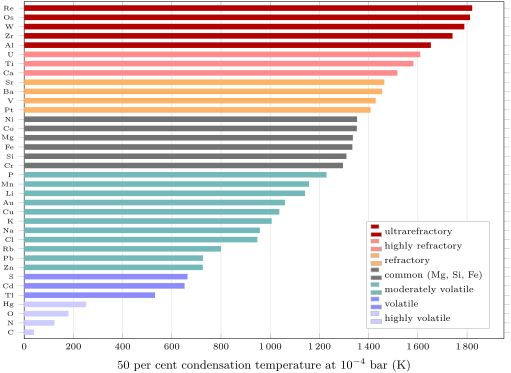
The 50 per cent condensation temperatures sort the elements into groups of volatility (figure below). Elements that condense above magnesium, silicon and iron are refractory; those that condense below them, volatile. Lodders divides each side further: the ultrarefractory elements, above , include aluminium, zirconium, the heavy rare earths and the metals osmium, rhenium and tungsten; the highly refractory ones () include calcium and titanium; the refractory ones () include strontium, barium, vanadium and platinum; the common elements magnesium, silicon and iron condense between and , together with nickel, cobalt and chromium; the moderately volatile elements, among them sodium, potassium, phosphorus, copper, zinc and lead, condense between and the appearance of troilite at ; the volatile ones, among them sulfur, cadmium and thallium, between and ; and the highly volatile elements, carbon, nitrogen, oxygen as ice, the noble gases and mercury, below that.
The sequence explains a pattern that runs through the whole Solar System. The oldest solids in meteorites are made of the first condensates; the Earth and the other rocky planets are poor in volatile elements; the far reaches of the disc, cold enough to keep ices, made icy bodies. The most important boundary is the one for water, because water ice is the most abundant solid of all: by mass, there is about as much water ice in a gas of solar composition as rock and metal together, times more.
Definition 2.4 (Snow line)
The snow line of a protoplanetary disc is the distance from the star beyond which the midplane is cold enough for water ice to be stable, about at the pressures of the disc.
Proposition 2.5 (Snow line of a passive disc)
If the midplane temperature falls as , the snow line of water, which condenses at , lies at
and beyond it the surface density of solids jumps by the factor , where and are the masses of water ice and of rock in the gas.
Proof. Solving for gives . Inside only rock and metal are solid; beyond it the water ice adds its mass to the rock of the same gas, so the solid mass is multiplied by . ∎
For the passive disc above, and give ; methane, at , freezes beyond (Exercise 2.6). With of water ice and of rock, the solids jump by a factor . The model places the snow line far inside the Earth’s orbit, which shows only that a young disc was not passive: heated by accretion, its inner midplane was warmer, and the snow line lay farther out, moving inward as the disc thinned. Beyond it, the planets had more than twice as much solid matter to build from, and this, more than anything else, separates the small rocky planets from the giants.
2.3 From dust to planets
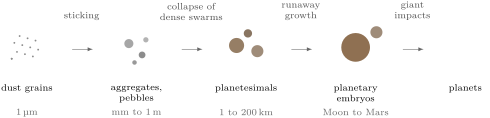
Between the micrometre grains of the interstellar medium and planets thousands of kilometres across lie some thirteen orders of magnitude of size. The growth is best described in three legs. Below about a centimetre, grains that collide gently stick, held by chemical bonds and van der Waals forces, and build fluffy aggregates. Well above a kilometre, bodies hold together by their own gravity, and the fragments of a collision fall back onto the larger body. Between the two lies the hardest leg: bodies from centimetres to metres are too large to stick and too small to attract one another, and the gas drags them inward. In numerical simulations, solids across gather into dense swarms that collapse under their own weight directly into bodies kilometres across, skipping the troublesome sizes; how the Solar System crossed this leg is still debated.
Definition 2.6 (Planetesimal, planetary embryo)
A planetesimal is a solid body of a protoplanetary disc large enough, from about a kilometre to a few hundred kilometres across, for its growth to be governed by gravity rather than by sticking. A planetary embryo is a body that has grown, by accreting planetesimals, large enough to dominate its own region of the disc and to sweep it clear of planetesimals.
Once gravity rules, growth runs away: a body slightly larger than its neighbours draws planetesimals towards itself from farther away, grows faster than they do, and pulls ahead. Its growth slows only when it has swept up the solids within its reach. Each embryo then rules its own annulus of the disc, and many embryos share the region of the rocky planets.
Proposition 2.7 (Isolation mass)
An embryo of mass at the distance from a star of mass attracts the solids of an annulus whose half-width is a few times its Hill radius . If it gathers all the solids of an annulus of total width and surface density , it stops growing at the isolation mass
Proof. The annulus of radius and width holds the mass . The embryo has swallowed it when , that is ; raising both sides to the power gives the formula. ∎
Models take . In the minimum-mass nebula the isolation mass is about Earth masses at , between the masses of the Moon () and of Mars (): the embryos of the inner Solar System were bodies of that size, and the Earth needed many of them. Beyond the snow line, at , the ice-rich solids give about Earth masses, and a disc with times the minimum mass of solids gives some five Earth masses (Exercise 2.7): enough, in models of Jupiter’s growth, for a core to pull in its gas envelope within three million years. The giant planets had to form before the gas of the disc was gone, within a few million years; Uranus and Neptune are rock and ice by mass: they gathered little gas.
The last stage of the rocky planets was violent. Once the gas was gone, the embryos’ orbits crossed, and they merged in giant collisions; the Moon is thought to have formed from the debris of one of them, which struck the young Earth. The figure below sums up the sequence.
The planets kept little memory of this history: they melted, mixed and reworked their matter. The record is in the bodies that stopped growing, the asteroids, and in the pieces of them that reach the Earth.
2.4 Meteorites
Definition 2.8 (Meteorite, meteorite fall, meteorite find)
A meteorite is a natural solid object from space that has survived its passage through the atmosphere and reached the ground. A meteorite fall is a meteorite collected after its arrival was observed, usually as a fireball; a meteorite find is one recognised on the ground without its fall having been seen.
The Earth sweeps up far more dust than stones. Measured in the snow of the Antarctic plateau, about of extraterrestrial dust reaches the ground each year as micrometeorites and molten spherules, out of some that enter the atmosphere, most of it shed by comets and about a fifth by asteroids. Meteorites, the stones and irons large enough to be recognised one by one, are fewer: the world’s catalogue holds about of them, of which only are falls.
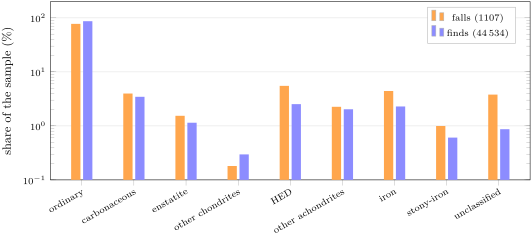
The distinction matters. A fall is collected within days, before rain and oxygen have altered it, and every kind of meteorite that falls is collected alike; a find may have lain on the ground for thousands of years, and its chance of being found depends on how it looks and where it fell. Half of all finds have been made in Antarctica (box below), where the search is systematic. The falls are the fairer sample of what arrives (figure below): more than four in five are chondrites, three in four ordinary chondrites.
In the field — Searching for meteorites on the blue ice
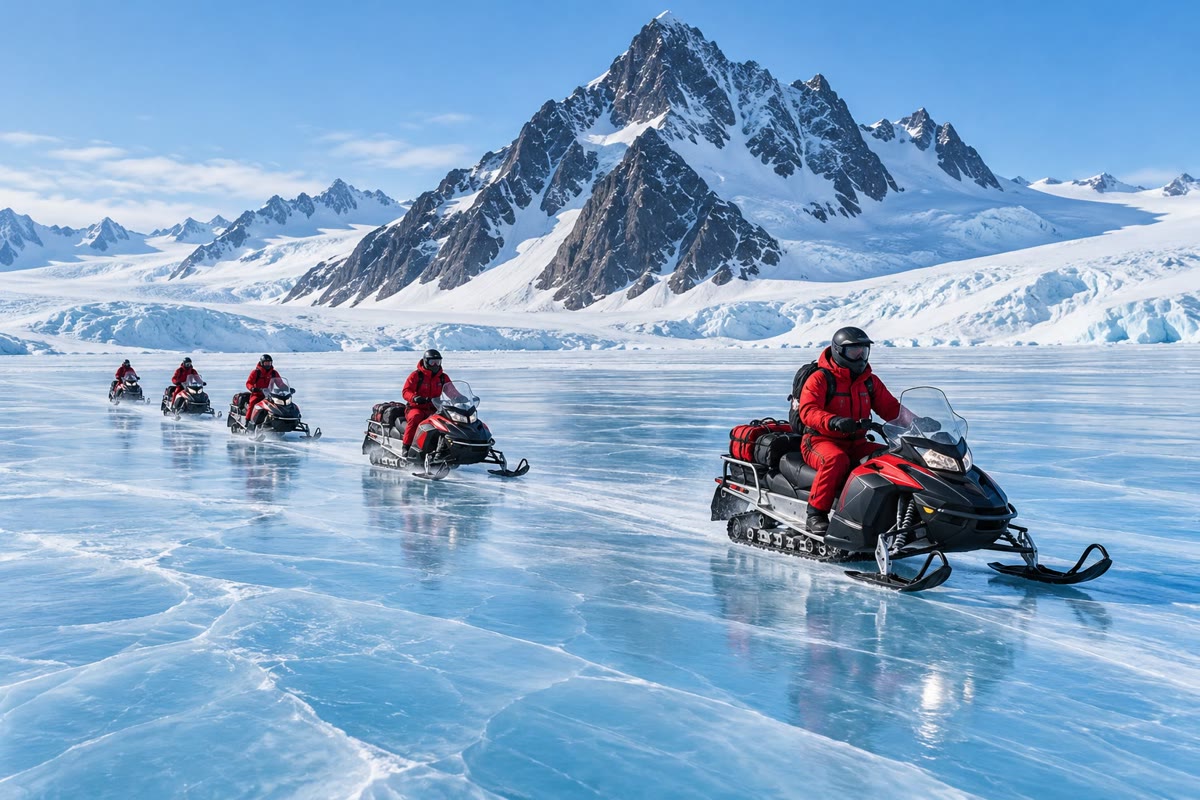
Most of the Antarctic ice sheet is white snow, but on about of its surface, where mountains block the flow of the ice, some of ice is lost each year and bare blue ice shows. Meteorites that fell on the snow upstream, over tens of thousands of years, are buried, carried along in the ice and brought back to the surface where it wastes away: the blue ice is a trap. Since systematic collecting began in the mid-1970s, teams have recovered more than specimens from such fields, and in the catalogue half of all finds come from south of S. The searchers cross the ice in lines, on foot or on snowmobiles, and every stone found is collected, however ordinary it looks, so that the collection is not biased towards the striking ones. Each find is photographed where it lies, to record its context, and given a field number; later it receives its official name, a three-letter code for the ice field followed by the year of the season and a serial number. In the curation laboratory the stones are chipped with stainless-steel tools or cut dry with a band saw; carbonaceous chondrites, which may hold organic compounds, have had a cabinet of their own since 1978.
2.4.1 Chondrites
Definition 2.9 (Chondrite, carbonaceous chondrite, chondrule, CAI)
A chondrite is a stony meteorite that never melted after it was assembled, and whose composition, apart from the most volatile elements, is close to that of the Sun. Most of it is made of chondrules, rounded droplets, a tenth of a millimetre to about a centimetre across, of silicate rock that solidified from a melt, set in a fine-grained matrix with grains of iron–nickel metal and iron sulfide. Some chondrites hold calcium–aluminium-rich inclusions (CAIs), irregular white grains of the minerals of calcium, aluminium and titanium that are the first condensates of the nebula. A carbonaceous chondrite is a chondrite rich in carbon, water-bearing minerals and matrix, whose content of the volatile elements comes closest to the Sun’s.
The chondrules were molten for only minutes and cooled over hours to days: some brief, local flash heating in the nebula, whose cause is still unknown, melted clumps of dust, which froze as droplets before they were swept together with dust and metal into a planetesimal. They fill up to of the volume of the most primitive meteorites. The CAIs make up from less than of ordinary chondrites to over of some carbonaceous ones, and they formed within about a hundred thousand years of one another.
Chondrites fall into groups that differ in the size and abundance of their chondrules, their content of metal, the iron content of their olivine and the proportion of their matrix (table below). The ordinary chondrites H, L and LL have high, low and very low contents of metal and of total iron (atomic ratios Fe/Si of , and ).
| H | L | LL | CI | CM | CV | |
|---|---|---|---|---|---|---|
| chondrules (vol. %) | 60–80 | 60–80 | 60–80 | 20 | 45 | |
| mean chondrule diameter (mm) | 0.3 | 0.7 | 0.9 | — | 0.3 | 1.0 |
| CAIs (vol. %) | 0.1–1 | 0.1–1 | 0.1–1 | 5 | 10 | |
| matrix (vol. %) | 10–15 | 10–15 | 10–15 | 70 | 40 | |
| iron–nickel metal (vol. %) | 10 | 5 | 2 | 0 | 0.1 | 0–5 |
| fayalite in olivine (mol %) | 16–20 | 23–26 | 27–32 | |||
| petrologic types | 3–6 | 3–6 | 3–6 | 1 | 2 | 3 |
| highest temperature (K) | 1220 | 1220 | 1220 | 430 | 670 | 870 |
Definition 2.10 (Petrologic type)
The petrologic type of a chondrite is a number from 1 to 6 that records what happened to it in its parent body: type 3 is the least altered; types 4 to 6 are increasingly heated, their chondrules blurred and their minerals recrystallised and of uniform composition; types 2 and 1 are increasingly altered by liquid water, which turned their minerals into clays.
The last row of the table gives the highest temperatures reached by each group: up to about for the most heated ordinary chondrites, never more than for the CI chondrites, soaked in water but never hot. The heating, as the last section shows, came from inside the parent bodies.
2.4.2 Achondrites and irons
Definition 2.11 (Achondrite, iron meteorite, stony-iron meteorite)
An achondrite is a stony meteorite that crystallised from a melt or recrystallised at high temperature in a body that melted, and so has no chondrules. An iron meteorite is made mostly of iron–nickel metal. A stony-iron meteorite is made of metal and silicate in roughly equal amounts.
These are the pieces of bodies that melted and separated: achondrites are their crusts and mantles, irons their metal cores, and stony-irons come from where metal and silicate met. The largest family of achondrites, the howardites, eucrites and diogenites (HED), basalts and pyroxene-rich rocks, makes up of all falls. Its source was traced, by its spectrum and its orbit, to the asteroid Vesta, about across, and the Dawn spacecraft, which reached Vesta in 2011, confirmed it: the chemistry and mineralogy of Vesta’s surface match the HED meteorites, a basin wide near its south pole shows where the fragments were knocked off, and its gravity field points to an iron core about across. Vesta melted, nearly or entirely, early in its history. Other achondrites come from the Moon and from Mars. The meteorites in the collections appear to come from about a hundred different parent bodies.
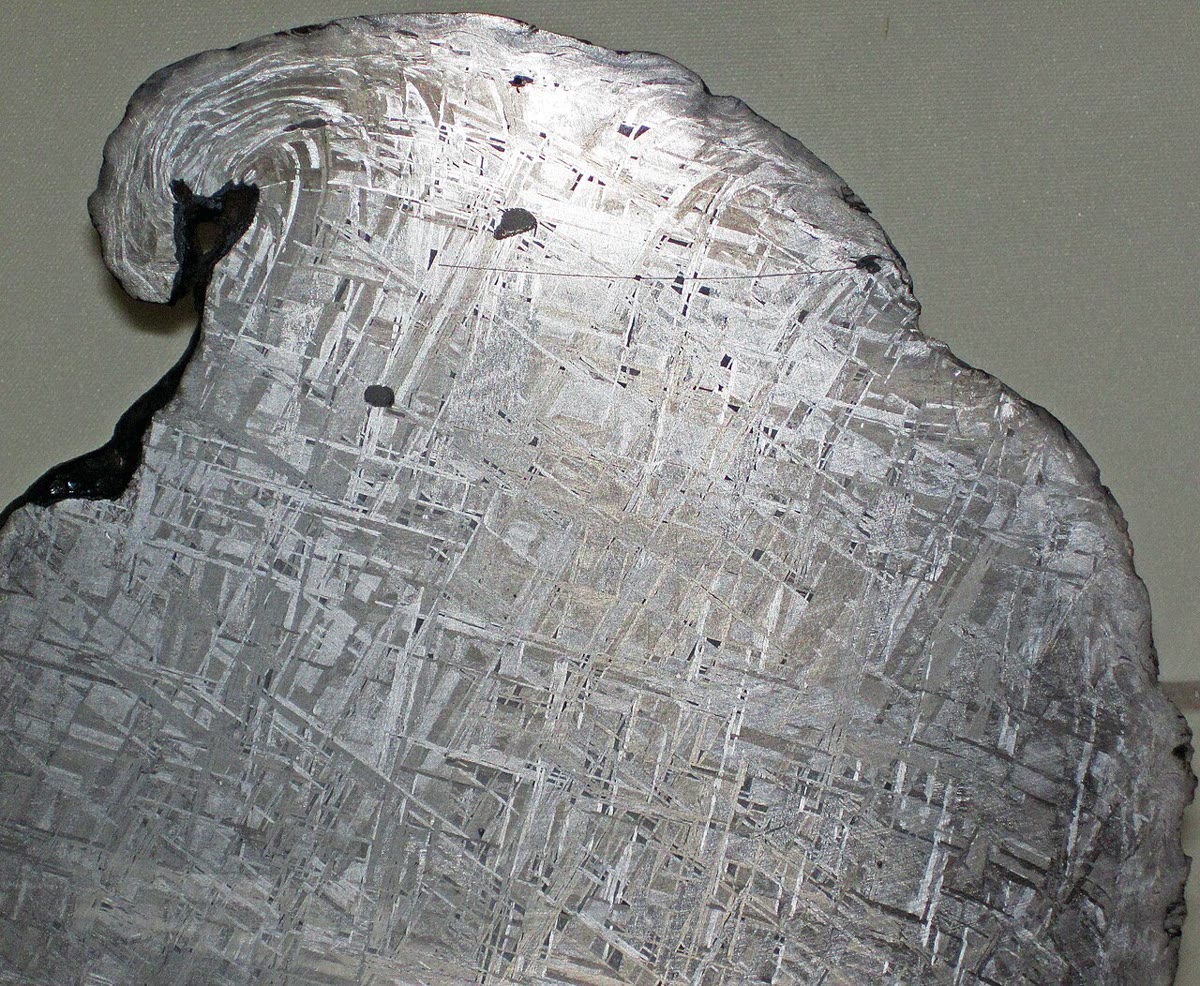
Iron meteorites keep the record of how their cores cooled. A cut and acid-etched face shows a criss-cross of plates (figure below): at high temperature the metal is a single alloy of iron and nickel; on slow cooling, a nickel-poor alloy grows in plates along the planes of the original crystal, and the slower the cooling, the wider the plates. Measured on many irons, the plate widths give the cooling rates of the cores they came from.
2.5 Dating the Solar System
The age of the Solar System is the age of its oldest solids. Uranium–lead isochrons of CAIs, built as in the Year 1 volume, give ; the CAIs formed within about of one another, a time short enough for their age to be taken as the birth of the Sun. The events of the next few million years, the formation of chondrules and the assembly and melting of the first bodies, are best dated relative to the CAIs, with clocks that ran fast and stopped early.
Definition 2.12 (Short-lived radionuclide)
A short-lived radionuclide is a radioactive nuclide with a half-life of roughly to , present when the Solar System formed and now extinct, whose former presence is shown by an excess of its daughter in minerals that were rich in its element.
The best known is aluminium-26, which decays to magnesium-26 with a half-life of (a mean life of ). When the CAIs formed, one aluminium atom in about was aluminium-26: the ratio was , the canonical value. Other short-lived nuclides cover longer spans (table below).
| nuclide | daughter | reference | half-life (Myr) | early ratio |
|---|---|---|---|---|
| 0.717 | ||||
| 2.62 | ||||
| 3.74 | ||||
| 6.5 | ||||
| 8.90 | ||||
| 15.7 |
Proposition 2.13 (Relative age from an extinct nuclide)
If the ratio of a short-lived nuclide to its reference isotope was everywhere when the CAIs formed, and is found to have been in an object when it formed, the object formed
after the CAIs, where is the mean life of the nuclide. An error on gives the error on .
Proof. The reference isotope is stable, so the ratio decays like the radioactive nuclide itself: . Taking logarithms, . Differentiating, . ∎
A relative error of on the ratio thus costs with aluminium-26 but with manganese-53 and with hafnium-182: each clock is precise only over a few of its own mean lives, and the right clock depends on the event. The ratio in an object is read from its minerals.
Proposition 2.14 (Aluminium–magnesium isochron)
Let several minerals of one object form together at the time with the same isotopic composition of magnesium, , but different ratios , and stay closed since. Today they lie on the straight line
whose slope is the ratio of the object when it formed.
Proof. Every aluminium-26 atom present at formation has since become a magnesium-26 atom, so a mineral gained atoms of magnesium-26, aluminium-27 being stable. Dividing by the number of magnesium-24 atoms, which is unchanged, gives the line. ∎
Aluminium-rich, magnesium-poor minerals such as plagioclase show large excesses of magnesium-26; olivine, almost free of aluminium, shows none. This is how the time sequence of the early Solar System was built: CAIs first; chondrules over the following few million years, with the evidence from chondrules setting the lifetime of the gas disc at less than five million years; the parent bodies of the chondrites assembled after their youngest chondrules. The diogenites, rocks of Vesta’s mantle, began to crystallise within about a million years of the CAIs, and Vesta’s core formed within the first one to four million years: iron meteorites and achondrites are older than many chondrites.
2.6 Heat from aluminium-26 and the first melting
Where did the heat that melted Vesta, and metamorphosed the ordinary chondrites, come from? Models and meteorites agree that in the earliest bodies the dominant source was the decay of aluminium-26. In rock of chondritic composition it carried, at the start, per kilogram ready to be released within a few million years: enough to heat the rock by thousands of kelvins, if the heat could not escape.
Proposition 2.15 (Heating of a planetesimal by aluminium-26)
Rock that receives the radioactive power per kilogram, has the specific heat capacity and loses no heat, warms after its accretion at the time as
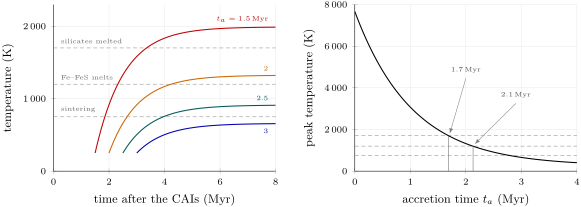
and tends to the peak temperature . A critical temperature is reached only if the body accreted before
Proof. With no losses, . Integrating from , where , gives , which tends to as . Setting and solving for gives ; for an earlier accretion the peak is higher. ∎
A model of the parent body of the ordinary chondrites uses , and . Then is about . Three temperatures matter: near the porous rock starts to sinter into a compact one; near the metal and the iron sulfide begin to melt together; near the last silicates melt. A body that accreted before melted entirely; before its metal and sulfide melted and could sink into a core; until about it was at least sintered and metamorphosed; later bodies stayed cool (figure below).
The proposition ignores heat loss, which holds only deep inside a large body. Heat diffuses over the distance in the time , where is the thermal diffusivity of the rock: with the values of the model, about in one mean life of aluminium-26 (Exercise 2.12). Bodies much smaller than this lose their heat as fast as they make it; detailed models show that bodies more than across could melt.
Definition 2.16 (Planetary differentiation)
Planetary differentiation is the separation of a body, once molten or partly molten, into layers of different composition and density: a metal core, a silicate mantle and a crust made of the last melts.
The meteorites thus record two kinds of early bodies. Those that formed within about the first two million years had enough aluminium-26 to melt and differentiate: their cores are the iron meteorites, their crusts and mantles the achondrites, Vesta the survivor. Those that formed later stayed chondrites, heated from inside to a degree set by their date of birth and by the depth of each fragment: the deepest became type 6, the shallowest stayed type 3. The Earth itself, built from embryos and planetesimals of both kinds and struck by giant impacts, differentiated into its core, mantle and crust.
2.7 Exercises
Exercise 2.1 ★
In the minimum-mass solar nebula, compute the surface density of the gas at and at , and the surface density of the solids at (rock only, ) and at (all ices condensed, ). How many times heavier than the solids is the gas at ?
Solution
Solution of Exercise 2.1.
Gas: at ; at , . Solids: at ; at . At the gas is times heavier than the solids.
Exercise 2.2 ★
Using the figure of the condensation temperatures, sort aluminium, sodium, magnesium, iron, sulfur and oxygen (as water ice) from the first to condense to the last, and give the volatility group of each. Which of them would you expect to find enriched in CAIs, and which depleted in the Earth compared with the Sun?
Solution
Solution of Exercise 2.2.
Aluminium (, ultrarefractory), magnesium (, common), iron (, common), sodium (, moderately volatile), sulfur (, volatile), oxygen as water ice (, highly volatile). CAIs, the first condensates, are enriched in aluminium (and calcium, titanium); the Earth is depleted in the volatile ones, sodium, sulfur and water, relative to magnesium and aluminium.
Exercise 2.3 ★
The catalogue lists falls, of which 856 are ordinary chondrites and 49 irons, and finds, of which are ordinary chondrites, irons and come from south of S. Compute the share of ordinary chondrites and of irons among the falls and among the finds, and the share of Antarctic finds. Which sample would you use to estimate the proportions in which the classes arrive on the Earth, and why?
Solution
Solution of Exercise 2.3.
Falls: ordinary chondrites , irons . Finds: and . Antarctic finds: . The falls: every observed fall is collected whatever its class, whereas a find depends on how well the meteorite survives on the ground, how it looks and where people search, and half of the finds come from one kind of place.
Exercise 2.4 ★
The minerals of an object give the initial ratio . How long after the CAIs did it form? Take and a mean life of .
Solution
Solution of Exercise 2.4.
after the CAIs.
Exercise 2.5 ★★
Using Proposition 2.2 with at ( , ), compute the mass of the minimum-mass nebula inside and inside , in solar masses. Compare with the observed discs, solar masses.
Solution
Solution of Exercise 2.5.
. Inside : , so solar masses; inside : , solar masses. Both lie within the observed range, nearer its upper end: the nebula was an ordinary disc.
Exercise 2.6 ★★
In the passive disc , find where water ice () and methane ice () become stable. A grain in direct sunlight reaches at . Why do the two estimates of the snow line differ, and which one applies to the bodies that built the planets?
Solution
Solution of Exercise 2.6.
au: for water, ; for methane, . The grain in direct sunlight is the surface layer of the disc; the midplane, shielded by the dust above it, is colder, so ice survives closer in. The planetesimals formed in the midplane, so the midplane estimate applies, provided the disc is passive; heating by accretion moves the snow line out.
Exercise 2.7 ★★
Compute the isolation mass, with , of an embryo at in the minimum-mass nebula (), and at beyond the snow line (), in Earth masses (, ). What does it become at in a disc with times more solids?
Solution
Solution of Exercise 2.7.
At : , , so ; , divided by : Earth masses. At : , , , Earth masses. With times more solids, grows as : 5.5 Earth masses.
Exercise 2.8 ★★
Rock of CI composition held atoms of aluminium-26 per gram when the CAIs formed, and each decay leaves of heat. Compute the heat released per kilogram over the whole decay, and the temperature rise it would give with and no losses. How many times more is it than the heat needed to warm the rock from to ?
Solution
Solution of Exercise 2.8.
Per kilogram, atoms, so . The temperature rise would be . Warming from to takes : aluminium-26 supplied about four times that.
Exercise 2.9 ★★
Over its whole decay, aluminium-26 releases per gram of CI rock and iron-60 per gram. Compute the ratio of the two energies. The half-life of iron-60 is : compute its mean life, and the ratio of the two initial heating powers, energy divided by mean life.
Solution
Solution of Exercise 2.9.
. The mean life of iron-60 is . Initial powers per gram: and erg per gram per million years, a ratio of about : aluminium-26 dominated by far.
Exercise 2.10 ★★★
With the results of Exercise 2.9, find the time after which iron-60 heats rock faster than aluminium-26. Could iron-60 have melted a body that accreted that late? (Compare the energy it still has to release then with the needed to warm rock from to .)
Solution
Solution of Exercise 2.10.
The powers are equal when , that is ; with per million years, . By then iron-60 has left , that is : thousands of times too little to melt anything.
Exercise 2.11 ★★★
With , , and (a year of ), compute the latest accretion times for which the centre of a large body reaches and . Some measurements suggest that the initial aluminium-26 was only half the canonical value in parts of the disc: by how much would both times move? Show that the shift does not depend on the critical temperature.
Solution
Solution of Exercise 2.11.
and . For : ; for : . Halving subtracts from both, since and only the first term changes: the shift is one half-life, whatever the critical temperature.
Exercise 2.12 ★★★
Rock of conductivity , density and specific heat capacity has the thermal diffusivity . Compute it, and the distance over which heat diffuses in one mean life of aluminium-26. Explain why the heating proposition applies to the centre of a body across but not to a body across, and compare with the smallest bodies that could melt, across.
Solution
Solution of Exercise 2.12.
and , about . The centre of a body across is deep, ten times this distance: its heat cannot escape while aluminium-26 decays, and the proposition applies. A body across loses its heat as fast as it makes it. Melting needs a radius of a few times , that is a diameter of some or more, as the models find.
2.8 Problem: The stone that fell on the frozen lake
Problem 2.1
Weekend problem — classifying a freshly fallen stone, dating its chondrules with aluminium-26, and finding how hot its parent body became
On a winter night a fireball crosses the sky above an invented northern lake, and a boom is heard. Next morning a black-crusted stone of is picked up from the ice, in the middle of a fresh crater in the snow. The cut stone shows chondrules making of its volume, across on average, with blurred edges; metal makes of its volume, and its olivine holds 18 mole per cent of fayalite. A laboratory analyses one chondrule (table below). Use the tables of the chapter, , , a year of , , , , a conductivity of , a density of , , and .
| mineral | ||
|---|---|---|
| olivine | 0.05 | |
| glass | 3.00 | |
| plagioclase | 15.0 |
Part I — The stone.
- Is the stone a fall or a find? Why does that make it valuable?
- Of the falls of the catalogue, 856 are ordinary chondrites. What is the chance that a fall, taken at random, is one?
- Using the table of chondrite groups, say to which group the stone belongs.
- Its chondrules have blurred edges and its minerals are of uniform composition. Which petrologic types does that suggest, and what is the highest temperature its group reached, in kelvins and in degrees Celsius?
- Why would you expect few CAIs in it, and why is the stone nonetheless younger than any CAI?
Part II — When did the chondrule form?
- Explain why the ratio rises with from mineral to mineral.
- From the olivine and the plagioclase, compute the slope of the isochron. What does it measure?
- Check that the glass lies on the same line.
- How long after the CAIs did the chondrule form?
- Taking the CAIs to be old, give the age of the chondrule.
- What would the ratio have been in a mineral formed after the CAIs? Which nuclide of the table would date such an event better?
Part III — Heating the parent body. The stone’s parent body, in radius, assembled after the CAIs, soon after its chondrules.
- Compute the thermal diffusivity of the rock and the time for heat to escape from the centre, in millions of years. May the centre be treated as losing no heat?
- Compute the heating power of aluminium-26 per kilogram of rock at the time of assembly.
- Compute the heat still to be released per kilogram after assembly.
- Compute the temperature rise and the peak temperature at the centre.
- Compare with the three critical temperatures of the chapter. Did the centre melt? Is this consistent with question 4?
- What is the latest assembly time for which the metal and sulfide of the centre would have begun to melt?
- How long after assembly is of the temperature rise reached? Give the date after the CAIs.
Part IV — The neighbours.
- An achondrite comes from a body that assembled after the CAIs. Compute the peak temperature that the proposition would give, and say what really happened to the body.
- How many times more aluminium-26 per kilogram did that body have at its assembly than the stone’s parent body?
- The stone is poorer than the Sun in zinc and lead, but not in magnesium or aluminium. Use the condensation temperatures to explain why.
- In the minimum-mass nebula, compute the surface density of rock () at , where the parent body orbited.
- Compute the isolation mass at , with , in kilograms and in Earth masses, and compare it with the mass of the parent body.
- State the peak temperature of the centre of the parent body, the key number of this problem, in degrees Celsius.
Solution
Solution of Problem 2.1.
1. A fall: its arrival was seen and it was picked up the next morning. It is unweathered, and it adds to the unbiased sample of what reaches the Earth.
2. : about three chances in four.
3. Chondrules across, metal and olivine with fayalite: an H chondrite ( metal, Fa 16–20).
4. Blurred chondrules and uniform minerals mean thermal metamorphism: types 5 to 6. The ordinary chondrites reached at most about , that is .
5. Ordinary chondrites hold only CAIs by volume. The stone is made of chondrules and matrix assembled after the CAIs, which are the oldest solids: any rock that contains them is younger.
6. Each mineral received at formation the same magnesium plus aluminium-26 in proportion to its aluminium; the aluminium-26 has since turned into magnesium-26, so the more aluminium a mineral had per magnesium, the more magnesium-26 it gained.
7. : the ratio of the chondrule when it formed.
8. : on the line.
9. .
10. .
11. , far too little magnesium-26 to measure. Hafnium-182 (half-life ) or manganese-53 () suit events some ten million years after the CAIs.
12. ; , sixteen times the mean life of aluminium-26: the centre keeps its heat.
13. .
14. .
15. ; peak .
16. Above , so the rock sintered and was metamorphosed; below , so neither metal nor sulfide melted. The stone is a heated chondrite, of high petrologic type, below the of question 4: consistent.
17. : about earlier.
18. The rise is ; needs , , that is after the CAIs.
19. , peak , far above the at which the silicates are molten. The body melted (the heat of melting held its temperature down) and differentiated into a metal core and a silicate mantle and crust.
20. times more.
21. Zinc and lead condense near , moderately volatile; magnesium () and aluminium () condense far earlier. The solids of the stone’s region gathered before the gas had cooled enough for all the zinc and lead to condense.
22. , .
23. ; ; , Earth masses. The parent body, , is five million times lighter: a planetesimal, not an embryo.
24. The centre of the parent body peaked at about (): hot enough to recrystallise the chondrite, too cool to melt its metal.
Terms defined in this chapter
- Achondrite, iron meteorite, stony-iron meteorite
- Chondrite, carbonaceous chondrite, chondrule, CAI
- Condensation temperature, condensation sequence
- Meteorite, meteorite fall, meteorite find
- Petrologic type
- Planetary differentiation
- Planetesimal, planetary embryo
- Short-lived radionuclide
- Snow line
- Solar nebula