
全部书籍

专业

应用 关于 Coach 登录 开始阅读

书籍暂未推出简体中文版——当前显示英文版。

Earth and Space Sciences · 术语表

什么是 Detachment fault, listric fault, rollover anticline?

又称: detachment fault · listric fault · rollover anticline

Definition 9.5 University Earth and Space Sciences — Year 3 · 第 9 章 — Extensional and Strike-Slip Tectonics

A detachment fault is a low-angle normal fault or shear zone of large displacement, kilometres to tens of kilometres, that separates an extended upper plate from a lower plate deformed differently. A listric fault is a normal fault whose dip decreases with depth, its profile concave upward. As the hanging wall of a listric fault moves down and away, it bends to stay in contact with the fault: its beds tilt towards the fault in a broad fold, the rollover anticline.
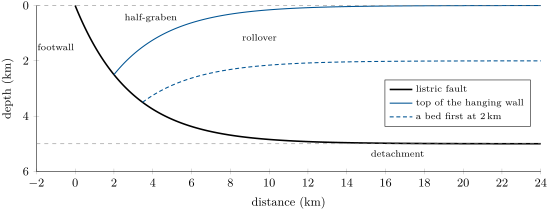
A listric fault dipping 60 at the surface and flattening into a detachment at 5\, km, after a heave of 2\, km drawn by the constant-heave construction. The top of the hanging wall and a deeper bed sag towards the fault in a rollover; the area below the original top, 10\, km2, is the heave times the depth of the detachment, and below the deeper bed 6\, km2, the heave times its height above it.
A listric fault dipping 60∘60{}^{\circ} at the surface and flattening into a detachment at 5 km5\,\mathrm{km}, after a heave of 2 km2\,\mathrm{km} drawn by the constant-heave construction. The top of the hanging wall and a deeper bed sag towards the fault in a rollover; the area below the original top, 10 km210\,\mathrm{km}^{2}, is the heave times the depth of the detachment, and below the deeper bed 6 km26\,\mathrm{km}^{2}, the heave times its height above it.
在原文中阅读 →