University Earth and Space Sciences — Year 3 · Bachelor Year 3
9Extensional and Strike-Slip Tectonics
Between the Sierra Nevada and the Colorado Plateau, ranges and basins alternate like the furrows of a field, each range a block of crust tilted along a normal fault. In the cores of some of these ranges, rocks that were buried 23 to deep, at 500 to , now lie at the surface, under a single fault that dips only a few degrees. A continent can be pulled apart by a factor of two or more, and torn sideways along faults that bend, step and open basins as deep as . This chapter builds the geometry of extension and of strike-slip faulting, the few rules that govern it, and the evidence that real systems leave.
You already know
Normal, strike-slip and transform faults, the half-graben and the continental rift are in the Year 1 volume, in its chapters on rifts and on faults, folds and fabrics, with Anderson’s theory: with vertical, normal faults dip , about ; with vertical, strike-slip faults strike at from . Byerlee’s law of rock friction, below and above, is in its chapter on stress, strain and rheology. The stretching model, in which the lithosphere is thinned uniformly by a factor , and the rift basin are in the Year 2 volume, in its chapter comparing sedimentary basins. Shear zones and mylonites are in Chapter 7; the depth to detachment from an excess area, , in Chapter 8.
9.1 Two models of a rift
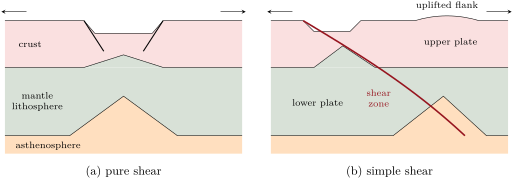
The stretching model of the Year 2 volume thins the whole lithosphere by the same factor beneath the same place: crust and mantle thin together, symmetrically, by pure shear. Many rifted margins are not symmetric: one side is a wide region of tilted blocks, the other a narrow steep slope, and the thinning of the mantle lies beside, not beneath, the thinning of the crust.
Definition 9.1 (Simple-shear rift model)
In the simple-shear rift model the lithosphere is pulled apart along a low-angle shear zone that cuts through it from the surface to its base. The plate above the shear zone, the upper plate, loses its lower part; the plate below, the lower plate, is pulled out from under it. The thinning of the crust and the thinning of the mantle are offset sideways, and the two conjugate margins that form when the continent breaks are asymmetric.
Real rifts mix the two: brittle faulting in the upper crust, ductile thinning below, and a mantle that may thin over a wider or a narrower region than the crust (depth-dependent stretching). Where the hot mantle rises beneath the rift, or beneath its flank in the simple-shear case, buoyancy raises the shoulders of the rift, which stand as mountains above the basin floor.
9.2 Normal-fault systems
Definition 9.2 (Domino faulting)
In domino faulting a set of parallel planar normal faults cuts the upper crust into rigid blocks which, as the region extends, rotate together like a row of books falling over: the faults become less steep and the beds, first horizontal, tilt the other way.
Theorem 9.3 (Extension by dominoes)
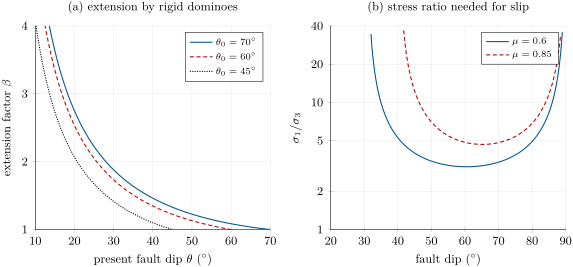
Let rigid blocks bounded by parallel planar faults that first dipped rotate until the faults dip . The beds then dip , away from the faults, and the region has been extended by the factor
Proof. The blocks are rigid, so the perpendicular distance between two neighbouring faults does not change. Along a horizontal line, two parallel planes that dip and are apart cut a segment of length ; the region’s width scales as the length of that segment, from to . The blocks turn through the angle by which the faults have flattened, , and the beds, horizontal at first, turn with them. ∎
Rotation alone gives modest extension: faults that start at and flatten to extend the region by . They cannot rotate for ever: a fault becomes harder to slip as it flattens, because the vertical presses on it more and shears it less.
Proposition 9.4 (Frictional lock-up of a normal fault)
Let a cohesionless fault with the friction coefficient make the angle with , all stresses effective. It slips when the ratio of the principal stresses reaches
which is least, , at , and infinite at . With vertical, the fault’s dip is : a normal fault dipping less than cannot slip at all.
Proof. Write and . On the plane, and . Slip needs ; dividing by and collecting gives the ratio, whose denominator vanishes at . In the other form the condition reads . The bracket is at most , reached at , where slip needs the least ; then , since the product of the last two brackets is 1. ∎
With Byerlee’s , the best-oriented normal fault dips and slips when , a fault at needs , and none dipping less than slips; with the lock-up dip is . The figure below shows both results. When a set of dominoes nears lock-up, a new set of steep faults cuts the old one: highly extended regions show several generations of faults.
Many large normal faults are curved, steep at the surface and flattening at depth into a nearly horizontal fault or shear zone.
Definition 9.5 (Detachment fault, listric fault, rollover anticline)
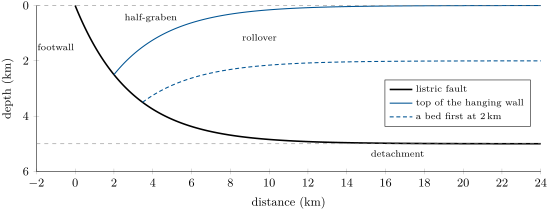
A detachment fault is a low-angle normal fault or shear zone of large displacement, kilometres to tens of kilometres, that separates an extended upper plate from a lower plate deformed differently. A listric fault is a normal fault whose dip decreases with depth, its profile concave upward. As the hanging wall of a listric fault moves down and away, it bends to stay in contact with the fault: its beds tilt towards the fault in a broad fold, the rollover anticline.
Method 9.6 (The constant-heave construction)
To draw the hanging wall of a listric fault after a horizontal displacement , the heave, on a section parallel to the slip:
- Divide the hanging wall into vertical columns. Move each column sideways by , away from the footwall.
- Lower each column by the fall of the fault beneath it: a column that started where the fault lies at the depth and ends where it lies at drops by , which brings its base back onto the fault.
- The space left between the footwall and the moved hanging wall is the half-graben, filled as it opens by sediments that thicken towards the fault.
Read backwards, the construction restores the section and predicts the shape of the fault from the shape of the rollover.
The area below the original level of a bed, counted from the fault, is the area of Chapter 8 with the sign changed: for a bed first at the depth above a detachment at the depth , since the rock under the bed keeps its area while its length grows by . Measuring and on a seismic section gives the depth of the detachment. The figure below draws the construction.
Normal faults are not endless. Where one fault dies out along strike, its displacement passes to another, often dipping the other way, and the half-grabens of a rift alternate in polarity along its length.
Definition 9.7 (Transfer zone)
A transfer zone is the region between two overlapping or offset normal-fault segments, or rift segments, across which the extension passes from one to the other: a relay ramp between two faults of the same polarity, a high between half-grabens of opposite polarity, or a strike-slip fault, the transfer fault, parallel to the extension.
9.3 Metamorphic core complexes
Definition 9.8 (Metamorphic core complex, rolling hinge)
A metamorphic core complex is a dome of metamorphic rocks and mylonites, brought up from the middle or lower crust, beneath a detachment fault whose upper plate is a mosaic of tilted blocks of upper-crustal rocks. In the rolling hinge model, the detachment slips at a moderate dip at depth; as the upper plate moves away, the unloaded footwall rises by isostasy and bends, so that each part of the fault rotates to a low dip, and stops slipping, once it has passed through a hinge that migrates with the extension.
The mylonites of the footwall record the deep part of the story: they are the shear zone of Chapter 7, and their kinematic indicators give the sense of transport of the upper plate. Higher up, the same rocks pass through the brittle–ductile transition and are overprinted by cataclasites and breccias just beneath the fault. In the northern Snake Range of Nevada, garnet-bearing schists of the footwall reached 6 to and 500 to , burial depths of 23 to ; the detachment that brought them up is interpreted as a rolling hinge.
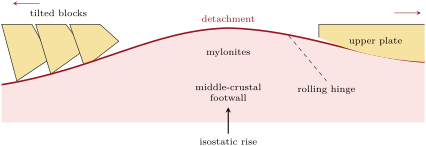
The low dips are a paradox: by the lock-up proposition no normal fault dipping less than about should slip under a vertical with Byerlee’s friction. The rolling hinge is one way out: the active part of the fault is steeper than what is seen. The others are a fault weakened by clays or by fluids at high pressure, which lowers the effective , or a stress field rotated near a shear zone at depth; earthquakes on low-angle normal faults are rare, which favours slip while steep or slip without earthquakes.
9.4 Strike-slip systems
In clay-cake experiments and in nature, a strike-slip fault does not cut a clean plane through a cover of sediments: it grows as a band of short, en-echelon fractures with consistent angles.
Definition 9.9 (Riedel shear)
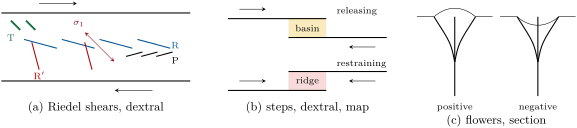
In a zone of strike-slip simple shear, Riedel shears are the short shear fractures that form first, in two sets: the R shears, at a small angle to the zone and with its sense of slip, and the R shears, at a large angle and with the opposite sense. Later P shears, symmetric to the R shears about the zone, and tension fractures T complete the pattern.
Proposition 9.10 (Riedel angles)
In a zone of simple shear, lies in the horizontal plane at to the zone. For rock that breaks by the Coulomb criterion with the angle of internal friction , the R shears make the angle with the zone, the R shears , both measured from the zone on the side of , and tension fractures form parallel to , at .
Proof. In simple shear the principal directions of the infinitesimal strain are at to the shear plane, and an isotropic material is loaded with along the shortening one. By Anderson’s theorem, the two Coulomb planes contain , vertical here, and make with on either side: the one closer to the zone at from it, the other at . Each slips so as to shorten along : the R shear with the zone, the R shear against it. Tension fractures open against and lie perpendicular to it. ∎
With the R shears lie at and the R shears at . Where the main fault is not straight, the blocks either side converge or diverge across it.
Definition 9.11 (Restraining bend, releasing bend)
A bend or step in a strike-slip fault is a restraining bend when the motion of the blocks pushes them together across it, and a releasing bend when it pulls them apart. For a dextral fault a step to the right is releasing and a step to the left restraining; for a sinistral fault the reverse.
Definition 9.12 (Pull-apart basin)
A pull-apart basin is a basin that opens at a releasing step between two overlapping strike-slip fault segments, bounded by the segments along its long sides and by oblique normal faults at its ends. Its area grows as the width of the step times the offset of the fault.
Definition 9.13 (Flower structure)
A flower structure is the fan of fault strands, seen on a cross-section, into which a steep strike-slip fault splits as it nears the surface: a positive flower, whose strands have a reverse component and lift a ridge, at a restraining bend; a negative flower, whose strands have a normal component and frame a sag, at a releasing bend.
Definition 9.14 (Transpression, transtension)
Transpression is strike-slip deformation combined with shortening across the zone; transtension, strike-slip deformation combined with extension across it. Both arise where the motion between two blocks is oblique to the boundary between them.
The oblique motion is often partitioned: a strike-slip fault takes the motion parallel to the boundary, and thrusts or folds beside it, or normal faults, take the motion across it.
9.5 Three systems
The Basin and Range. A reconstruction of the region since finds about of extension, oriented about NW, both in the north, where it amounts to , and in the centre, where it reaches : the central part is three times as wide as before. Since 10 to , part of the right-lateral motion of the Pacific–North America boundary has jumped into the continent, about oriented NW, about : the region is now transtensional. Its core complexes lie where the extension was largest.
The Dead Sea. The Dead Sea Transform has taken about of left-lateral motion between Africa and Arabia since about . Along it, the Dead Sea basin is a pull-apart long, 7 to wide and up to deep, bounded along its sides by subvertical faults; gravity models give of stretching along its axis, a factor of 1.19, which at the plate rate of takes about . Elsewhere on the transform, a segment shows a positive flower structure 100 to wide in its top few hundred metres, and others small pull-aparts.
The San Andreas fault. The fault system is more than (800 miles) long; it has moved at least (350 miles) since it came into being 15 to ago, and surveying shows a drift of up to about (2 inches a year). Where it bends north of Los Angeles, the motion is oblique to the fault: blocks within and next to the fault zone in the San Bernardino Mountains have risen by 3 to or more, at or more, by the convergence and slip partitioning of transpression.
In the field — Mapping a detachment fault
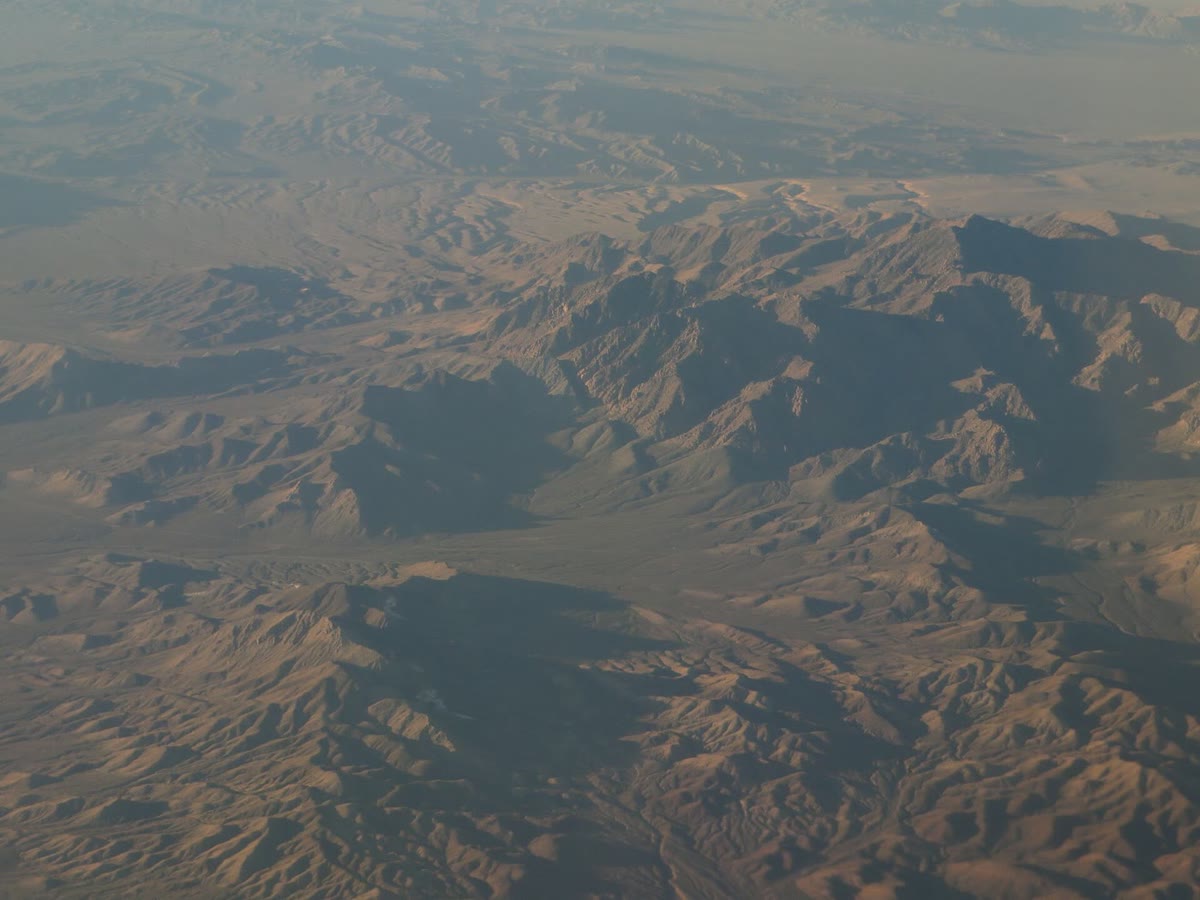
On a core complex, the detachment often forms the smooth, gently dipping surface of the range itself, where erosion has stripped the upper plate. The geologists who map it follow the contact between the brittle rocks of the upper plate and the mylonites below, plot its attitude every few hundred metres on a stereonet, and measure the lineations on the fault surface and in the mylonites: their trend gives the direction of transport, their kinematic indicators the sense. Samples of the footwall go to the laboratory for geobarometry and for mineral ages that date its cooling; the upper-plate blocks are mapped for the tilt of their beds, which records how far their faults have rotated.
9.6 Exercises
Exercise 9.1 ★
A domain of rigid dominoes has faults that dip ; they formed at . Compute the dip of the beds and the extension factor.
Solution
Solution of Exercise 9.1.
The beds dip , away from the faults; .
Exercise 9.2 ★
Say whether each step opens a basin or raises a ridge: a dextral fault stepping right; a dextral fault stepping left; a sinistral fault stepping left; a sinistral fault stepping right.
Solution
Solution of Exercise 9.2.
Dextral stepping right: basin. Dextral stepping left: ridge. Sinistral stepping left: basin. Sinistral stepping right: ridge.
Exercise 9.3 ★
The Dead Sea Transform has moved in about . Compute the mean rate in and compare it with the used for the Dead Sea basin.
Solution
Solution of Exercise 9.3.
, close to the : the rate need not have been constant over .
Exercise 9.4 ★
In the central Basin and Range, of extension amounts to . Compute the width of the region before and after. Do the same for the northern part, at .
Solution
Solution of Exercise 9.4.
means : and . In the north, : and .
Exercise 9.5 ★★
The San Andreas fault has moved at least in 15 to . Compute the range of mean rates, and compare them with a present drift of about . What could explain the difference?
Solution
Solution of Exercise 9.5.
to . The offset is a minimum, and the drift measured by surveying across the fault zone also includes motion on neighbouring faults of the system and elastic strain stored between earthquakes.
Exercise 9.6 ★★
With , compute the ratio needed to slip normal faults dipping , and , and the lock-up dip.
Solution
Solution of Exercise 9.6.
. At : ; at : ; at : . Lock-up at .
Exercise 9.7 ★★
Compute the lock-up dip of a normal fault for and . What friction coefficient would let a fault dipping slip under a vertical ?
Solution
Solution of Exercise 9.7.
and . A fault dipping slips only if .
Exercise 9.8 ★★
On a seismic section parallel to the slip, a listric fault has a heave of ; it flattens into a detachment deep. Compute the area of the sag below the original top of the hanging wall, and below a bed first deep.
Solution
Solution of Exercise 9.8.
and .
Exercise 9.9 ★★
The Dead Sea basin is long and stretched by the factor 1.19 along its axis. Compute its initial length and the stretching, and the time that stretching takes at .
Solution
Solution of Exercise 9.9.
, stretched by , which takes .
Exercise 9.10 ★★★
Blocks apart, measured perpendicular to their faults, rotate from fault dips of to . Compute the horizontal width of one block before and after, the extension per block, and the dip of the beds. Why must the beds dip the other way from the faults?
Solution
Solution of Exercise 9.10.
before and after: per block (). The beds dip . Each block turns as a whole: the rotation that lowers the dip of faults dipping, say, east turns a horizontal line in the block so that it rises to the east, and the beds dip west, opposite to the faults.
Exercise 9.11 ★★★
Give the angles of the R and R shears and of the tension fractures for a rock with in a sinistral zone striking east–west, as azimuths, and their senses of slip.
Solution
Solution of Exercise 9.11.
In a sinistral east–west zone trends . R shears at from the zone on the side of : strike , sinistral. R at : strike , dextral. Tension fractures parallel to : strike .
Exercise 9.12 ★★★
A domain of dominoes forms with its faults at the best dip for slip and rotates until they lock up. Compute the largest extension factor that rotation alone gives for and for , and say which rocks can be extended further before new faults must form.
Solution
Solution of Exercise 9.12.
For the faults form at and lock at : . For : from to , . Faults with lower friction rotate further before locking: weak rocks extend more before new faults must form.
9.7 Problem: The Merrow Half-Graben
Problem 9.1
Weekend problem — the extension of an invented rift border, from its dominoes, its listric fault, its core complex and its transfer fault
The Merrow half-graben is an invented basin on the border of a continental rift. Its master fault is listric, dipping at the surface. In its hanging wall a domain wide is cut by planar faults now dipping east, between which the beds dip west. On a seismic section parallel to the slip, the master fault has a heave of and the top of its hanging wall sags below its original level over an area of . Along strike to the south, erosion has removed the upper plate of the same system and exposed a core complex. To the north, a sinistral transfer fault links the half-graben to the next one. Take , and a crustal density of .
Part I — The dominoes.
- Why is the initial dip of the faults the sum of the present fault and bed dips? Give it, and compare it with Anderson’s theory.
- Compute the extension factor of the domain.
- Compute its initial width and the extension it records.
- Compute the ratio needed to slip the faults now, and compare it with that of new, well-oriented faults.
- At what dip do these faults lock up, and what extension factor could the domain reach by rotation alone? What happens then?
Part II — The listric master fault.
- Explain, with the constant-heave construction, why the hanging-wall beds tilt towards the fault.
- Compute the depth of the detachment.
- The sag area is known to . How well is the depth known?
- What sag area do you predict for a bed that was first deep?
- What is the horizontal extension across the master fault?
- How do the sediments of the half-graben record the activity of the fault?
Part III — The core complex.
- Mylonites of the footwall equilibrated at . Compute their depth.
- Their micas closed to argon at , and pebbles of the same mylonites appear in the half-graben fill at . Compute the mean exhumation rate, taking the closure depth as the depth of the previous question.
- To bring the mylonites up, how much slip is needed on a detachment of mean dip , and how much horizontal extension?
- The detachment dips at the surface today. Could it have slipped at that dip under a vertical ? Give two ways out.
- If it slipped at at depth, through what angle has the exposed part rotated, and why?
- Compare the extension of the core complex with that of the half-graben.
Part IV — The transfer fault.
- The sinistral transfer fault steps left by , its two strands overlapping over . Does the step open a basin or raise a ridge?
- The fault has slipped at for . Compute the offset.
- Compute the area opened, the length of the basin floor (overlap plus offset) and its ratio of length to width.
- Compare that ratio with the Dead Sea basin’s, long and 7 to wide.
- Where the same fault bends the other way, what structure forms, and what would a cross-section through it show?
- What is the total horizontal extension across the Merrow half-graben, from its master fault and its dominoes?
Solution
Solution of Problem 9.1.
1. The beds were horizontal and have turned with the blocks; the faults have turned by the same angle, so , Anderson’s dip for .
2. .
3. ; the domain has been extended by ().
4. : , against for new faults at : half as much again.
5. At ; at most. Before that, new faults at about would cut the blocks, and a second generation of dominoes would take over.
6. Every column of the hanging wall drops by the fall of the fault beneath it over the heave; the fault is steepest near the surface and flattens away from it, so the columns close to the fault drop most and those far away least: the beds tilt towards the fault.
7. .
8. is proportional to : .
9. .
10. The heave, .
11. The fill thickens towards the fault, in a wedge, and its older layers are more tilted than the younger ones: each layer was deposited while the rollover and the space next to the fault kept growing.
12. .
13. .
14. of slip, and of horizontal extension.
15. No: is below the lock-up dip of . Either the fault slipped while it was steeper and was then rotated (rolling hinge), or it was weak, with from clays or fluids at high pressure.
16. By : as the upper plate moved away, the unloaded footwall rose by isostasy and bent, rotating the fault through the hinge.
17. against the half-graben’s (question 23): four times more. Core complexes lie where extension is greatest, as in the central Basin and Range.
18. A sinistral fault stepping left: releasing, a basin opens.
19. .
20. ; long; .
21. to : the Dead Sea basin is far more elongated, its offset many times its width.
22. A restraining bend: a ridge pushed up between the strands; in section, a positive flower structure, the fault splaying upward into strands with a reverse component, like the one 100 to wide on the Dead Sea Transform.
23. : the Merrow half-graben has been extended by .