
全部书籍

专业

应用 关于 Coach 登录 开始阅读

书籍暂未推出简体中文版——当前显示英文版。

Earth and Space Sciences · 术语表

什么是 Dislocation?

又称: dislocation (crystal defect)

Definition 7.1 University Earth and Space Sciences — Year 3 · 第 7 章 — Deformation Mechanisms and Shear Zones

A dislocation is a line defect in a crystal: the boundary, inside the crystal, between a part of a lattice plane that has slipped and a part that has not. Its Burgers vector b\mathbf b is the slip that it carries, one lattice spacing in a lattice direction. In an edge dislocation b\mathbf b is perpendicular to the line, which is the edge of an extra half-plane of atoms; in a screw dislocation it is parallel to the line. A dislocation moves by glide on its slip plane, and an edge dislocation leaves that plane by climb, as atoms or vacancies diffuse to or from the edge of its half-plane.
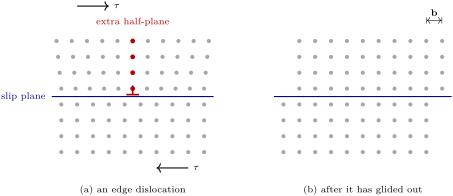
(a) An edge dislocation: an extra half-plane of atoms (red) ends on the slip plane, distorting the lattice around its edge (the symbol ). Under the shear stress  it glides along the slip plane by breaking and re-forming one row of bonds at a time. (b) When it has crossed the crystal, the upper half has slipped by one Burgers vector b, and the lattice is perfect again.
(a) An edge dislocation: an extra half-plane of atoms (red) ends on the slip plane, distorting the lattice around its edge (the symbol ⊥\perp). Under the shear stress τ\tau it glides along the slip plane by breaking and re-forming one row of bonds at a time. (b) When it has crossed the crystal, the upper half has slipped by one Burgers vector b\mathbf b, and the lattice is perfect again.
在原文中阅读 →