书籍暂未推出简体中文版——当前显示英文版。
University Earth and Space Sciences — Year 3 · 本科三年级
7Deformation Mechanisms and Shear Zones
At the surface, the granite of a mountain shatters along faults. Twenty kilometres down, the same granite flows like toffee in a shear zone a few hundred metres wide, its feldspars rolled into eyes and its quartz drawn out into ribbons. A crystal can flow without breaking because it is never perfect: it moves by its defects, one row of atoms at a time, or by atoms diffusing from one face of a grain to another. This chapter follows those mechanisms from the crystal lattice to the laws that geodynamics uses, to the maps that say which mechanism wins, and to the shear zones in which the rock records how it moved.
You already know
Point defects, the Arrhenius law and the activation energy are in the chemistry books’ university volumes; the diffusion coefficient in the physics books’. Stress and strain, the strain ellipse, simple shear and its ellipse (, long axis at from the shear direction with ), power-law creep with its constants for wet quartzite and dry olivine, the strength envelope and the brittle–ductile transition are in the Year 1 volume, in its chapter on stress, strain and rheology; foliation, lineation and the descriptive mylonite in its chapter on faults, folds and fabrics. The effective viscosity of the mantle is in Chapter 6.
7.1 Crystal defects
To shear a perfect crystal, every bond across a lattice plane would have to break at once, and that needs a stress of the order of a tenth of the shear modulus, which in the mantle is about (Chapter 6): thousands of megapascals. Real crystals yield at far lower stresses, because they slip one line of atoms at a time.
Definition 7.1 (Dislocation)
A dislocation is a line defect in a crystal: the boundary, inside the crystal, between a part of a lattice plane that has slipped and a part that has not. Its Burgers vector is the slip that it carries, one lattice spacing in a lattice direction. In an edge dislocation is perpendicular to the line, which is the edge of an extra half-plane of atoms; in a screw dislocation it is parallel to the line. A dislocation moves by glide on its slip plane, and an edge dislocation leaves that plane by climb, as atoms or vacancies diffuse to or from the edge of its half-plane.
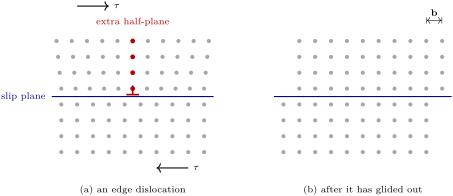
The lattice resists the glide of a dislocation with a small stress, the Peierls stress, which depends on the strength and the direction of the bonds: that is why some slip systems of a mineral are easy and others hard. As a crystal deforms, dislocations multiply and tangle; they block one another, and the crystal hardens, unless they can climb round obstacles or annihilate, which needs diffusion, hence heat.
7.2 Mechanisms of creep
Definition 7.2 (Mechanisms of creep)
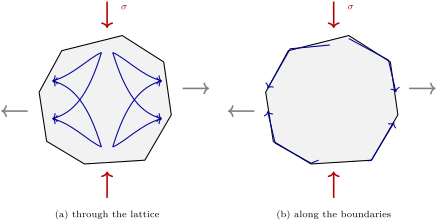
In dislocation creep crystals deform by the glide of dislocations, with climb releasing them from obstacles. In diffusion creep they change shape by the diffusion of atoms, through the lattice (Nabarro–Herring creep) or along the grain boundaries (Coble creep), from the faces under the highest normal stress to those under the lowest. In grain-boundary sliding grains slide past one another along their boundaries, the gaps being closed by diffusion or dislocation creep. In pressure solution the matter dissolves in a fluid film on the faces under high stress and is deposited where the stress is low, or carried away.
Proposition 7.3 (Grain-size dependence of diffusion creep)
At low stress , a rock of grain size creeps by diffusion at the rate
where and are the diffusion coefficients in the lattice and in the boundaries, the width of a boundary, the volume of an atom, Boltzmann’s constant and , numbers of order ten that depend on the shape of the grains.
Proof. A normal stress on a face changes the work needed to form a vacancy there by , so the concentration of vacancies differs between faces under tension and under compression by when . Across a distance of order , the diffusive flux of vacancies, hence of atoms the other way, is of order per unit area. Through the lattice the flux crosses an area of order , along the boundaries an area of order . The volume moved per unit time, divided by the grain’s volume , is the strain rate: of order in the lattice, and in the boundaries. The product is the self-diffusion coefficient written in the statement. ∎
Diffusion creep is linear in the stress, a true viscous flow, and it is fast in fine-grained rock: halving the grain size makes Coble creep eight times faster (figure below). Dislocation creep does not depend on the grain size, but grows with a high power of the stress.
Deformed crystals also mend themselves while they deform.
Definition 7.4 (Recovery, subgrain, dynamic recrystallisation)
Recovery is the rearrangement of dislocations, by climb and cross-slip, into lower-energy arrays, and their annihilation. Dislocations arranged in walls divide a grain into subgrains, parts of the grain whose lattices are tilted by a few degrees from one another. Dynamic recrystallisation is the replacement, during deformation, of strained grains by new grains with fewer dislocations, either by the rotation of subgrains until they become grains, or by the migration of grain boundaries into the more strained neighbours.
Definition 7.5 (Crystallographic preferred orientation)
A rock has a crystallographic preferred orientation (CPO) when the lattices of its grains are not oriented at random but cluster about directions set by the deformation; dislocation creep produces it, by rotating each grain’s slip systems towards the flow.
A rock with a CPO inherits the anisotropy of its crystals: its seismic speeds, for instance, depend on direction, which lets seismology see the fabric of the deep mantle. Diffusion creep and grain-boundary sliding, which let grains rotate freely, do not build one.
7.3 Flow laws
Definition 7.6 (Flow law, stress exponent, homologous temperature)
A flow law gives the strain rate of a rock deforming by one mechanism as a function of the differential stress , the grain size , the temperature and the pressure :
with , , , the activation energy and the activation volume measured in the laboratory. The stress exponent is , the grain-size exponent . The homologous temperature of a mineral is , its absolute temperature over its absolute melting temperature.
In the laws used here, dislocation creep has of 3.5 or 4 and ; diffusion creep has and or 3 (Proposition 7.3). Creep grows as the homologous temperature approaches 1. Forsterite melts at , so the mantle at stands at ; ice at at 0.96, which is why glaciers flow. The olivine values used here are those of a widely used laboratory compilation: dry olivine in dislocation creep, , , , ; in diffusion creep, , , , , (stress in megapascals, grain size in micrometres, time in seconds); wet quartzite is the Year 1 volume’s. Water weakens olivine: at a water fugacity of about , olivine aggregates creep five to six times faster than dry ones in dislocation creep, five times faster in diffusion creep.
Proposition 7.7 (Effective viscosity)
A rock obeying a flow law at given , and has the effective viscosity
for it falls as the rock deforms faster.
Proof. For a Newtonian fluid, in a uniaxial flow, by the definition of viscosity; is the viscosity of the Newtonian fluid that would flow at the same rate under the same stress. Substituting gives the second form. ∎
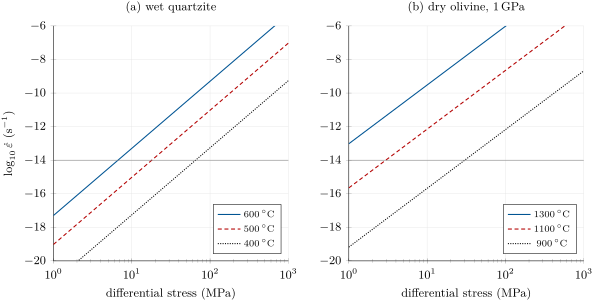
Wet quartzite at flowing at needs and has an effective viscosity of ; at , and : a hundred degrees divides the strength by more than three (figure below). Dry olivine at and needs only . The strength envelopes of the Year 1 volume are built from exactly these laws.
7.4 Deformation mechanism maps
Several mechanisms run in parallel, and the fastest carries the deformation.
Definition 7.8 (Deformation mechanism map)
A deformation mechanism map of a mineral or rock shows, on axes of two of the variables stress, grain size and temperature, the fields in which each mechanism is the fastest, with contours of the total strain rate.
Proposition 7.9 (Mechanism boundary)
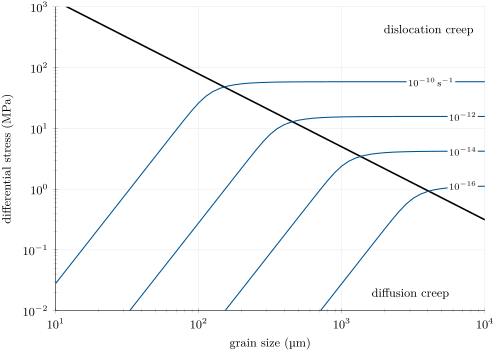
At given and , dislocation creep (, , , , no grain-size dependence) and diffusion creep (, , , , ) run equally fast at the stress
so the boundary is a straight line of slope on logarithmic axes of grain size and stress; dislocation creep wins above it.
Proof. Equate the two flow laws and solve for . Above , the ratio of the two rates, proportional to , exceeds 1. ∎
For dry olivine at and , the boundary lies at for a grain size of and at for (figure below). Fine-grained mantle creeps by diffusion, coarse mantle by dislocations; laboratory and geophysical evidence suggests that both regimes occur in the upper mantle, the hot, shallow mantle flowing by dislocation creep and the colder or deeper by diffusion creep, and that where the stress rises and the grains shrink, the mantle near the boundary weakens and the deformation localises.
The grain size that dynamic recrystallisation produces depends on the stress, and this makes the grains a stress gauge.
Definition 7.10 (Palaeopiezometer)
A palaeopiezometer is a feature of a deformed rock whose size or density is set by the differential stress under which it formed, calibrated in the laboratory, from which the stress of a past deformation can be read.
For quartz, experiments at and 800 to , at flow stresses from 34 to , gave recrystallised grains from 46 down to , fitted by
with no detectable effect of the temperature. A quartz mylonite with recrystallised grains across deformed under about .
7.5 Shear zones
Definition 7.11 (Shear zone, strain softening)
A shear zone is a tabular zone, between walls that are little deformed, in which the strain is concentrated and is close to a simple shear parallel to the zone. A rock undergoes strain softening when its strength falls as it deforms.
Strain softening is what keeps a shear zone narrow: once a band is weaker than its walls, the deformation stays in it. Grain-size reduction by dynamic recrystallisation, which may tip the rock into diffusion creep, the growth of a CPO that aligns easy slip systems, the entry of water and reactions that make weak minerals such as micas all soften the rock. The mylonites of the Year 1 volume are their product. In a shear zone of simple shear, a marker that crossed the zone at right angles is deflected into it: if inside the zone it makes the angle with its original direction, the shear strain is , and the displacement across a zone of width is .
Definition 7.12 (Kinematic indicators)
A kinematic indicator is a structure whose asymmetry records the sense of shear, the sense in which one wall of a shear zone moved relative to the other, read in the plane that contains the stretching lineation and is perpendicular to the foliation. An S–C fabric is a pair of foliations: S, the foliation of flattened grains, oblique to the zone and turned towards the direction of stretching, and C, shear bands parallel to the zone. A porphyroclast system is a strong grain with tails of recrystallised material: in a -type the tails step from one side of the clast’s centre line to the other without crossing it, in a -type, dragged round by the clast’s rotation, they cross it. A mica fish is a lozenge-shaped mica grain inclined to the shear plane, with thin tails, stepping like those of a -type clast.
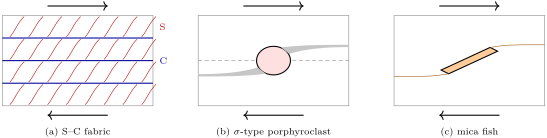
Read together, a few indicators that agree give the sense of shear with confidence; a single one can mislead, since back-rotated clasts and asymmetric folds of other origins exist. The photograph in the box below shows porphyroclasts in a mylonite.
In the lab — Squeezing rock at mantle conditions
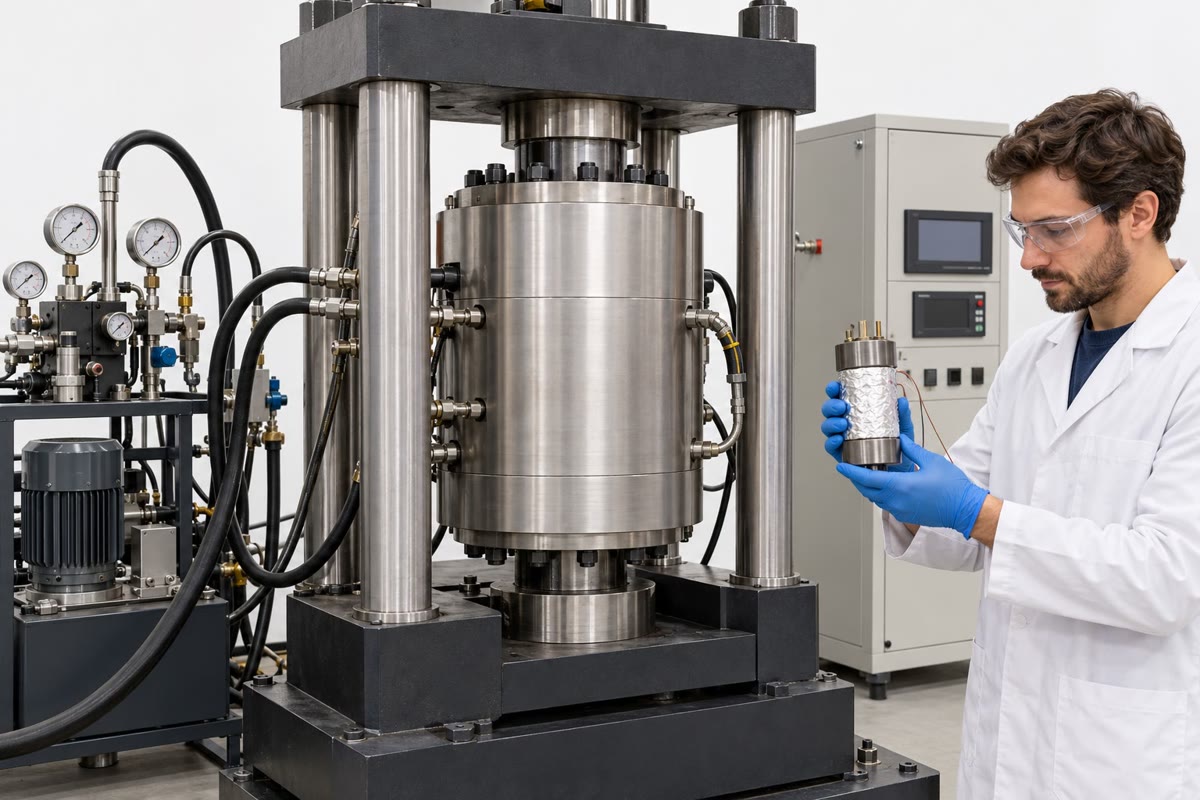
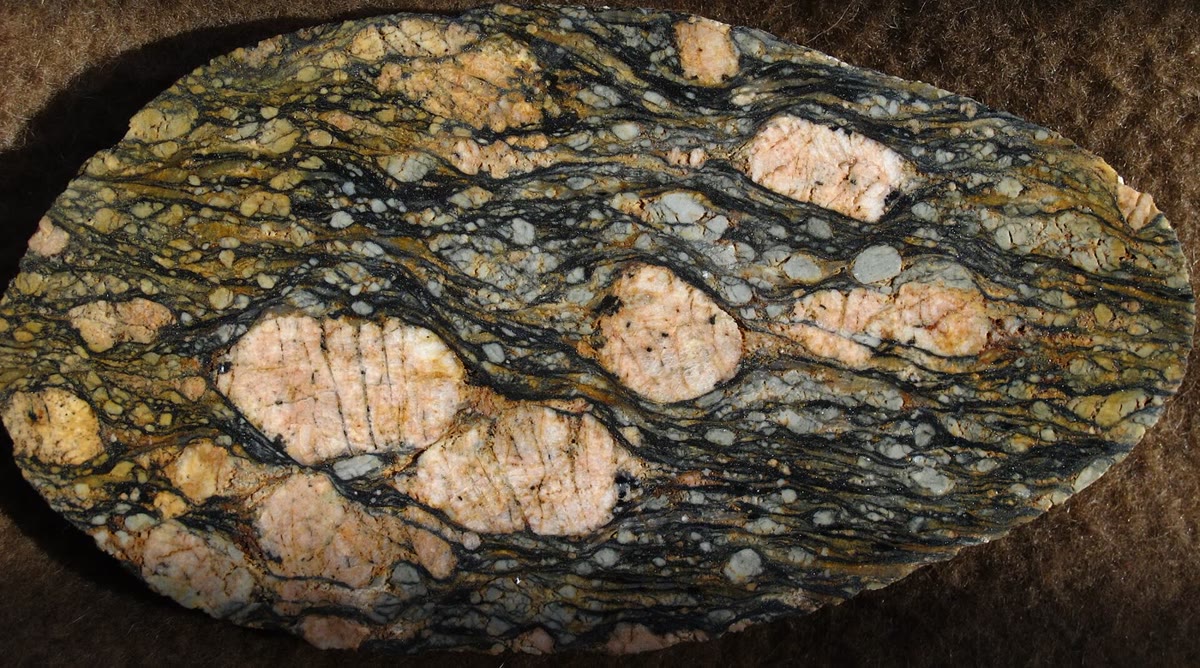
In a gas-medium deformation apparatus, a cylinder of rock or of hot-pressed olivine powder, a centimetre or two long, is sealed in a thin metal jacket and placed with its pistons inside a furnace, in a steel vessel filled with a compressed inert gas that sets the confining pressure, a few hundred megapascals. An actuator drives the piston at a constant rate, or under a constant load, while an internal load cell measures the stress on the sample itself, free of the friction of the seals. Olivine is deformed this way at temperatures near ; at the end of a run the sample is quenched, cut, polished and examined under the microscope and the electron microscope, where its grain size, subgrains and dislocations are measured.
7.6 Exercises
Exercise 7.1 ★
Forsterite melts at and ice at . Compute the homologous temperature of forsterite at and of ice at . Which creeps more readily?
Solution
Solution of Exercise 7.1.
Forsterite: ; ice: . Ice is far closer to its melting point and creeps more readily: glaciers flow at the Earth’s surface.
Exercise 7.2 ★
A dyke crossing a shear zone at right angles is deflected inside the zone by , and another by . Compute the shear strains. Why are large strains hard to measure this way?
Solution
Solution of Exercise 7.2.
and . Near the tangent changes very fast with the angle: one degree of error at changes by a fifth.
Exercise 7.3 ★
With the quartz piezometer, what stress does a recrystallised grain size of indicate?
Solution
Solution of Exercise 7.3.
.
Exercise 7.4 ★
With the flow law of wet quartzite (, , , ), compute the strain rate at under .
Solution
Solution of Exercise 7.4.
, so .
Exercise 7.5 ★★
Compute the effective viscosity of wet quartzite flowing at at () and at (). Compare with the mantle viscosities of Chapter 6.
Solution
Solution of Exercise 7.5.
: at and at : the middle crust at these temperatures is about as viscous as the mantle beneath the ice sheets.
Exercise 7.6 ★★
Two experiments at the same temperature give under and under . Compute the stress exponent and name the likely mechanism.
Exercise 7.7 ★★
At the same stress, a sample creeps ten times faster at than at . Compute the activation energy.
Solution
Solution of Exercise 7.7.
, so .
Exercise 7.8 ★★
By what factor does the strain rate of diffusion creep change when the grain size is divided by ten, for Nabarro–Herring and for Coble creep? Why is Coble creep the more sensitive?
Solution
Solution of Exercise 7.8.
Nabarro–Herring (): 100 times faster; Coble (): 1000 times. Along the boundaries the diffusing atoms use a path whose cross-section, , shrinks with the grain, on top of the shorter distance and the smaller volume to move.
Exercise 7.9 ★★
For dry olivine at and , the two flow laws give and (units of the text). Compute the boundary stress for and , and the slope of the boundary.
Solution
Solution of Exercise 7.9.
: for , ; for , . The slope is : a tenfold finer grain raises the boundary by .
Exercise 7.10 ★★★
Following the proof of Proposition 7.3, explain why the lattice path gives and the boundary path , and show that boundary diffusion wins below the grain size .
Solution
Solution of Exercise 7.10.
In both paths the driving difference of concentration is the same and the distance is ; the volume to move per unit strain is . The lattice offers a cross-section , so the rate goes as ; the boundaries offer , so . The ratio of boundary to lattice rates is , larger than 1 when .
Exercise 7.11 ★★★
For a flow law with , by what factor does the effective viscosity fall when the strain rate is multiplied by ten? Why does this favour the localisation of strain into shear zones?
Solution
Solution of Exercise 7.11.
: ten times faster divides the viscosity by . A band that happens to deform faster becomes weaker, so it takes more of the deformation: the strain gathers into it.
Exercise 7.12 ★★★
In the dry olivine of exercise 9, a mantle shear zone under recrystallises from to grains. Compute the total strain rate before and after, and the factor of softening. Which mechanism carries the deformation in each case?
Solution
Solution of Exercise 7.12.
Before: and : , dislocation creep. After: , diffusion creep, times faster at the same stress: recrystallisation has softened the zone enormously.
7.7 Problem: The Varden Shear Zone
Problem 7.1
Weekend problem — the strain, stress, strain rate and age of an invented shear zone
Beneath the granite of the Varden Hills, the series’ invented region, a borehole and a deep road cut (both invented) reveal a ductile shear zone wide, formed at about depth and . A dolerite dyke that crosses the walls at right angles makes, inside the zone, an angle of only with the zone’s boundaries. Its quartz is a mylonite of recrystallised grains across (from 15 to ). Take the quartz piezometer , the flow law of wet quartzite (, , ), , , and, in simple shear, .
Part I — The strain.
- Compute the deflection of the dyke and the shear strain.
- Compute the displacement of one wall relative to the other.
- Compute the principal stretches of the strain ellipse and its axial ratio.
- Compute the angle of the long axis with the zone. What does the foliation of the zone do as grows?
- Seen from above, the dyke, followed from the southern wall, bends to the east as it enters the east–west zone, then returns to its northward course at the northern wall. Which way did the northern wall move, and is the zone dextral or sinistral?
- In which plane should a thin section be cut to read the kinematic indicators, and how should its S foliation lean?
Part II — The stress.
- Compute the stress indicated by the grains.
- Compute the stresses for 15 and .
- Is the stress within the range of the calibration?
- The piezometer showed no effect of temperature. Why does this matter here?
- What grain size would a stress of have produced?
Part III — The strain rate.
- Compute at and the Arrhenius factor.
- Compute the strain rate of the quartz under the stress of question 7 (take ).
- Compute the shear strain rate.
- Compute the effective viscosity of the zone and compare it with the upper mantle of Chapter 6.
- By what factors would the strain rate change at 400 and , at the same stress?
- By what factor if the stress were the of the finest grains?
Part IV — The time.
- Compute the time needed to accumulate the shear strain of question 1, in seconds.
- Convert it to thousands of years.
- Compute the mean slip rate across the zone, in .
- Compare it with plate-boundary rates of tens of millimetres a year.
- If the zone had carried , what shear strain rate, stress and recrystallised grain size would it have had?
- How do the uncertainties of the grain size and of the piezometer’s exponent affect the time?
- Give the time the Varden shear zone took to accumulate its strain, in thousands of years.
Solution
Solution of Problem 7.1.
1. The dyke turns from to from the zone: and .
2. , about .
3. , , and .
4. , : the foliation, close to the long axis, turns ever closer to the zone as grows.
5. Followed northwards, the dyke is carried east inside the zone and leaves it further east: the northern wall moved east relative to the southern. Seen from the southern wall, the far side moved to the right: the zone is dextral.
6. In the plane containing the stretching lineation, horizontal here for a strike-slip zone, and perpendicular to the vertical foliation: a horizontal section. Its S foliation leans anticlockwise from the zone, towards east-north-east, like the long axis of the strain ellipse.
7. .
8. for and for .
9. Yes: the experiments spanned 34 to .
10. The zone deformed at , far below the 800 to of the experiments; a relation that does not depend on the temperature can be carried down to it, though it is still an extrapolation.
11. .
12. and .
13. .
14. .
15. , close to the of the upper mantle beneath Lake Ardo: the zone was as weak as the mantle.
16. changes by the factor 0.064 at (sixteen times slower) and 11.0 at .
17. times faster.
18. .
19. .
20. .
21. Ten or more times slower than the main plate boundaries: the zone was a minor strand, or one of several that shared a boundary’s motion.
22. , 6.2 times faster; the stress rises by , to , and the grains would be .
23. The time goes as : the grain-size range alone gives to times the estimate, and the uncertainty of the exponent and of the flow law’s constants widens it further: the result is an order of magnitude, not a date.
24. The Varden shear zone took about to accumulate its strain.