
全部书籍

专业

应用 关于 Coach 登录 开始阅读

书籍暂未推出简体中文版——当前显示英文版。

Earth and Space Sciences · 术语表

什么是 El Niño–Southern Oscillation; El Niño; La Niña; Southern Oscillation?

又称: El Niño--Southern Oscillation · El Niño · La Niña · Southern Oscillation

Definition 23.5 University Earth and Space Sciences — Year 2 · 第 23 章 — Climate Variability

The El Niño–Southern Oscillation (ENSO) is the coupled ocean–atmosphere mode of the tropical Pacific: coherent year-to-year variations of the sea-surface temperature, the convective rainfall, the surface pressure and the circulation along the equatorial Pacific, with preferred time scales of two to about seven years. El Niño is its warm phase, a warming of the sea surface of the central and east-central equatorial Pacific; La Niña is its cold phase, a cooling of the same region. The Southern Oscillation is its atmospheric part, a see-saw of surface pressure between the western and the eastern tropical Pacific: during El Niño the pressure is higher than average over Indonesia and the western Pacific and lower over the eastern Pacific, and the reverse during La Niña.
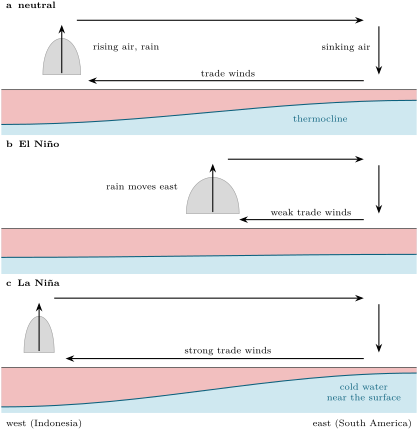
The equatorial Pacific along the equator in the three phases of ENSO (schematic, not to scale): the Walker circulation above, the warm upper layer and the thermocline below. During El Niño the trade winds weaken, the warm water and the rain spread east and the thermocline in the east deepens to 150 to 175\, m; during La Niña the trades strengthen and the thermocline in the east rises to 50 to 100\, m.
The equatorial Pacific along the equator in the three phases of ENSO (schematic, not to scale): the Walker circulation above, the warm upper layer and the thermocline below. During El Niño the trade winds weaken, the warm water and the rain spread east and the thermocline in the east deepens to 150 to 175 m150\text{ to }175\,\mathrm{m}; during La Niña the trades strengthen and the thermocline in the east rises to 50 to 100 m50\text{ to }100\,\mathrm{m}.
在原文中阅读 →