
সব বই

পেশাদার

1 Markets I: The Ecosystem and Exchange-Traded Marketsবাজার অনলাইন 2 Markets II: Rates, FX and Creditবাজার অনলাইন 3 Markets III: Commodities, Energy and Cryptoবাজার অনলাইন 4 Quantitative Methodsপদ্ধতি অনলাইন 5 Derivatives and Volatilityডেরিভেটিভস অনলাইন 6 Rates, Credit, XVA and Riskসুদহার, ঋণ ও ঝুঁকি অনলাইন 7 Research Craft: Predictors, Backtests, Measurement, Portfoliosগবেষণা অনলাইন 8 Strategies I: Equities and Futuresকৌশল অনলাইন 9 Strategies II: Volatility, Relative Value, Macro and the Bank Desksকৌশল অনলাইন 10 Microstructure and Executionএক্সিকিউশন অনলাইন 11 Market Making and High-Frequency Tradingমার্কেট মেকিং অনলাইন 12 Machine Learning for Marketsমেশিন লার্নিং অনলাইন 13 Low-Latency Softwareপ্রযুক্তি অনলাইন 14 Networks, Hardware and Trading Infrastructureপ্রযুক্তি অনলাইন 15 Research, Data and Risk Platformsপ্রযুক্তি অনলাইন 16 The Desk and the Firmপ্রতিষ্ঠান অনলাইন 17 The Industry: Firms, Roles and Careersক্যারিয়ার অনলাইন 18 Interviews I: Maths, Probability and Speedক্যারিয়ার অনলাইন 19 Interviews II: Markets, Trading Games and the Final Roundক্যারিয়ার অনলাইন 20 Interviews III: Codeক্যারিয়ার অনলাইন
অ্যাপ পরিচিতি Coach সাইন ইন পড়া শুরু করো

বইগুলো এখনো বাংলা ভাষায় পাওয়া যায় না — ইংরেজি সংস্করণ দেখানো হচ্ছে।

Earth and Space Sciences · পরিভাষা

Elastic rebound, seismic cycle, recurrence interval কী?

অন্য নাম: elastic rebound · seismic cycle · recurrence interval

Definition 18.1 University Earth and Space Sciences — Year 1 · অধ্যায় 18 — The Earthquake Source

Elastic rebound is the sudden return toward their unstrained shape of the rocks on either side of a fault, when the fault, locked while they were strained, slips in an earthquake; the elastic energy stored in them is released, partly as seismic waves. The seismic cycle of a fault segment is the repeated sequence of a long interseismic stage, during which the segment is locked and the strain accumulates around it, a coseismic stage, the earthquake, during which it slips, and a postseismic stage, of months to decades, during which the surroundings adjust to the new state. The recurrence interval of a segment is the time between two successive large earthquakes on it.
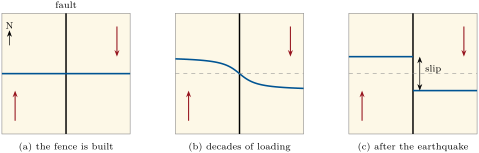
Elastic rebound seen from above, on a fence (blue) built straight across a locked dextral fault. Red arrows: the motion of the two blocks far from the fault, relative to it. (b) While the fault is locked, the far ground moves and the fence bends, along the curve of the interseismic profile of . (c) The earthquake releases the bending: each half of the fence is straight again, and the two halves are offset at the fault by the slip. The bending is exaggerated: a real fence bends by a few metres over tens of kilometres.
Elastic rebound seen from above, on a fence (blue) built straight across a locked dextral fault. Red arrows: the motion of the two blocks far from the fault, relative to it. (b) While the fault is locked, the far ground moves and the fence bends, along the curve of the interseismic profile of Section 18.4. (c) The earthquake releases the bending: each half of the fence is straight again, and the two halves are offset at the fault by the slip. The bending is exaggerated: a real fence bends by a few metres over tens of kilometres.
প্রসঙ্গসহ পড়ো →