全部书籍

专业

应用 关于 Coach 登录 开始阅读

书籍暂未推出简体中文版——当前显示英文版。

Earth and Space Sciences · 术语表

什么是 Eustasy, relative sea level?

又称: eustasy · relative sea level

Definition 23.11 University Earth and Space Sciences — Year 1 · 第 23 章 — Diagenesis and Sedimentary Basins

Eustasy is the change of the level of the world ocean measured relative to a fixed reference, the centre of the Earth, caused by a change in the volume of water in the ocean or in the volume of the ocean basins; it is the same everywhere. The relative sea level at a place is the height of the sea surface above a datum attached to the basement there; it changes by eustasy and by the vertical motion of the ground.
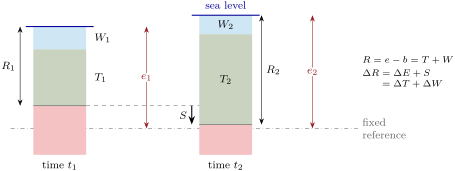
Accommodation at one place at two times (schematic). Between t_1 and t_2 sea level rises by E = e_2 - e_1 above the fixed reference and the basement subsides by S: the relative sea level R grows by E + S, the accommodation created, which is shared between more sediment (T_2 > T_1) and a change of water depth (here a slight shallowing, W_2 < W_1).
Accommodation at one place at two times (schematic). Between t1t_1 and t2t_2 sea level rises by ΔE=e2−e1\Delta E = e_2 - e_1 above the fixed reference and the basement subsides by SS: the relative sea level RR grows by ΔE+S\Delta E + S, the accommodation created, which is shared between more sediment (T2>T1T_2 > T_1) and a change of water depth (here a slight shallowing, W2<W1W_2 < W_1).
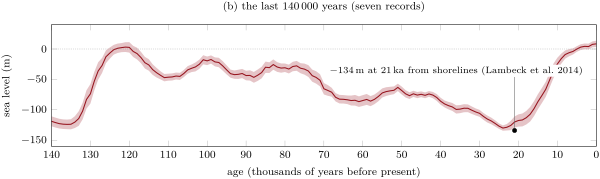
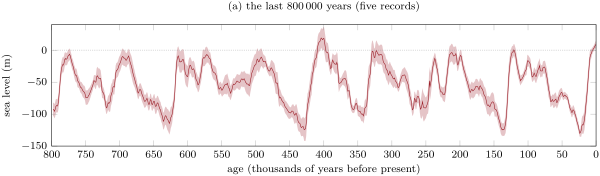
Global sea level relative to today from the stack of Spratt and Lisiecki (2016): the first principal component of five reconstructions from deep-sea cores over 800\,000 years (a) and of seven over the last 140\,000 (b), with its one-standard-deviation band. The lowest value of the stack, -130\, m at 24\, ka, lies within that band of the -134\, m found from former shorelines (dot); the last interglacial stands about 3\, m above today at 121\, ka. Data: NOAA NCEI World Data Service for Paleoclimatology. Global sea level relative to today from the stack of Spratt and Lisiecki (2016): the first principal component of five reconstructions from deep-sea cores over 800\,000 years (a) and of seven over the last 140\,000 (b), with its one-standard-deviation band. The lowest value of the stack, -130\, m at 24\, ka, lies within that band of the -134\, m found from former shorelines (dot); the last interglacial stands about 3\, m above today at 121\, ka. Data: NOAA NCEI World Data Service for Paleoclimatology.
Global sea level relative to today from the stack of Spratt and Lisiecki (2016): the first principal component of five reconstructions from deep-sea cores over 800 000800\,000 years (a) and of seven over the last 140 000140\,000 (b), with its one-standard-deviation band. The lowest value of the stack, −130 m-130\,\mathrm{m} at 24 ka24\,\mathrm{ka}, lies within that band of the −134 m-134\,\mathrm{m} found from former shorelines (dot); the last interglacial stands about 3 m3\,\mathrm{m} above today at 121 ka121\,\mathrm{ka}. Data: NOAA NCEI World Data Service for Paleoclimatology.
在原文中阅读 →