
All books

Professional

Apps About Coach Log in Start reading

Earth and Space Sciences · Glossary

What is Frontal surface; stationary front; occluded front?

Also known as: frontal surface · stationary front · occluded front

Definition 22.1 University Earth and Space Sciences — Year 2 · Chapter 22 — Weather Systems

The frontal surface of a front is the sloping boundary between the two air masses, the denser, colder one lying beneath as a wedge; the front on the map is its intersection with the ground. A stationary front is a front that moves very slowly or not at all. An occluded front is a composite of two fronts, formed when a cold front overtakes a warm or stationary front.
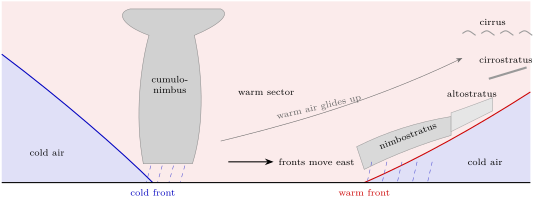
A cross-section through a cold front and a warm front, west on the left (schematic: the vertical scale is exaggerated about a hundred times, and the cold front is drawn steeper than the warm front). Cloud names and sequences as in the text.

Examples

Example 22.3 (A typical slope)

At 45∘45{}^{\circ} N, f=1.03×10⁻⁴ s−1f = 1.03 \times 10^{-4}\,\mathrm{s}^{-1}. Across a front with Tˉ=280 K\bar T = 280\,\mathrm{K}, a temperature contrast of 5 K5\,\mathrm{K} and a wind that changes by 10 m/s10\,\mathrm{m}/\mathrm{s} along it, tan⁡α=1.03×10−4×280×10/(9.81×5)=0.0059\tan\alpha = 1.03 \times 10^{-4} \times 280 \times 10/(9.81 \times 5) = 0.0059, about 1 in 170: the frontal surface reaches a height of 1 km1\,\mathrm{km} some 170 km170\,\mathrm{km} from the front on the ground. A sharper wind shift gives a steeper surface; a stronger temperature contrast, a gentler one.

Read in context →