
全部书籍

专业

应用 关于 Coach 登录 开始阅读

书籍暂未推出简体中文版——当前显示英文版。

Earth and Space Sciences · 术语表

什么是 G-dwarf problem?

Definition 30.11 University Earth and Space Sciences — Year 3 · 第 30 章 — Where the Elements Come From

The G-dwarf problem is the shortage of metal-poor long-lived stars in the solar neighbourhood compared with the prediction of the closed-box model: far fewer of the long-lived dwarf stars of spectral type G have low metallicities than a closed box would have made.
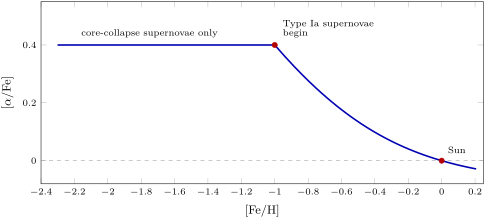
A two-phase model of [ / Fe] in a closed box: the plateau at +0.4 is the ratio made by core-collapse supernovae; Type Ia supernovae, which begin when the gas has reached [ Fe/H] = -1, then add iron at a steady rate, until the ratio is solar at [ Fe/H] = 0. The plateau and the knee are those seen in the stars of the Galaxy; the shape between is the model’s. At the Sun’s metallicity, 60\,\% of the iron in this model has come from Type Ia supernovae.
A two-phase model of [α/Fe][\alpha/\mathrm{Fe}] in a closed box: the plateau at +0.4+0.4 is the ratio made by core-collapse supernovae; Type Ia supernovae, which begin when the gas has reached [Fe/H]=−1[\mathrm{Fe/H}] = -1, then add iron at a steady rate, until the ratio is solar at [Fe/H]=0[\mathrm{Fe/H}] = 0. The plateau and the knee are those seen in the stars of the Galaxy; the shape between is the model’s. At the Sun’s metallicity, 60 %60\,\% of the iron in this model has come from Type Ia supernovae.
在原文中阅读 →