
全部书籍

专业

应用 关于 Coach 登录 开始阅读

书籍暂未推出简体中文版——当前显示英文版。

Earth and Space Sciences · 术语表

什么是 General circulation model; dynamical core; parameterisation?

又称: general circulation model · dynamical core · parameterisation

Definition 22.9 University Earth and Space Sciences — Year 3 · 第 22 章 — Climate Models

A general circulation model (GCM) is a numerical model of the atmosphere, of the ocean, or of both coupled, that solves the equations of motion, continuity and energy of a fluid on the rotating Earth — for the atmosphere, with the hydrostatic approximation, the “primitive equations” — on a three-dimensional grid covering the globe, stepping forward in time. Its dynamical core is the part that solves these equations for the motions the grid resolves. A parameterisation represents the effect on the resolved variables of a process smaller than a grid cell — clouds, convection, turbulence, gravity waves — by a formula in the resolved variables, with parameters that the modellers choose.
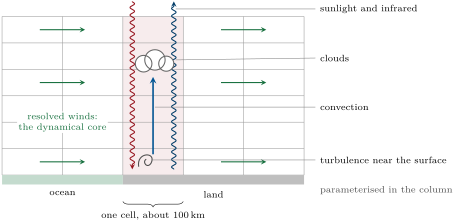
A slice through the grid of a global model, not to scale. Between cells, the winds and the transports of heat and moisture are computed by the dynamical core; inside each column, the processes smaller than the cell — clouds, convection, the transfer of sunlight and infrared, the turbulence of the lowest layer — are parameterised, from the resolved temperature, humidity and wind of the column.
在原文中阅读 →