全部书籍

专业

应用 关于 Coach 登录 开始阅读

书籍暂未推出简体中文版——当前显示英文版。

Earth and Space Sciences · 术语表

什么是 Geological COX2 storage, trapping mechanisms, storage efficiency factor?

又称: geological CO_2 storage · CO_2 trapping mechanisms · storage efficiency factor

Definition 30.13 University Earth and Space Sciences — Year 2 · 第 30 章 — Energy Geology

Geological COX2\ce{CO2} storage is the injection of carbon dioxide into porous rock formations deep underground, depleted oil and gas reservoirs, deep saline formations or coal beds, for retention over long times. The COX2\ce{CO2} trapping mechanisms that retain it are structural (and stratigraphic) trapping below a seal; residual trapping, as an immobile phase held in the pores by capillary forces; solubility trapping, by dissolution in the formation water; mineral trapping, by reaction with minerals into carbonates; and, in coal and shale, adsorption onto organic matter. The storage efficiency factor EE of a formation is the fraction of its pore volume that the injected COX2\ce{CO2} can be expected to fill.

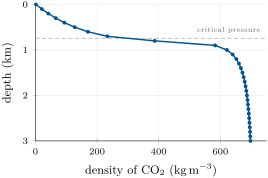
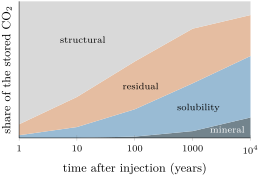
Left: density of pure CO2 with depth along a geotherm of 25\, C/ km from 15\, C, under hydrostatic pressure. Data: NIST Chemistry WebBook (Span–Wagner equation of state), along the conditions of the IPCC Special Report on Carbon Dioxide Capture and Storage (2005). Right: how the trapping mechanisms share the stored CO2 over time (schematic, after the same report): trapping by the seal gives way to the residual, dissolved and mineral forms, which are less mobile.
Left: density of pure COX2\ce{CO2} with depth along a geotherm of 25 ∘C/km25\,{}^{\circ}\mathrm{C}/\mathrm{km} from 15 ∘C15\,{}^{\circ}\mathrm{C}, under hydrostatic pressure. Data: NIST Chemistry WebBook (Span–Wagner equation of state), along the conditions of the IPCC Special Report on Carbon Dioxide Capture and Storage (2005). Right: how the trapping mechanisms share the stored COX2\ce{CO2} over time (schematic, after the same report): trapping by the seal gives way to the residual, dissolved and mineral forms, which are less mobile.
在原文中阅读 →