Also known as: geostrophic balance · geostrophic wind
Definition 28.5University Earth and Space Sciences — Year 1 · Chapter 28 — The General Circulation of the Atmosphere
A horizontal flow is in geostrophic balance when its pressure-gradient force and its Coriolis force cancel. The geostrophic windvg is the wind that achieves this balance for a given pressure field: −(1/ρ)∇p−fk×vg=0.
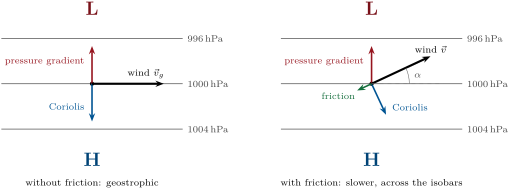
Forces on a parcel of air in the Northern Hemisphere, with low pressure to the north. Left: in the free atmosphere the pressure-gradient force (red) and the Coriolis force (blue) cancel, and the wind blows along the isobars with the low on its left. Right: near the ground friction (green) acts against the wind; the three forces balance only if the wind is slower and turned by an angle α towards the low (drawn for α=25∘ and the drag of Proposition 28.8).
Examples
Example 28.7(A wind read from the isobars)
At 50∘ N, f=2×7.292×10−5×sin50∘=1.117×10⁻⁴s−1. Isobars 4hPa apart and 400km apart give ∣∇p∣=400/4×105=1.0×10−3Pam−1 and, with ρ=1.225kgm−3, a geostrophic wind of 1.0×10⁻³/(1.225×1.117×10−4)=7.3m/s. The same spacing at 20∘ N, where f is less than half as large, would give 16.4m/s.
 Coach