সব বই

পেশাদার

1 Markets I: The Ecosystem and Exchange-Traded Marketsবাজার অনলাইন 2 Markets II: Rates, FX and Creditবাজার অনলাইন 3 Markets III: Commodities, Energy and Cryptoবাজার অনলাইন 4 Quantitative Methodsপদ্ধতি অনলাইন 5 Derivatives and Volatilityডেরিভেটিভস অনলাইন 6 Rates, Credit, XVA and Riskসুদহার, ঋণ ও ঝুঁকি অনলাইন 7 Research Craft: Predictors, Backtests, Measurement, Portfoliosগবেষণা অনলাইন 8 Strategies I: Equities and Futuresকৌশল অনলাইন 9 Strategies II: Volatility, Relative Value, Macro and the Bank Desksকৌশল অনলাইন 10 Microstructure and Executionএক্সিকিউশন অনলাইন 11 Market Making and High-Frequency Tradingমার্কেট মেকিং অনলাইন 12 Machine Learning for Marketsমেশিন লার্নিং অনলাইন 13 Low-Latency Softwareপ্রযুক্তি অনলাইন 14 Networks, Hardware and Trading Infrastructureপ্রযুক্তি অনলাইন 15 Research, Data and Risk Platformsপ্রযুক্তি অনলাইন 16 The Desk and the Firmপ্রতিষ্ঠান অনলাইন 17 The Industry: Firms, Roles and Careersক্যারিয়ার অনলাইন 18 Interviews I: Maths, Probability and Speedক্যারিয়ার অনলাইন 19 Interviews II: Markets, Trading Games and the Final Roundক্যারিয়ার অনলাইন 20 Interviews III: Codeক্যারিয়ার অনলাইন
অ্যাপ পরিচিতি Coach সাইন ইন পড়া শুরু করো

বইগুলো এখনো বাংলা ভাষায় পাওয়া যায় না — ইংরেজি সংস্করণ দেখানো হচ্ছে।

Earth and Space Sciences · পরিভাষা

Gravitational microlensing; Einstein radius কী?

অন্য নাম: gravitational microlensing · Einstein radius

Definition 28.10 University Earth and Space Sciences — Year 3 · অধ্যায় 28 — Exoplanets

Gravitational microlensing is the temporary brightening of a background star when a foreground star, the lens, passes close to the line of sight; the images it forms are too close together to be resolved. The Einstein radius is the angular radius θE\theta_\mathrm E of the ring into which a point lens of mass MM at the distance DLD_L would turn a source at the distance DSD_S exactly behind it:

θE=4GMc2 DS−DLDLDS.\theta_\mathrm E = \sqrt{\frac{4GM}{c^2}\,\frac{D_S - D_L}{D_L D_S}} .
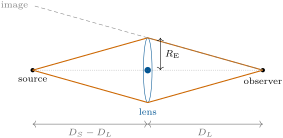
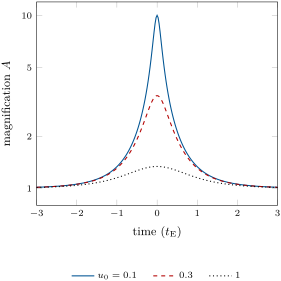
Left: the geometry of a gravitational lens, not to scale; rays from the source pass the lens at about the Einstein radius R_ E = _ E D_L and reach the observer, who sees the source displaced to the image. Right: the magnification of a point source by a point lens against time, in units of the time t_ E the lens takes to move by one Einstein radius, for three distances of closest approach u_0 (in Einstein radii). Left: the geometry of a gravitational lens, not to scale; rays from the source pass the lens at about the Einstein radius R_ E = _ E D_L and reach the observer, who sees the source displaced to the image. Right: the magnification of a point source by a point lens against time, in units of the time t_ E the lens takes to move by one Einstein radius, for three distances of closest approach u_0 (in Einstein radii).
Left: the geometry of a gravitational lens, not to scale; rays from the source pass the lens at about the Einstein radius RE=θEDLR_\mathrm E = \theta_\mathrm E D_L and reach the observer, who sees the source displaced to the image. Right: the magnification of a point source by a point lens against time, in units of the time tEt_\mathrm E the lens takes to move by one Einstein radius, for three distances of closest approach u0u_0 (in Einstein radii).
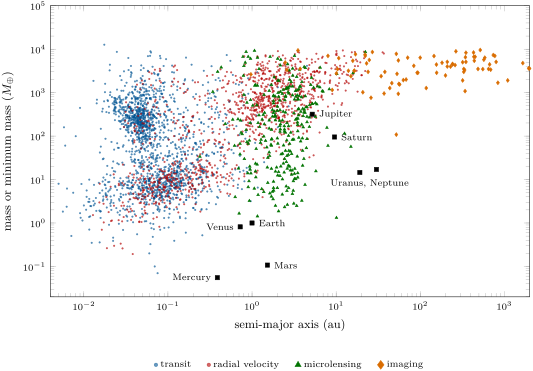
Confirmed planets with a measured mass (or minimum mass) and semi-major axis, by method of discovery (NASA Exoplanet Archive, 23 October 2026: 1691 by transit, 1151 by radial velocity, 286 by microlensing, 94 by imaging), with the Solar System’s planets (black squares). Masses predicted from a mass–radius relation are left out. This research has made use of the NASA Exoplanet Archive, which is operated by the California Institute of Technology, under contract with the National Aeronautics and Space Administration under the Exoplanet Exploration Program.
প্রসঙ্গসহ পড়ো →