全部书籍

专业

应用 关于 Coach 登录 开始阅读

书籍暂未推出简体中文版——当前显示英文版。

Earth and Space Sciences · 术语表

什么是 Gravitational microlensing; Einstein radius?

又称: gravitational microlensing · Einstein radius

Definition 28.10 University Earth and Space Sciences — Year 3 · 第 28 章 — Exoplanets

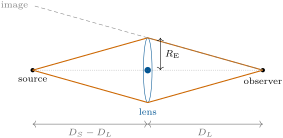
Gravitational microlensing is the temporary brightening of a background star when a foreground star, the lens, passes close to the line of sight; the images it forms are too close together to be resolved. The Einstein radius is the angular radius θE\theta_\mathrm E of the ring into which a point lens of mass MM at the distance DLD_L would turn a source at the distance DSD_S exactly behind it:

θE=4GMc2 DS−DLDLDS.\theta_\mathrm E = \sqrt{\frac{4GM}{c^2}\,\frac{D_S - D_L}{D_L D_S}} .
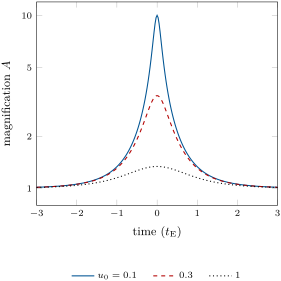
Left: the geometry of a gravitational lens, not to scale; rays from the source pass the lens at about the Einstein radius R_ E = _ E D_L and reach the observer, who sees the source displaced to the image. Right: the magnification of a point source by a point lens against time, in units of the time t_ E the lens takes to move by one Einstein radius, for three distances of closest approach u_0 (in Einstein radii). Left: the geometry of a gravitational lens, not to scale; rays from the source pass the lens at about the Einstein radius R_ E = _ E D_L and reach the observer, who sees the source displaced to the image. Right: the magnification of a point source by a point lens against time, in units of the time t_ E the lens takes to move by one Einstein radius, for three distances of closest approach u_0 (in Einstein radii).
Left: the geometry of a gravitational lens, not to scale; rays from the source pass the lens at about the Einstein radius RE=θEDLR_\mathrm E = \theta_\mathrm E D_L and reach the observer, who sees the source displaced to the image. Right: the magnification of a point source by a point lens against time, in units of the time tEt_\mathrm E the lens takes to move by one Einstein radius, for three distances of closest approach u0u_0 (in Einstein radii).
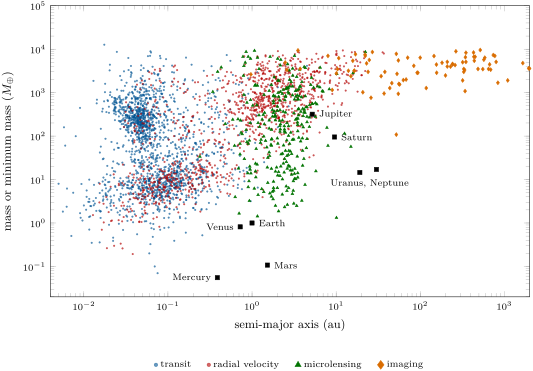
Confirmed planets with a measured mass (or minimum mass) and semi-major axis, by method of discovery (NASA Exoplanet Archive, 23 October 2026: 1691 by transit, 1151 by radial velocity, 286 by microlensing, 94 by imaging), with the Solar System’s planets (black squares). Masses predicted from a mass–radius relation are left out. This research has made use of the NASA Exoplanet Archive, which is operated by the California Institute of Technology, under contract with the National Aeronautics and Space Administration under the Exoplanet Exploration Program.
在原文中阅读 →