
全部书籍

专业

应用 关于 Coach 登录 开始阅读

书籍暂未推出简体中文版——当前显示英文版。

Earth and Space Sciences · 术语表

什么是 Heat-pipe volcanism?

Definition 26.10 University Earth and Space Sciences — Year 3 · 第 26 章 — Planetary Interiors and Surfaces

Heat-pipe volcanism is the loss of a planet’s internal heat mainly by magma rising through narrow conduits and erupting at the surface, where the lavas cool and are buried by later ones: the lithosphere is built from the top and carried downwards, cold.
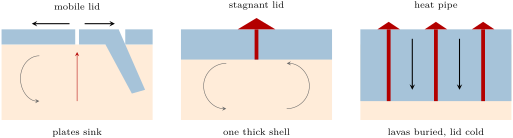

Three ways of losing heat (schematic). Left: a mobile lid, plates made at ridges and sinking at trenches, as on the Earth. Centre: a stagnant lid, one rigid shell over the convecting mantle, crossed by the magma of a few long-lived volcanoes. Right: heat pipes, magma rising through a thick cold lithosphere in narrow conduits, its lavas buried by later ones and carried down.
Olympus Mons on Mars, a mosaic of images of the Viking orbiters: the summit calderas at the centre, the flanks of lava flows and the cliffed scarp that rings the base, some 600\, km across. NASA/JPL/USGS, public domain.
Olympus Mons on Mars, a mosaic of images of the Viking orbiters: the summit calderas at the centre, the flanks of lava flows and the cliffed scarp that rings the base, some 600 km600\,\mathrm{km} across. NASA/JPL/USGS, public domain.
在原文中阅读 →