University Earth and Space Sciences — Year 3 · Bachelor Year 3
26Planetary Interiors and Surfaces
Seen through binoculars, the Moon has two kinds of ground. The bright highlands are covered with craters, crater on crater: they were saturated with large craters by an intense bombardment that ended about 3.8 billion years ago. The dark maria, plains filled with lava between 4.2 and 1.2 billion years ago, carry far fewer. The Apollo and Luna missions brought back rocks from both, and their radiometric ages turned the density of craters on a surface into a clock. The clock now dates plains on Mars, Mercury and the icy moons, from which no rock has yet been brought back. This chapter reads the interiors of the planets in their gravity, rotation and tides, then their surfaces in their craters, volcanoes and faults.
You already know
The moment-of-inertia factor , the two-layer model of a planet built from it and from the mean density, the terrestrial and the giant planets are in the Year 1 volume, in its chapter on comparative planetology; mantle plumes and large igneous provinces, in its chapter on hotspots. Planetary differentiation and the meteorites are in the Year 2 volume, in its chapter on planet formation. The dynamical form factor , MacCullagh’s formula and the flexure of the lithosphere are in this volume, in its chapter on gravity and geodesy; the Rayleigh number, in its chapter on mantle convection. Tides, Kepler’s laws and the elastic moduli are in the physics books; the Poisson distribution, in the mathematics books.
26.1 Interiors from gravity, rotation and tides
A planet’s mass, from the orbit of a moon or a spacecraft, gives its mean density; the precession of its axis and its give its moment of inertia. The two-layer proposition of the Year 1 volume turns the two numbers into a core, but only once a mantle density has been chosen: two measurements cannot fix three unknowns.
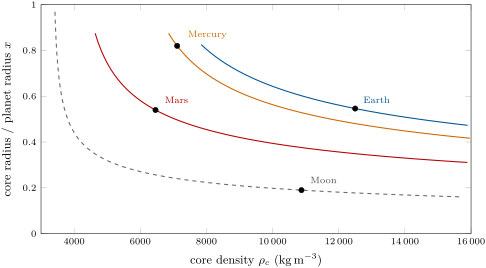
Each planet gives a curve, not a point. For Mars, the core radius of measured by InSight picks a mantle of and a core of . For Mercury, the core about in radius fills 82 percent of the radius. The Moon’s curve is nearly flat: its is so close to that a small core of any density fits, and a change of in moves the core radius by more than a factor of two (Exercise 26.10). Gravity alone cannot see a small core; the tides and the seismic waves can.
Definition 26.1 (Love number)
When a tidal potential of degree 2 acts on a planet, the planet deforms and its redistributed mass adds a potential of its own. The Love number is the ratio of that added potential to the tidal potential, both taken at the planet’s surface.
A rigid planet has ; a fluid planet of uniform density yields fully, with . Between the two, the number measures how much of the planet gives way.
Proposition 26.2 (Love number of a uniform elastic sphere)
An incompressible sphere of uniform density , radius , surface gravity and rigidity has
The result, due to Kelvin, is admitted. The ratio compares the elastic stiffness with the self-gravity that pulls the tidal bulge back: small planets are stiff, large ones yield. For Mars, ; with the rigidity of the Earth’s upper mantle, at depth in the reference Earth model, the formula gives . The tracking of the Mars Global Surveyor orbiter measured the solar tide of Mars: , too large for a solid iron core. At least the outer part of the core is liquid, and its radius was placed between 1520 and in 2003.
Seismometers settled the question. The InSight lander recorded marsquakes and detected waves reflected from the top of the core: radius , under a mantle deep and a crust 20 to thick. On the Moon, the seismometers set up by the Apollo astronauts recorded moonquakes, the deepest of them, hundreds of kilometres down, set off by the Earth’s tides. The Moon’s core is now described as a solid iron-rich inner core in radius, a liquid iron shell thick around it, and a partially molten layer above.
26.2 Impact cratering
A body from space strikes a planet at no less than the planet’s escape velocity, for the Earth; asteroids typically meet the Earth at 15 to and comets at up to . At each kilogram carries , some fifty times the energy of a kilogram of explosive. The impact sends a shock wave into the ground and into the projectile, which melts and vaporises; behind the shock the rock is set moving outwards and a crater opens in seconds.
Definition 26.3 (Transient crater, simple crater, complex crater, ejecta blanket)
The transient crater is the bowl-shaped cavity opened by the excavation flow at the moment it stops growing; its depth is about a third of its diameter. A simple crater is a bowl with a raised rim, the transient crater barely modified: its steep walls slump inwards into a lens of breccia. A complex crater is a larger crater whose transient bowl collapsed: the floor rose into a central uplift, the rim slid inwards along terraces, and the floor is flat. The ejecta blanket is the sheet of excavated rock thrown out beyond the rim and deposited around the crater.
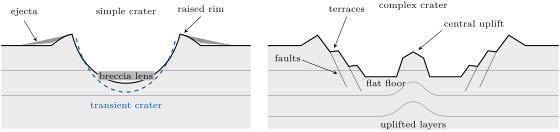
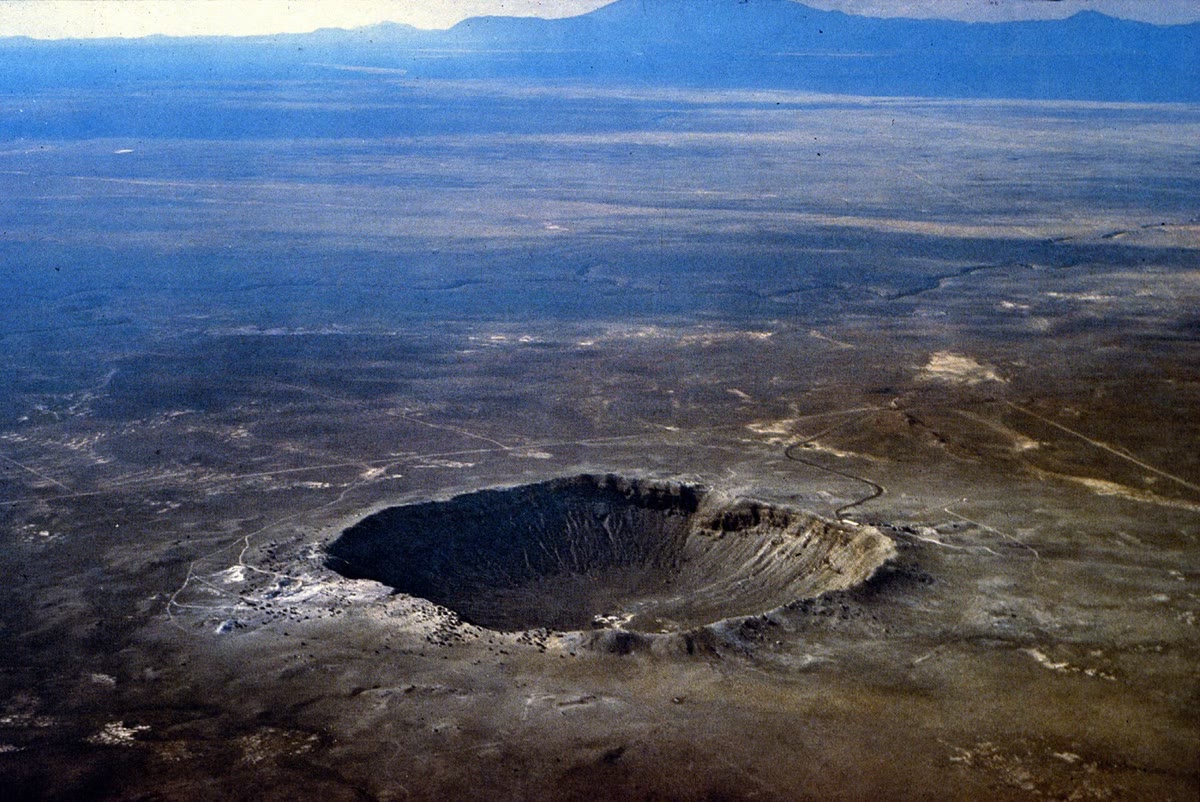
The excavation of a crater across takes about six seconds, that of a crater across about a minute and a half. What size of crater an impact makes depends on the projectile’s energy, on gravity and on the strength of the rock; the laws that relate them are fitted to experiments and explosions in the form of products of dimensionless groups, and are admitted here. Their spirit is in a balance of energies.
Proposition 26.4 (Gravity-regime scaling)
If a fixed fraction of the impact energy lifts the excavated rock of density against gravity , the diameter of the crater grows as
Proof. The excavated volume scales as , its mass as , and it is lifted by a height of order : the work is of order , which is proportional to . ∎
Part of the energy goes into heat, melting and the breaking of rock, so the real laws fall between this one and simpler rules: a table often quoted for the Earth takes a crater twenty times as wide as its stony projectile. Gravity also sets where a crater stops being simple. The walls of the transient bowl collapse when the weight of rock they hold, of order , exceeds the strength of the rock, so the transition diameter varies as : about in crystalline rock and in sediments on the Earth, about on the Moon, where gravity is six times weaker.
26.3 Crater dating
A surface left alone collects craters at the rate at which bodies strike it. Counting them dates the surface, provided the rate is known and the craters are those of the surface, not of what lies beneath or of the debris thrown from a neighbour.
Definition 26.5 (Crater size–frequency distribution)
The crater size–frequency distribution of a surface is the number of craters of diameter at least per unit area, as a function of (the cumulative distribution), or the numbers counted in bins of diameter, usually each times wider than the last (the incremental distribution).
Definition 26.6 (Crater dating; production and chronology functions; equilibrium density)
Crater dating is the determination of the age of a surface from the density of its craters. The crater production function is the shape of the size–frequency distribution of the craters a surface acquires, , assumed the same at every age. The crater chronology function is the number of craters of and more per unit area accumulated in a time . A surface is at the crater equilibrium density for craters of a given size when each new crater erases, on average, as many old ones as it adds: their number no longer grows.
The model age of a surface follows from one count: measured at any gives , and solves . The lines for fixed are called isochrons. For Mars, a widely used production function is a polynomial of degree 11 in , and the chronology function has the form
linear over the last three billion years, steeply exponential before. The Moon’s function has the same form with and . It was fitted to the ages of the Apollo and Luna landing sites; that of Mars is the Moon’s, scaled by an estimate of the ratio of the cratering rates on Mars and on the Moon.
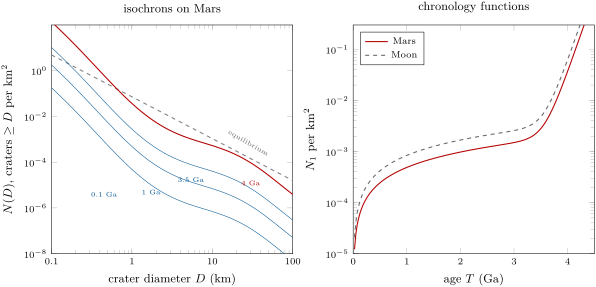
Craters are struck at random, independently of each other, so the number found on an area is a Poisson variable.
Proposition 26.7 (Counting error of a model age)
If craters are counted on an area , the density has the standard deviation , a relative error , and the model age the standard deviation
Proof. A Poisson variable of mean has variance , estimated by . The age is ; to first order , and . ∎
The relative error of the count alone is ten percent for a hundred craters. On a young surface, where is linear, the age inherits it: . On an old one the steep function shrinks it, by a factor of six at (Exercise 26.11); the model ages of old surfaces are then limited instead by the calibration of the function itself. Two further limits bound a count. Small craters saturate: on the oldest surfaces, craters below about are at the equilibrium density and stop recording time. And a surface may be renewed without being erased: a lava flow that buries small craters but not the rims of large ones leaves a distribution with a kink, old at large and young at small . The kink dates the resurfacing.
Definition 26.8 (Resurfacing)
Resurfacing is the renewal of a planetary surface, by lava, sediment, ice or deformation, that removes or buries its craters and resets its crater clock.
26.4 Volcanism and tectonics beyond the Earth
Every terrestrial planet loses its internal heat through its lithosphere. The Earth does it with moving plates; the others do it differently.
Definition 26.9 (Stagnant lid)
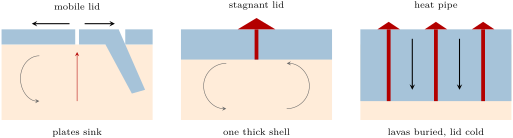
A planet has a stagnant lid when its lithosphere is a single rigid shell that does not take part in the convection of the mantle below: heat crosses it by conduction and by the magma that rises through it. On a mobile-lid planet like the Earth, the lithosphere is broken into plates that sink back into the mantle.
Definition 26.10 (Heat-pipe volcanism)
Heat-pipe volcanism is the loss of a planet’s internal heat mainly by magma rising through narrow conduits and erupting at the surface, where the lavas cool and are buried by later ones: the lithosphere is built from the top and carried downwards, cold.
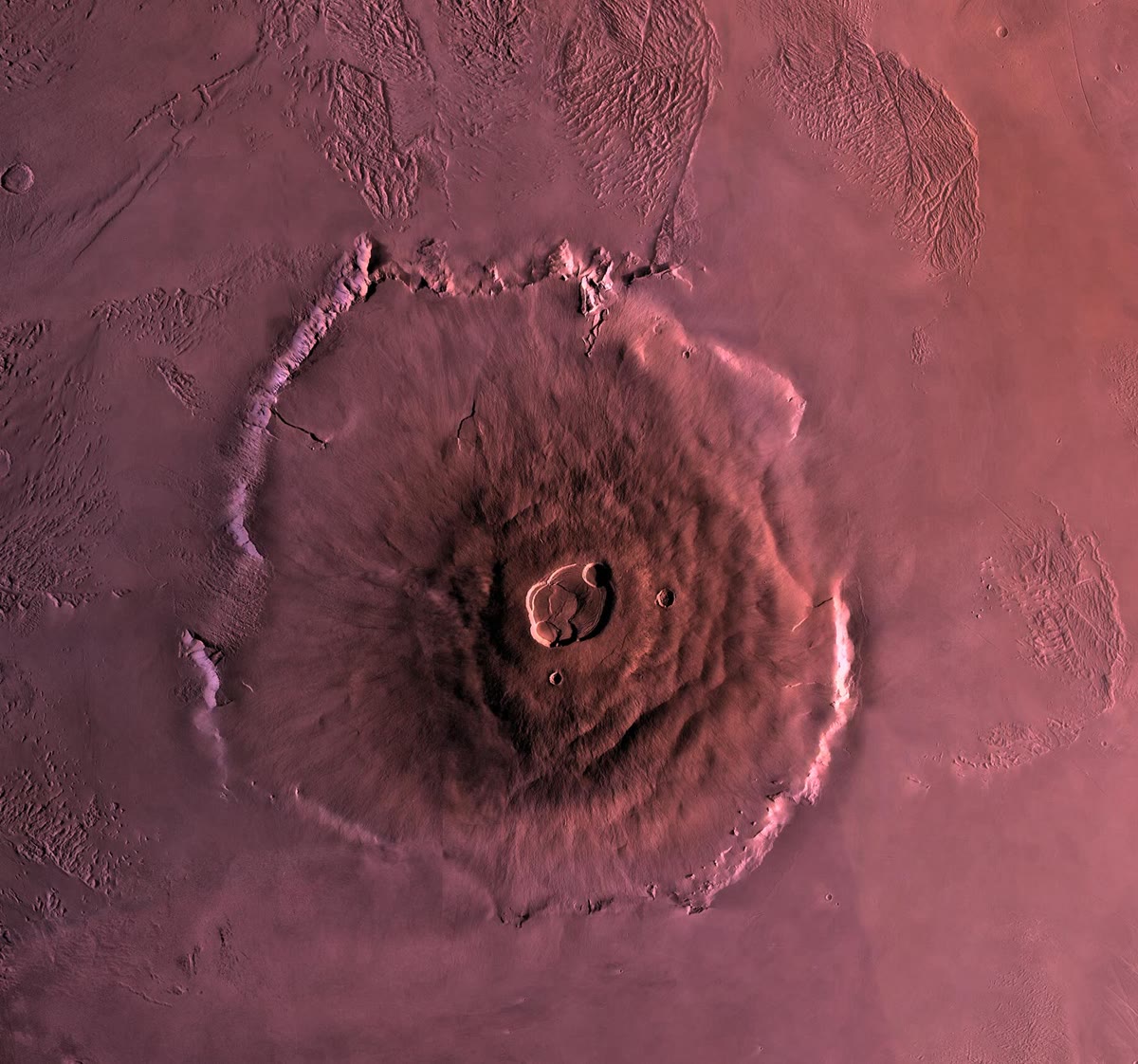
Mars has a stagnant lid. Without plates to carry them away from their sources, its volcanoes grew in place for a long time over the Tharsis bulge. Olympus Mons, the largest known volcano in the Solar System, stands high on a base more than across, ringed by a scarp up to high; the three Tharsis Montes nearby are each 350 to across. A load so large bends the lithosphere, and the width of the moat it digs measures, as on the Earth, the elastic thickness of the lid.
Venus, the Earth’s twin in size, has by far the fewest impact craters of any rocky planet except the Earth. Its surface features may be on average as young as 150 million years, with older patches between them: volcanism and deformation renewed most of its surface, perhaps piecemeal over a long time, perhaps faster. Venus has thousands of volcanoes and no sign of moving plates.
Io, the innermost large moon of Jupiter, loses more than through its surface, some 27 times the Earth’s average of . Its heat is not that of radioactivity: it is made by the tides.
Definition 26.11 (Tidal heating)
Tidal heating is the heat produced inside a body by the friction of the deformation that a varying tide imposes on it. A moon in synchronous rotation on an eccentric orbit sees the tide of its planet change in strength and swing back and forth during each orbit.
Proposition 26.12 (Tidal power of a synchronous moon)
A moon of radius in synchronous rotation, on an orbit of mean motion and small eccentricity , dissipates the power
where is the moon’s tidal quality factor, so that measures the part of the tidal deformation lost as heat.
The proposition is admitted. Tides that dissipate energy also round off an orbit; Io’s stays elliptical, of eccentricity 0.004, because the precisely timed pulls of Europa and Ganymede perturb it, their orbital periods of 1.77, 3.55 and days standing almost exactly as 1:2:4 (Exercise 26.8). Its surface rises and falls by as much as at each orbit. The volcanoes cover Io with lava faster than craters can form on it; one model of how its heat escapes is heat-pipe volcanism, which would keep a thick, cold lithosphere under its fiery surface.
Definition 26.13 (Subsurface ocean)
A subsurface ocean is a global layer of liquid water under the ice shell of a moon or dwarf planet, kept liquid by tidal and radiogenic heat.
Definition 26.14 (Cryovolcanism)
Cryovolcanism is the eruption of water, brines or other volatile liquids and vapours, instead of molten rock, onto the icy surface of a moon or dwarf planet.
Europa’s ice shell, measured by the microwave radiometer of the Juno spacecraft in the region it flew over, averages about thick; beneath it lies a salty ocean holding twice as much water as all the Earth’s oceans. On Saturn’s moon Enceladus, only about across, the Cassini spacecraft found in 2005 jets of ice grains and gas leaving warm fractures near the south pole at about . Its gravity and the wobble of its rotation showed that the jets draw on a global ocean, under an ice shell 20 to thick on average and perhaps only 1 to at the south pole.
26.5 Large cores and small ones
The four measured cores make an odd family. Relative to its radius, the Earth’s core reaches 0.55 of the way to the surface and Mars’s 0.54; the Moon’s 0.19; Mercury’s 0.82. Differentiation, in the Year 2 volume, sorts metal from silicate inside each body, but cannot make the proportions of metal so different. Giant impacts can. The Moon is thought to have formed from the debris of a collision between a body the size of Mars and the young Earth about 4.5 billion years ago, the metal of the impactor joining the Earth’s core and the Moon gathering mostly mantle rock, hence its small core. Similar impacts may have stripped a large part of the silicate mantle of Mercury and left it the iron-rich planet whose core fills most of it. The cores record, as the craters do, a history of collisions.
26.6 Exercises
Exercise 26.1 ★
Mercury has a mean density of , a moment-of-inertia factor of 0.35 and a radius of . With a two-layer model and a mantle of , compute the relative radius of the core, its radius in kilometres and its density.
Solution
Solution of Exercise 26.1.
; , , a core of ; .
Exercise 26.2 ★
A stony projectile across, of density , strikes the Earth vertically at . Compute its mass and its kinetic energy, in joules and in megatons of explosive (). What diameter of crater does the rule of twenty projectile diameters give?
Solution
Solution of Exercise 26.2.
; , or . The rule gives a crater of .
Exercise 26.3 ★
On a Martian plain of , 120 craters of and more are counted. Compute , its relative error, and the model age of the plain with its error.
Solution
Solution of Exercise 26.3.
, relative error . On the linear part, (the exponential term, , is negligible), and .
Exercise 26.4 ★
Io, of radius , loses . Compute its total heat loss and compare it with the Earth’s, , in total and per square metre ().
Solution
Solution of Exercise 26.4.
Area ; power , 2.2 times the Earth’s total from a surface twelve times smaller, and times its flux.
Exercise 26.5 ★★
Mars has a mass of and a radius of . (a) Compute its mean density, its surface gravity and . (b) Treating it as a uniform incompressible sphere of rigidity , compute its Love number . (c) The measured value is . What does the comparison say?
Solution
Solution of Exercise 26.5.
(a) ; ; . (b) , . (c) The measured value is larger by 2.6 standard deviations: Mars yields more than a solid planet with a mantle’s rigidity, as it would with a liquid core inside.
Exercise 26.6 ★★
On the Earth () the simple-to-complex transition occurs at about in crystalline rock and in sediments. (a) Assuming that the transition diameter varies as , predict it on the Moon () and on Mars and Mercury (); compare with the observed on the Moon. (b) If collapse begins when exceeds the strength of the rock, what strength does the Earth’s crystalline transition give, for ?
Solution
Solution of Exercise 26.6.
(a) Moon: in crystalline rock, in sediments; Mars and Mercury: and . The of the Moon lies between its two predictions: the rule holds to a few tens of percent. (b) , the strength of fractured rock rather than of an intact crystal.
Exercise 26.7 ★★
A surface carries craters of and more per square kilometre. Find its model age with the chronology function of Mars, by solving the equation numerically. What age would the lunar function have given, and why may the two not be exchanged?
Solution
Solution of Exercise 26.7.
Mars: ; the linear guess Ga is far too old, the exponential being large there; bisection gives (exponential term , linear term ). The lunar function gives . Each function is calibrated for one body: the rate of impacts and the size of the craters a given projectile makes differ between the Moon and Mars.
Exercise 26.8 ★★
The orbital periods of Io, Europa and Ganymede are 1.769138, 3.551181 and days. (a) Compute the ratios of successive periods. (b) Compute and comment. (c) Why can resonances keep an eccentricity that tides would otherwise remove?
Solution
Solution of Exercise 26.8.
(a) and , close to . (b) per day, to : the three mean motions are locked, a resonance that holds the moons’ relative positions at each conjunction. (c) The pulls repeat at the same points of the orbit, so they add up instead of averaging out; they feed the eccentricity as fast as the tides damp it.
Exercise 26.9 ★★
Io orbits Jupiter in days with eccentricity 0.004. Compute the power the tidal-power proposition gives per unit of , and the value of that would supply Io’s heat loss of Exercise 26.4.
Solution
Solution of Exercise 26.9.
, , ; per unit of . Then .
Exercise 26.10 ★★★
For the Moon, and . (a) Show that in the two-layer model at fixed . (b) With the mantle density that gives a core of , , what are and when , and when ? (c) What does this say about weighing a small core with the moment of inertia?
Solution
Solution of Exercise 26.10.
(a) is linear in , of slope . (b) The slope is : changes by for of . For , , , ; for , : no core at all. (c) Near the moment of inertia barely feels a small core: its third significant figure decides between a large light core and none. Seismic waves, tides and the magnetic field are needed.
Exercise 26.11 ★★★
(a) For 100 craters, compute the counting error of the model age of a Martian surface old and of one old. (b) Show that on the linear part of the chronology function . (c) Why are the ages of old surfaces then still uncertain?
Solution
Solution of Exercise 26.11.
(a) : at , , ; at , and , , six times smaller. (b) With , and . (c) The chronology function itself is uncertain: it rests on a few dated sites of the Moon and on the scaling from the Moon to Mars, errors that no count reduces.
Exercise 26.12 ★★★
Europa, of radius , orbits in days with eccentricity 0.009. (a) If Europa dissipated tides with the same as Io, what fraction of Io’s tidal power would it make, and what heat flow? (b) Why is the assumption doubtful for a moon with an ocean under its ice?
Solution
Solution of Exercise 26.12.
(a) The ratio is : about , or . (b) An ocean decouples the ice shell from the interior: the shell flexes far more than a solid moon would, and its ice dissipates differently from Io’s hot rock, so and both change.
26.7 Problem: Two Plains on Mars
Problem 26.1
Weekend problem — the core of Mars and the ages of two invented lava plains
Mars has a mass of , a radius of and a moment-of-inertia factor of 0.366. Two invented plains, A and B, lie on its volcanic provinces; their craters have been counted on images in bins wide.
Part I — The core.
- Compute the mean density of Mars.
- With a two-layer model and a mantle of , compute the relative radius of the core, its radius in kilometres and its density.
- InSight measured a core radius of . What mantle and core densities does the two-layer model then require?
- Compare that core density with the density of the Earth’s outer core just below its top, in the reference Earth model, and say why a lower value is expected for Mars, and what else it suggests.
- The uniform-sphere Love number of Mars with a rigidity of is 0.109; the measured one is 0.153. Which observation came first, and what did it already say about the core?
- The crust of Mars is 20 to thick. What fraction of the planet’s volume does it hold? Was it right to ignore it?
Part II — The counts on plain A. Plain A covers . Its craters, by bin of diameter (km):
| bin | 1–1.41 | 1.41–2 | 2–2.83 | 2.83–4 | 4–5.66 | 5.66–8 | 8–11.3 | 11.3–16 | 16–22.6 |
|---|---|---|---|---|---|---|---|---|---|
| plain A | 38 | 6 | 5 | 3 | 0 | 0 | 0 | 1 | 1 |
| plain B | 48 | 8 | 31 | 12 | 7 | 2 | 0 | 2 | 2 |
- Compute the cumulative counts of plain A, from up.
- Compute per square kilometre and its standard deviation.
- The production function gives and . Are the counts at 1.41 and consistent with the shape of the production function?
- Is plain A anywhere near the equilibrium density, at ?
- Why are the bins chosen wide?
- Clusters and chains of small craters are left out of a count. Why?
Part III — Model ages. Use the chronology function of Mars.
- Compute the model age of plain A. Check that the exponential term may be neglected.
- Compute its counting error.
- What age would the lunar chronology have given?
- Plain B covers . Using its craters of and more, compute , then , then its model age, by solving the equation numerically.
- Compute the counting error of that age.
- Compare the relative errors of the two ages and explain the difference.
Part IV — The buried craters of plain B.
- How many craters between 1 and should plain B carry if its whole surface had the age of question 16? How many does it carry?
- Assume that lava buried every crater smaller than at a time and spared the larger ones. Compute from the – craters.
- Compute the counting error of .
- Take a fresh simple crater on Mars to be a fifth as deep as it is wide (an assumption of this problem). How thick must the lava be to bury a crater, and why do the larger ones still show?
- Could the lava of plain B and that of plain A belong to one episode of volcanism?
- Give the model age of plain A, in billions of years, to two significant figures.
Solution
Solution of Problem 26.1.
1. .
2. ; , , a core of ; .
3. ; , .
4. It is a third lower. The pressure in the core of Mars is far lower than in the Earth’s, so its metal is less compressed; and a core so light suggests much lighter elements mixed with the iron.
5. The Love number (2003) came long before InSight (2021): it already showed that at least the outer core is liquid and placed its radius between 1520 and , a range that contains the seismological value.
6. to of the volume, and less of the mass: lighter than the mantle, it lowers the effective mantle density a little, an effect smaller than the uncertainty of the model.
7. From : 54; from 1.41: 16; from 2: 10; from 2.83: 5; from 4, 5.66, 8 and 11.3: 2; from 16: 1.
8. , ().
9. Expected craters from and from ; counted 16 and 10, within one standard deviation (, ): consistent.
10. No: times below it. The count records time.
11. Bins of equal width in cover the range evenly and keep comparable numbers of craters in the bins of a steep distribution.
12. They are secondary craters, made by blocks thrown out of a large primary crater: not independent impacts from space, they would add craters the chronology function does not count.
13. ; the exponential term, , is a millionth of .
14. : Ga.
15. , younger by almost half.
16. craters; ; . Bisection on gives (exponential term , linear term ).
17. ; .
18. Plain A: ; plain B: . In the steep, early part of the chronology a large change of the crater density means a small change of age; on the linear part the age is as uncertain as the count.
19. ; it carries .
20. , .
21. .
22. A crater is deep: the lava was at least that thick. Larger craters are deeper and their rims stand higher; they were partly filled and still show.
23. and Ga differ by , about one combined standard deviation (): the counts allow a single episode, though they do not prove it.
24. The young lava plain A has a model age of 1.4 billion years ( Ga).