全部书籍

专业

应用 关于 Coach 登录 开始阅读

书籍暂未推出简体中文版——当前显示英文版。

Earth and Space Sciences · 术语表

什么是 Ice-volume effect?

Definition 24.3 University Earth and Space Sciences — Year 2 · 第 24 章 — Climate Archives and Proxies

The ice-volume effect is the change of the oxygen-isotope composition of the whole ocean caused by the growth or decay of the continental ice sheets, which store water depleted in 18O; it shifts the δ18\delta^{18}O of every carbonate formed in the sea by the same amount, whatever the temperature.
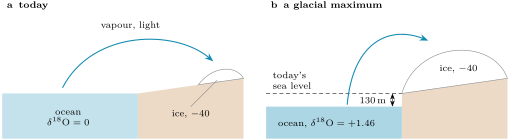
The ice-volume effect (schematic, not to scale): the vapour that feeds the ice sheets is depleted in 18O, so storing 130\, m of sea level as ice of 18 O = -40 per mil leaves the ocean 1.46 per mil heavier (). Values in per mil, VSMOW.
The ice-volume effect (schematic, not to scale): the vapour that feeds the ice sheets is depleted in 18O, so storing 130 m130\,\mathrm{m} of sea level as ice of δ18O=−40\delta^{18}\mathrm{O} = -40 per mil leaves the ocean 1.461.46 per mil heavier (Proposition 24.4). Values in per mil, VSMOW.
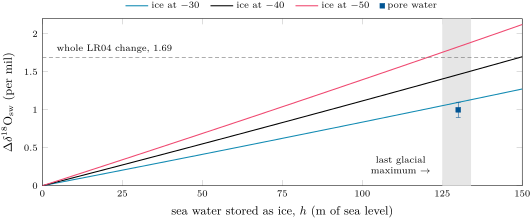
The ice-volume effect from the mass balance of , for three compositions of the ice (per mil, VSMOW); grey band: the sea-level fall of the Last Glacial Maximum, 125 to 134\, m; square: the change measured in sediment pore waters, 1.0 ± 0.1 per mil, placed at 130\, m; dashed: the change of the benthic stack between today and the Last Glacial Maximum.
The ice-volume effect from the mass balance of Proposition 24.4, for three compositions of the ice (per mil, VSMOW); grey band: the sea-level fall of the Last Glacial Maximum, 125 to 134 m134\,\mathrm{m}; square: the change measured in sediment pore waters, 1.0±0.11.0 \pm 0.1 per mil, placed at 130 m130\,\mathrm{m}; dashed: the change of the benthic stack between today and the Last Glacial Maximum.
在原文中阅读 →