সব বই

পেশাদার

1 Markets I: The Ecosystem and Exchange-Traded Marketsবাজার অনলাইন 2 Markets II: Rates, FX and Creditবাজার অনলাইন 3 Markets III: Commodities, Energy and Cryptoবাজার অনলাইন 4 Quantitative Methodsপদ্ধতি অনলাইন 5 Derivatives and Volatilityডেরিভেটিভস অনলাইন 6 Rates, Credit, XVA and Riskসুদহার, ঋণ ও ঝুঁকি অনলাইন 7 Research Craft: Predictors, Backtests, Measurement, Portfoliosগবেষণা অনলাইন 8 Strategies I: Equities and Futuresকৌশল অনলাইন 9 Strategies II: Volatility, Relative Value, Macro and the Bank Desksকৌশল অনলাইন 10 Microstructure and Executionএক্সিকিউশন অনলাইন 11 Market Making and High-Frequency Tradingমার্কেট মেকিং অনলাইন 12 Machine Learning for Marketsমেশিন লার্নিং অনলাইন 13 Low-Latency Softwareপ্রযুক্তি অনলাইন 14 Networks, Hardware and Trading Infrastructureপ্রযুক্তি অনলাইন 15 Research, Data and Risk Platformsপ্রযুক্তি অনলাইন 16 The Desk and the Firmপ্রতিষ্ঠান অনলাইন 17 The Industry: Firms, Roles and Careersক্যারিয়ার অনলাইন 18 Interviews I: Maths, Probability and Speedক্যারিয়ার অনলাইন 19 Interviews II: Markets, Trading Games and the Final Roundক্যারিয়ার অনলাইন 20 Interviews III: Codeক্যারিয়ার অনলাইন
অ্যাপ পরিচিতি Coach সাইন ইন পড়া শুরু করো

বইগুলো এখনো বাংলা ভাষায় পাওয়া যায় না — ইংরেজি সংস্করণ দেখানো হচ্ছে।

Earth and Space Sciences · পরিভাষা

Invariant point কী?

Definition 10.8 University Earth and Space Sciences — Year 2 · অধ্যায় 10 — Metamorphic Reactions and Facies

An invariant point is a point of the pressure–temperature plane where three or more phases of a system coexist in equilibrium and every univariant line among them meets; no variable is free there.
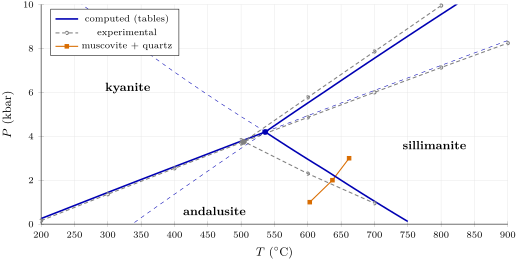
The Al2SiO5 diagram computed from the thermodynamic tables of Robie and Hemingway (1995) with temperature-dependent enthalpy and entropy (blue; dashed: metastable extensions), and the experimental diagram of Holdaway and Mukhopadhyay (1993) (grey, their tabulated points). Orange: the muscovite + quartz breakdown measured by Day (1973), which bends.
The AlX2SiOX5\ce{Al2SiO5} diagram computed from the thermodynamic tables of Robie and Hemingway (1995) with temperature-dependent enthalpy and entropy (blue; dashed: metastable extensions), and the experimental diagram of Holdaway and Mukhopadhyay (1993) (grey, their tabulated points). Orange: the muscovite + quartz breakdown measured by Day (1973), which bends.
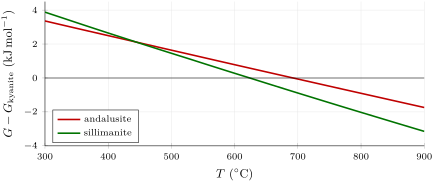
Gibbs energies of andalusite and sillimanite relative to kyanite at 6\, kbar, from the same tables. Kyanite is stable while both curves are positive; sillimanite takes over at 624\, C. Andalusite crosses zero only at 692\, C, where sillimanite is already lower: above the pressure of the triple point, andalusite is never the most stable.
Gibbs energies of andalusite and sillimanite relative to kyanite at 6 kbar6\,\mathrm{kbar}, from the same tables. Kyanite is stable while both curves are positive; sillimanite takes over at 624 ∘C624\,{}^{\circ}\mathrm{C}. Andalusite crosses zero only at 692 ∘C692\,{}^{\circ}\mathrm{C}, where sillimanite is already lower: above the pressure of the triple point, andalusite is never the most stable.
প্রসঙ্গসহ পড়ো →
