书籍暂未推出简体中文版——当前显示英文版。
University Earth and Space Sciences — Year 2 · 本科二年级
10Metamorphic Reactions and Facies
A basalt that sinks with its plate does not stay a basalt. Its plagioclase and pyroxene react, in the solid state, into other minerals, and the new assemblage depends on the pressure and temperature it reached: a blue rock of glaucophane and lawsonite, or a green-and-red rock of omphacite and garnet. Metamorphic rocks keep these minerals when they return to the surface, and a petrologist who knows the reactions can read the conditions back. This chapter writes those reactions with the thermodynamics of the chemistry course, computes from measured data the most famous metamorphic phase diagram, that of the three minerals, compares it with experiment, and organises the assemblages of metamorphic rocks into facies.
You already know
From the high-school volume: metamorphism, metamorphic grade, index minerals and isograds, contact metamorphism and its aureole, foliation and schistosity, lithostatic pressure; kyanite, andalusite and sillimanite as polymorphs, and their phase diagram. From the physics and chemistry books’ Year 1 volumes: the Gibbs energy , whose minimum marks the stable state at given and ; enthalpy, entropy and heat capacity; ; the Clausius–Clapeyron relation for the vaporisation of a pure substance and the triple point of water. From the Year 1 volume: subduction zones, collision belts and the geotherm.
10.1 Metamorphism
The high-school volume met metamorphism as the transformation of a rock by heat and pressure. An international recommendation gives the definition used here.
Definition 10.1 (Metamorphism; protolith)
Metamorphism is a process that changes the minerals or the microstructure of a rock, or both, essentially in the solid state, as the rock adjusts to physical conditions that differ from those under which it formed and from those normally found at the Earth’s surface and in the zone of diagenesis. It may coexist with partial melting and may change the chemical composition of the rock. The rock before metamorphism is its protolith.
The lower limit excludes diagenesis, the changes of a sediment as it is buried and lithified, and the upper limit is melting, studied in Chapter 12. The agents are temperature, pressure, the fluids that circulate through the rock (water and carbon dioxide above all) and deformation. Metamorphism is classified by its extent and its setting.
Regional metamorphism affects large volumes of rock and goes with large-scale tectonic processes: it is orogenic in mountain belts, where crust thickens in a collision; burial metamorphism affects rocks deeply buried under thick sedimentary or volcanic piles, without deformation or magmatism, so that its rocks usually lack schistosity; ocean-floor metamorphism alters the crust near spreading ridges, where hot seawater circulates through it under steep thermal gradients, and its recrystallisation is usually incomplete. Local metamorphism has a local cause: contact metamorphism heats the country rocks of an intrusion; hydrothermal metamorphism is driven by hot water-rich fluids; dislocation metamorphism, in fault and shear zones, reduces the grain size and makes mylonites and cataclasites; impact metamorphism, under a meteorite impact, can melt and vaporise rock. Metamorphism is called prograde while temperature rises and retrograde while it falls.
10.2 Metamorphic reactions
Definition 10.2 (Metamorphic reaction; devolatilisation reaction)
A metamorphic reaction transforms a set of minerals of a rock, the reactants, into another set, the products, in the solid state, possibly with a fluid phase taking part. A devolatilisation reaction is one that releases a volatile, water in a dehydration reaction or carbon dioxide in a decarbonation reaction.
Three types will appear in this chapter. Polymorphic changes, such as kyanite to sillimanite or calcite to aragonite, keep the formula and change the structure. Other reactions among solids redistribute components between minerals, such as albite giving jadeite plus quartz:
Devolatilisation reactions release a fluid, such as muscovite and quartz breaking down at high temperature:
For a reaction among minerals of fixed composition, the change of Gibbs energy is ; the products are stable where , the reactants where , and the two coexist where .
Definition 10.3 (Univariant reaction)
A reaction among phases of fixed composition is univariant when its equilibrium condition leaves one variable free: the equilibrium is a line in the pressure–temperature plane, which separates the field of the reactants from that of the products.
Definition 10.4 (Clapeyron slope)
The Clapeyron slope of a reaction is the slope of its equilibrium line in the pressure–temperature plane.
Proposition 10.5 (Clapeyron slope of a reaction)
Along the equilibrium line of a reaction with entropy change and volume change ,
Proof. For each phase , so for the reaction . Along the line stays zero: . ∎
This is the Clausius–Clapeyron relation of physics, written for solids. With in and in (one is ), the slope comes out in bars per kelvin. Two consequences shape every metamorphic phase diagram. Among solids, entropy and volume changes are small, so that a reaction line may be steep or shallow, positive or negative: the high-temperature side holds the products of higher entropy, and the high-pressure side those of smaller volume. In a devolatilisation reaction the fluid brings a large entropy, so the products lie on the high-temperature side; and the volume of the fluid, large at low pressure and shrinking as pressure rises, makes the slope shallow at low pressure and steeper at high pressure. The reaction line bends. Experiments on muscovite and quartz place it at 603, 637 and at 1, 2 and of water pressure: between 1 and the line climbs per kelvin, between 2 and 3, (Exercise 10.9).
10.3 The aluminosilicates
Definition 10.6 (Aluminosilicate polymorphs)
The aluminosilicate polymorphs are the three minerals of formula : kyanite (triclinic), andalusite and sillimanite (both orthorhombic).
They are common in metamorphosed mudstones, whose aluminium they carry, and since they share a formula, which one grows depends only on pressure and temperature. The table below gives their measured properties.
| () | () | () | density () | |
|---|---|---|---|---|
| kyanite | 82.80 | 4.415 | 3.670 | |
| andalusite | 91.39 | 5.152 | 3.145 | |
| sillimanite | 95.40 | 4.986 | 3.250 |
Kyanite is the densest and has the least entropy: it is the high-pressure, low-temperature polymorph. Andalusite, the least dense, holds low pressure; sillimanite, of the highest entropy, holds high temperature. Their equilibrium lines can be computed.
Method 10.7 (Computing a reaction line)
(1) From the tables, form , and at and . (2) Neglect the change of and with temperature (heat capacities of products and reactants nearly equal) and of with pressure and temperature (solids barely compress or expand):
(3) Set it to zero: , a straight line of slope . (4) Where precision matters, replace and by their values at temperature , from tables of and , and solve again. (5) Keep only the part of each line where its two phases are more stable than any third one.
For kyanite to andalusite, , and : at and , , so kyanite, not andalusite, is the stable polymorph at the Earth’s surface; kyanite to sillimanite has there. The slopes are for kyanite to andalusite, for kyanite to sillimanite and for andalusite to sillimanite, the only reaction of the three whose high-temperature product is the denser.
Definition 10.8 (Invariant point)
An invariant point is a point of the pressure–temperature plane where three or more phases of a system coexist in equilibrium and every univariant line among them meets; no variable is free there.
Proposition 10.9 (The triple point)
The three lines kyanite andalusite, kyanite sillimanite and andalusite sillimanite meet at one point. Around it, each line is stable on one side only; its metastable extension lies in the field of the third polymorph.
Proof. For any , , since the Gibbs energies of andalusite cancel. Where the first two lines cross, two of these terms vanish, so the third does too: the third line passes through the crossing. Beyond the crossing, on the line kyanite andalusite, say, , but the point lies on the sillimanite side of the two other lines, so is smaller than both: neither kyanite nor andalusite is stable there, and the line is metastable. ∎
With the constant properties of the method, the triple point lies at and (the weekend problem); with the temperature dependence of the tables, at and . The experimental diagram, built from reversed experiments, puts it at and (the figure below).
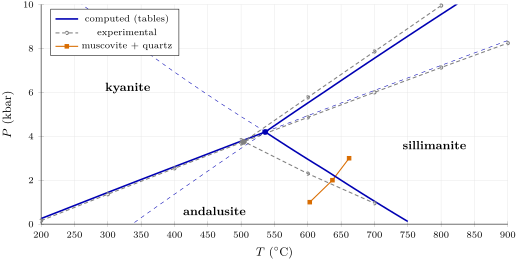
The computed kyanite–andalusite line falls within of the experimental one between 400 and , but the andalusite–sillimanite line lies too high at . That line is the most fragile of the three: with , an error of in , a twentieth of the uncertainty of each enthalpy in the table, moves it by . The enthalpies of the tables are themselves adjusted to fit the experiments, within their uncertainties; the experiments, not calorimetry alone, fix the diagram.
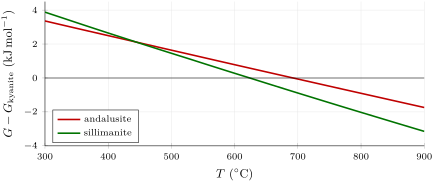
The figure below shows why a line is a boundary. At the Gibbs energies of andalusite and sillimanite, measured from that of kyanite, cross zero where each would become more stable than kyanite; the differences never exceed a few kilojoules per mole, which is why a small error in an enthalpy moves a line so far.
In the lab — Reversing a reaction
A reaction line is located in the laboratory by experiments at fixed pressure and temperature that start from a mixture of reactants and products. In a piston–cylinder apparatus, the mixture is held for one to a few days; the direction of reaction is then read from X-ray diffraction, by comparing the ratio of the peaks of product and reactant with that of the starting mix, and confirmed by overgrowths on the stable mineral. Other studies weigh a single crystal of andalusite reacted in a powder of kyanite or sillimanite, with a microbalance precise to about . An equilibrium is reversed when growth of each side has been observed on either side of the line; the line then lies in the bracket between, drawn with the errors of the apparatus, typically and . Experimenters judge a phase diagram first by such reversals, and only second by the rocks.
10.4 Assemblages and facies
Definition 10.10 (Mineral assemblage)
A mineral assemblage is the set of minerals that grew together in equilibrium in a metamorphic rock.
An assemblage depends on the conditions of metamorphism and on the composition of the rock. Eskola, who introduced the concept of facies in 1915, saw that rocks of the same composition carry the same assemblage under the same conditions, and that the assemblages of different rocks change together when the conditions change; the international recommendation keeps his concept.
Definition 10.11 (Metamorphic facies; facies grid)
A metamorphic facies is a set of metamorphic mineral assemblages, repeatedly associated in time and space, showing a regular relationship between mineral composition and bulk chemical composition, such that different facies correspond to different metamorphic conditions, chiefly temperature and pressure. The facies are named and defined on the assemblages of rocks of basaltic composition. A facies grid is the arrangement of the facies in the pressure–temperature plane.
The table below lists ten facies by their diagnostic minerals in metabasalts.
| facies | diagnostic minerals of a metabasalt |
|---|---|
| zeolite | zeolites such as laumontite and heulandite |
| prehnite–pumpellyite | prehnite + pumpellyite, prehnite + actinolite, pumpellyite + actinolite |
| greenschist | actinolite + albite + chlorite + epidote |
| epidote amphibolite | hornblende + albite + epidote chlorite |
| amphibolite | hornblende + plagioclase (more than anorthite) |
| granulite | clinopyroxene + orthopyroxene + plagioclase; olivine not stable with plagioclase or garnet |
| blueschist | glaucophane + epidote garnet, or glaucophane + lawsonite |
| eclogite | omphacite + garnet; plagioclase not stable |
| pyroxene hornfels | clinopyroxene + orthopyroxene + plagioclase; olivine stable with plagioclase |
| sanidinite | the same, with very-high-temperature minerals such as pigeonite |
The recommendation stresses what the facies do not do: they record regularities among assemblages, and do not try to fix the pressure and temperature of each. Their order in the pressure–temperature plane follows from the reactions between them, and the figure below draws it schematically. Temperature grows from the zeolite facies through the greenschist and amphibolite facies to the granulite facies; at low pressure and high temperature lie the hornfels facies of contact aureoles; at high pressure and low temperature, the blueschist facies; at high pressure and higher temperature, the eclogite facies. Reactions of this chapter fix pieces of the boundaries: plagioclase, present as albite or as a more calcic plagioclase from the greenschist to the granulite facies, is not stable in the eclogite facies, as its albite does when it turns into jadeite and quartz (Exercise 10.8); calcite turns into the denser aragonite at high pressure (Exercise 10.7).
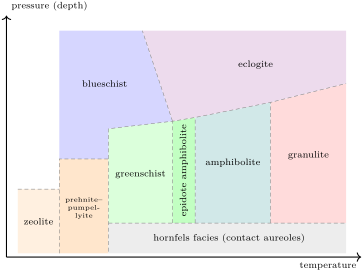
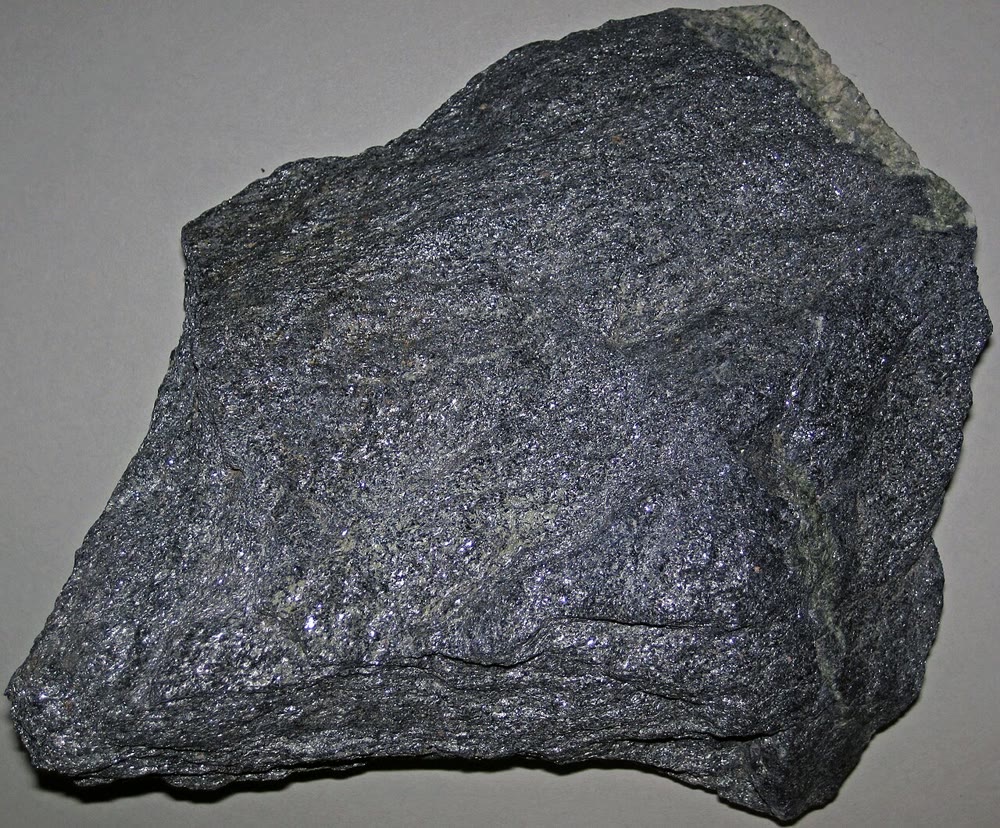
Rocks buried and heated together pass through facies in a regular order, which reflects the ratio of pressure to temperature along their path: high in a subduction zone, where blueschists form; intermediate in a collision belt; low near an intrusion. Chapter 11 names these series and reads such paths from minerals.
10.5 The protolith matters
The facies are defined on basalts, but every protolith records the same conditions in its own minerals.
Definition 10.12 (Metapelite; metabasite)
A metapelite is a metamorphosed mudstone (a pelite), rich in aluminium and potassium, whose assemblages hold micas, chlorite, garnet, staurolite and the aluminosilicates. A metabasite is a metamorphosed basalt, gabbro or other mafic rock, rich in calcium, magnesium and iron, whose assemblages define the facies.
In a metapelite the index minerals of the high-school volume appear in sequence as grade rises (chlorite, biotite, garnet, staurolite, kyanite, sillimanite), the muscovite + quartz reaction of this chapter makes sillimanite and K-feldspar at higher temperature still, and the aluminosilicate present tells on which side of the triple point the rock passed. A metamorphosed limestone or dolostone becomes a marble, of calcite or dolomite; impure carbonates, with silica and clay, become calc-silicate rocks whose decarbonation reactions release carbon dioxide; a quartz sandstone becomes a quartzite, which shows little but its grain size. A metapelite of the chlorite zone and a metabasalt beside it, at the same pressure and temperature, look nothing alike, the second a greenstone of actinolite, chlorite, epidote and albite: one set of conditions, two assemblages.
10.6 Exercises
Exercise 10.1 ★
Name the type of metamorphism: (a) a limestone recrystallised to marble within of a granite; (b) a fine-grained, banded rock along a large strike-slip fault, its grains crushed and recrystallised; (c) a basalt of the ocean crust whose glass has turned to chlorite and zeolites near a ridge, its minerals only partly replaced; (d) volcanic sandstones at the bottom of a pile thick, recrystallised without schistosity.
Solution
Solution of Exercise 10.1.
(a) Contact metamorphism, a local thermal metamorphism by the heat of the intrusion. (b) Dislocation metamorphism, in a fault zone: grain-size reduction, a mylonite. (c) Ocean-floor metamorphism, by hot seawater near the ridge, with incomplete recrystallisation. (d) Burial metamorphism, regional, without deformation or schistosity.
Exercise 10.2 ★
From the table of the aluminosilicates, compute , and the Clapeyron slope of kyanite sillimanite, in and in . By how much does the equilibrium pressure change over ?
Solution
Solution of Exercise 10.2.
, ; slope . Over the equilibrium pressure rises by .
Exercise 10.3 ★
To which facies does each metabasalt belong? (a) actinolite, albite, chlorite and epidote; (b) glaucophane and lawsonite; (c) hornblende and plagioclase with anorthite; (d) omphacite and garnet, no plagioclase.
Solution
Solution of Exercise 10.3.
(a) Greenschist. (b) Blueschist. (c) Amphibolite: hornblende with plagioclase of more than anorthite. (d) Eclogite.
Exercise 10.4 ★
(a) From the molar mass and the molar volumes 44.15, 51.52 and , compute the densities of kyanite, andalusite and sillimanite. (b) Which does pressure favour, and why? (c) Mineral databases give 3.61, 3.15 and : why can natural crystals differ from the pure phases?
Solution
Solution of Exercise 10.4.
(a) : kyanite , andalusite , sillimanite . (b) Kyanite: at higher pressure the term of the Gibbs energy grows least for the smallest volume. (c) Natural crystals contain other elements (ferric iron, for instance, replaces some aluminium in natural andalusite and sillimanite) and the measurements on natural specimens are less precise than the molar volumes of the tables.
Exercise 10.5 ★★
For kyanite andalusite, , , . (a) Which polymorph is stable at and ? (b) At what temperature do the two coexist at ? (c) Compute the equilibrium pressure at and compare it with the experimental . (d) Why is andalusite nonetheless found in rocks that cooled to the surface?
Solution
Solution of Exercise 10.5.
(a) : kyanite. (b) At , : . (c) , against 2.54 measured. (d) The reaction is too slow at low temperature to proceed: andalusite survives metastably, as most high-temperature minerals do at the surface.
Exercise 10.6 ★★
Test step (2) of the method. At the tables give = 285.02 for kyanite and 296.44 for sillimanite, and = 122.29 and 121.39 (). (a) Compute , and of kyanite sillimanite at and . (b) Compare with the constant values of the table. (c) Which polymorph is stable there, and how large is the error of the simple method?
Solution
Solution of Exercise 10.6.
(a) ; ; . (b) With the values at : . (c) Sillimanite. The simple method errs by , about ; divided by , that is about on the line, much less than the effect of the uncertainty of the enthalpies.
Exercise 10.7 ★★
Calcite and aragonite () have, at , = and , = 91.7 and 88.0 , = 36.93 and , and equal enthalpies of formation. (a) Find the equilibrium pressure at . (b) Compute the Clapeyron slope. (c) Find the equilibrium pressure at . (d) Many shells are made of aragonite and live at : what does that say?
Solution
Solution of Exercise 10.7.
(a) and : . (b) ; slope . (c) With , : at , . (d) Shell aragonite is metastable at the surface: organisms make it, and it persists because it turns into calcite only slowly.
Exercise 10.8 ★★
For albite jadeite + quartz, the tables give , , . (a) Compute the Clapeyron slope. (b) Compute the equilibrium pressure at . (c) The enthalpies of formation of albite, jadeite and quartz are uncertain by 2.6, 3.6 and ; combining them as independent errors, how uncertain is that pressure? (d) Why does the eclogite facies lack plagioclase?
Solution
Solution of Exercise 10.8.
(a) . (b) . (c) on , so on the pressure. (d) At the pressures of the eclogite facies the albite component of plagioclase is unstable relative to jadeite and quartz; the sodium goes into the pyroxene (omphacite), and plagioclase disappears.
Exercise 10.9 ★★
Muscovite + quartz breaks down at 603, 637 and at 1, 2 and . (a) Compute the slope of the line between each pair of points. (b) If the entropy of reaction hardly changes over this range, by what factor did shrink from the first interval to the second? (c) Which phase is responsible?
Solution
Solution of Exercise 10.9.
(a) From 1 to : ; from 2 to 3: . (b) With fixed, is inversely proportional to the slope: it shrank by a factor . (c) The water released: its molar volume falls as pressure rises, while the volumes of the solids hardly change.
Exercise 10.10 ★★★
With the constant properties of the method: (a) compute the pressures of the three reactions at ; (b) show that at and the pressure of kyanite andalusite, sillimanite is the most stable polymorph, so that this point of the line is metastable; (c) which polymorph is stable at and , and at and ?
Solution
Solution of Exercise 10.10.
(a) At : kyanite andalusite ; kyanite sillimanite ; andalusite sillimanite . (b) At , below the kyanite sillimanite line (5782), sillimanite is more stable than kyanite, and above the andalusite sillimanite line (1799), more stable than andalusite: the point lies in the sillimanite field, and the kyanite andalusite equilibrium there is metastable. (c) At : between 1799 and , sillimanite. At : above kyanite beats sillimanite, and above it beats andalusite: kyanite.
Exercise 10.11 ★★★
A schist holds kyanite, andalusite and sillimanite together, all three grown in equilibrium. (a) With the experimental triple point, and , and a crust of density (), at what depth did it grow? (b) Taking at the surface, what mean thermal gradient does that imply? (c) Why are such rocks rare?
Solution
Solution of Exercise 10.11.
(a) , uncertain by . (b) . (c) The three minerals coexist in equilibrium only at the invariant point: the path of the rock must pass through it, and the reactions must stop there. Most rocks pass beside it and keep one or two polymorphs.
Exercise 10.12 ★★★
Two rocks are buried to depth , from at the surface: rock X along to under rocks of mean density , rock Y along to under rocks of mean density . (a) Compute and at the end of each path. (b) With the constant-property lines (calcite aragonite: bar with in kelvin; albite jadeite + quartz from Exercise 10.8; the aluminosilicates from the table), which of aragonite or calcite, of jadeite + quartz or albite, and which aluminosilicate does each rock hold? (c) Which path is the colder, high-pressure one, and in which facies does each end?
Solution
Solution of Exercise 10.12.
(a) X: (); . Y: (); . (b) X: calcite aragonite at , aragonite; albite jadeite + quartz at , jadeite + quartz; kyanite andalusite at , below the temperature of the triple point: kyanite. Y: calcite aragonite at , calcite; albite jadeite + quartz at , albite; above the triple point, kyanite sillimanite at and andalusite sillimanite at : sillimanite. (c) X, at , is the colder path: jadeite and aragonite at only place it in the blueschist facies. Y, three times warmer, ends with sillimanite at and moderate pressure, in the amphibolite facies.
10.7 Problem: Building the triple point
Problem 10.1
Weekend problem — the aluminosilicate diagram from the tables, and how far to trust it
Use the table of the aluminosilicates (, ) and the method of this chapter, with constant , and ; write in kelvin, in bar, and neglect the 1 in .
Part I — The reactions.
- Compute , and for kyanite andalusite.
- Do the same for kyanite sillimanite.
- Do the same for andalusite sillimanite, and check that each property is the difference of the first two.
- Which polymorph has the largest entropy, which the smallest volume? On which side of each line will each lie?
- Compute the three Clapeyron slopes.
- Why is the slope of andalusite sillimanite negative?
Part II — Where the lines run.
- Compute of the first two reactions at . Which polymorph is stable at the surface?
- At what temperature (in ) does each reaction reach equilibrium at ?
- Of the three temperatures of question 8, which are stable equilibria and which metastable? (Use the order of the three at .)
- Compute the pressure of kyanite andalusite at ; the experiments give .
- Compute the pressure of kyanite sillimanite at ; the experiments give .
- Sketch the three lines between 200 and .
Part III — The triple point.
- Write the first two lines as ; give , , , .
- Solve for the temperature of their intersection.
- Compute its pressure.
- Check that andalusite sillimanite passes through it.
- Compare with the experimental and .
- With the temperature dependence of the tables, the triple point moves to and . Did the refinement bring it closer to experiment? What does that suggest about the main source of error?
Part IV — How far to trust it.
- Raise the enthalpy of formation of andalusite by . By how much does the kyanite andalusite line move in pressure, at fixed temperature?
- By how much does the triple point move in temperature?
- Do the same for a rise of in the enthalpy of sillimanite.
- Each enthalpy is uncertain by . What range of triple-point temperatures do the calorimetric data alone allow?
- How, then, can thermodynamic tables reproduce the experimental diagram within ?
- State the temperature of the triple point computed in Part III, rounded to the degree: the key number of this problem.
Solution
Solution of Problem 10.1.
Part I.
1. ; ; .
2. ; ; .
3. ; ; ; each is the second minus the first, since andalusite cancels.
4. Sillimanite has the largest entropy (95.40): it lies on the high-temperature side of both its lines. Kyanite has the smallest volume (4.415): it lies on the high-pressure side of both its lines. Andalusite, the largest volume, holds the low-pressure side.
5. ; ; .
6. Sillimanite has more entropy but less volume than andalusite: and . Raising the temperature favours sillimanite, raising the pressure too, so the line runs to lower pressure at higher temperature.
Part II.
7. ; . Both positive: kyanite is stable at the surface.
8. : ; ; .
9. Heating at , kyanite gives way to andalusite at ; at kyanite is no longer stable, so kyanite sillimanite is metastable there; andalusite gives way to sillimanite at . The first and third are stable equilibria.
10. , from experiment.
11. , above experiment.
12. Kyanite andalusite rises from at with slope ; andalusite sillimanite falls from about at to at ; kyanite sillimanite, the steeper of the two rising lines, crosses both near and , each line stable on one side of the crossing only (the diagram of the chapter).
Part III.
13. , ; , .
14. .
15. .
16. : the same pressure to within the rounding of the data, as the proposition of the chapter requires.
17. lies from , inside the uncertainty; lies from 3.75, inside 0.25. The agreement is good.
18. No: lies from experiment, outside its uncertainty. Neglecting the heat capacities was not the main error: the enthalpies are.
Part IV.
19. of kyanite andalusite rises by ; at fixed , falls by .
20. : the triple point moves to about .
21. The kyanite sillimanite line falls by , and the triple point moves by .
22. Each enthalpy alone, varied by , moves the triple point by (andalusite) or (sillimanite): calorimetry alone allows triple points over several hundred degrees.
23. The tabulated enthalpies are not purely calorimetric: within their uncertainties they are adjusted so that the computed lines fit the reversed experiments. The experiments fix the diagram; the tables carry it, consistently, to other reactions.
24. The triple point computed from the tables with constant properties lies at .