全部书籍

专业

应用 关于 Coach 登录 开始阅读

书籍暂未推出简体中文版——当前显示英文版。

Earth and Space Sciences · 术语表

什么是 Jeans escape; escape parameter?

又称: Jeans escape · escape parameter

Definition 27.5 University Earth and Space Sciences — Year 3 · 第 27 章 — Planetary Atmospheres and Habitability

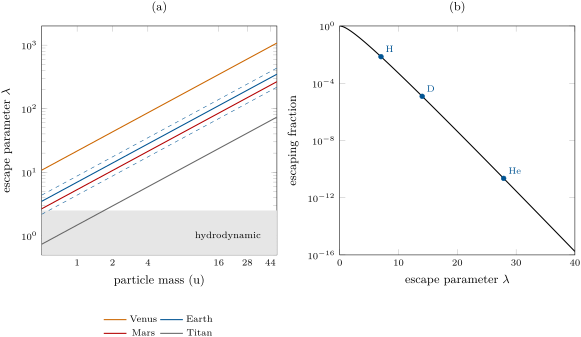
Jeans escape is the loss to space of the particles of the Maxwell–Boltzmann tail that move upwards at the exobase faster than the escape velocity. The escape parameter of particles of mass mm at the exobase, of radius rr and temperature TT, on a planet of mass MM, is

λ=GMmkTr=vesc2u2,u=2kTm,\lambda = \frac{GMm}{kTr} = \frac{v_\mathrm{esc}^2}{u^2}, \qquad u = \sqrt{\frac{2kT}m},

the ratio of their gravitational binding energy to kTkT, and also the square of the escape velocity over the most probable thermal speed uu.

(a) The escape parameter at the exobase against the mass of the particle, for Venus (290\, K), the Earth (1000\, K; dashed: 800 and 1600\, K, the range of the solar cycle), Mars (270\, K) and Titan (180\, K); below 2.5 (shaded) escape turns hydrodynamic. (b) The fraction (1 + )e- of the upward flux that escapes, with hydrogen, deuterium and helium at the Earth’s exobase; oxygen, at = 111, is far off the scale.
(a) The escape parameter at the exobase against the mass of the particle, for Venus (290 K290\,\mathrm{K}), the Earth (1000 K1000\,\mathrm{K}; dashed: 800 and 1600 K1600\,\mathrm{K}, the range of the solar cycle), Mars (270 K270\,\mathrm{K}) and Titan (180 K180\,\mathrm{K}); below λ≈2.5\lambda \approx 2.5 (shaded) escape turns hydrodynamic. (b) The fraction (1+λ)e−λ(1 + \lambda)e^{-\lambda} of the upward flux that escapes, with hydrogen, deuterium and helium at the Earth’s exobase; oxygen, at λ=111\lambda = 111, is far off the scale.
在原文中阅读 →